Department of Plant Cytology and Embryology, Institute of Botany, Faculty of Biology, Jagiellonian University in Kraków, 9 Gronostajowa St., 30-387 Kraków, Poland.
Department of Plant Cytology and Embryology, Faculty of Biology, University of Gdańsk, 59 Wita Stwosza St., 80-308 Gdańsk, Poland.
Cells. 2022 Feb 8;11(3):586. doi: 10.3390/cells11030586.
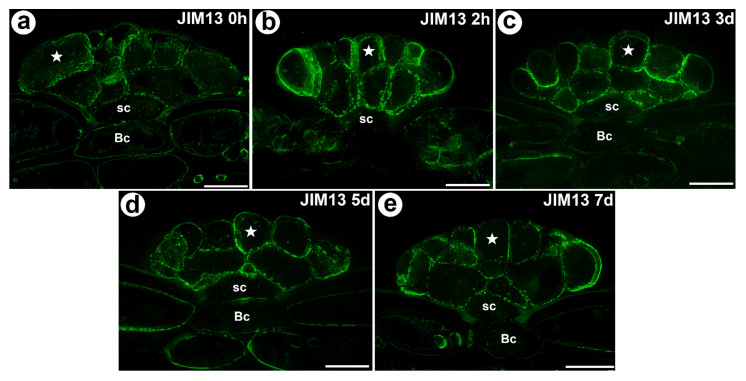
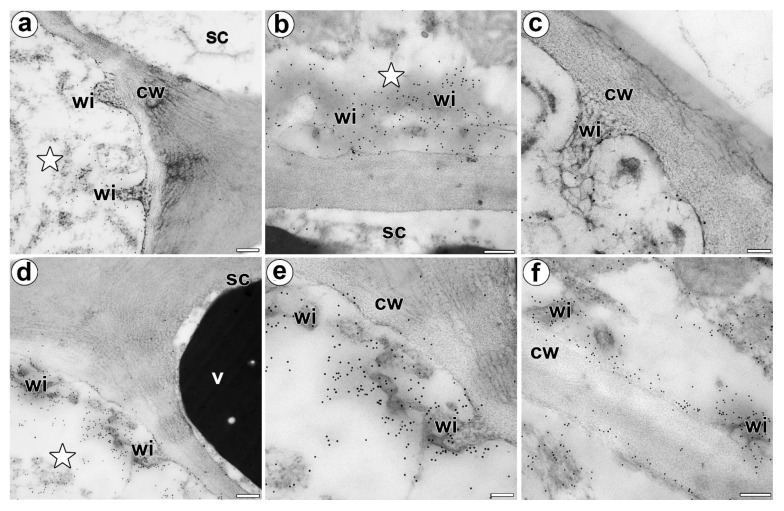
The arabinogalactan proteins (AGP) play important roles in plant growth and developmental processes. However, to the best of our knowledge, there is no information on the spatial distribution of AGP in the plant organs and tissues of carnivorous plants during their carnivorous cycle. The Dionaea muscipula trap forms an "external stomach" and is equipped with an effective digestive-absorbing system. Because its digestive glands are composed of specialized cells, the hypothesis that their cell walls are also very specialized in terms of their composition (AGP) compared to the cell wall of the trap epidermal and parenchyma cells was tested. Another aim of this study was to determine whether there is a spatio-temporal distribution of the AGP in the digestive glands during the secretory cycle of D. muscipula. Antibodies that act against AGPs, including JIM8, JIM13 and JIM14, were used. The localization of the examined compounds was determined using immunohistochemistry techniques and immunogold labeling. In both the un-fed and fed traps, there was an accumulation of AGP in the cell walls of the gland secretory cells. The epitope, which is recognized by JIM14, was a useful marker of the digestive glands. The secretory cells of the D. muscipula digestive glands are transfer cells and an accumulation of specific AGP was at the site where the cell wall labyrinth occurred. Immunogold labeling confirmed an occurrence of AGP in the cell wall ingrowths. There were differences in the AGP occurrence (labeled with JIM8 and JIM13) in the cell walls of the gland secretory cells between the unfed and fed traps.
阿拉伯半乳聚糖蛋白(AGP)在植物生长和发育过程中发挥重要作用。然而,据我们所知,目前尚无关于肉食性植物在肉食周期中器官和组织内 AGP 空间分布的信息。捕蝇草陷阱形成“外部胃”,并配备有效的消化吸收系统。由于其消化腺由特化细胞组成,因此假设其细胞壁在组成(AGP)方面与陷阱表皮和实质细胞的细胞壁非常特化。本研究的另一个目的是确定在捕蝇草分泌周期中,消化腺中 AGP 是否存在时空分布。使用针对 AGP 的抗体,包括 JIM8、JIM13 和 JIM14。使用免疫组织化学技术和免疫金标记法确定被检查化合物的定位。在未喂食和喂食的陷阱中,腺分泌细胞的细胞壁中均积累了 AGP。被 JIM14 识别的表位是消化腺的有用标记物。捕蝇草消化腺的分泌细胞是转移细胞,特定 AGP 的积累发生在细胞壁迷宫出现的部位。免疫金标记证实了细胞壁内陷中 AGP 的存在。在未喂食和喂食的陷阱中,腺分泌细胞细胞壁中 AGP 的出现(用 JIM8 和 JIM13 标记)存在差异。