Occhipinti Jo-An, Rose Danya, Skinner Adam, Rock Daniel, Song Yun Ju C, Prodan Ante, Rosenberg Sebastian, Freebairn Louise, Vacher Catherine, Hickie Ian B
Brain and Mind Centre, Faculty of Medicine and Health, University of Sydney, Sydney, NSW 2006, Australia.
Computer Simulation & Advanced Research Technologies (CSART), Sydney, NSW 2021, Australia.
Int J Environ Res Public Health. 2022 Jan 27;19(3):1468. doi: 10.3390/ijerph19031468.
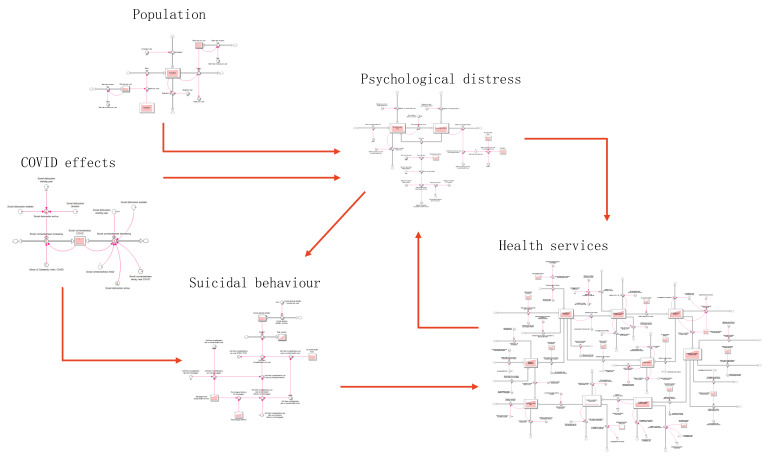
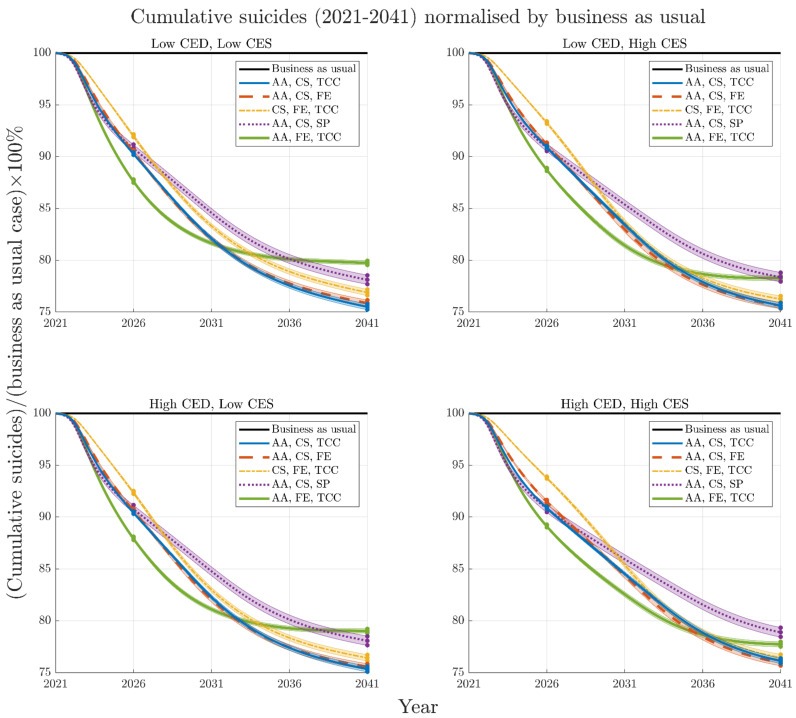
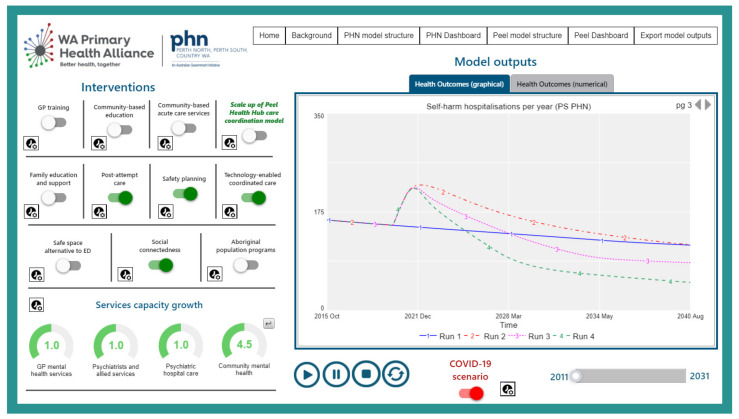
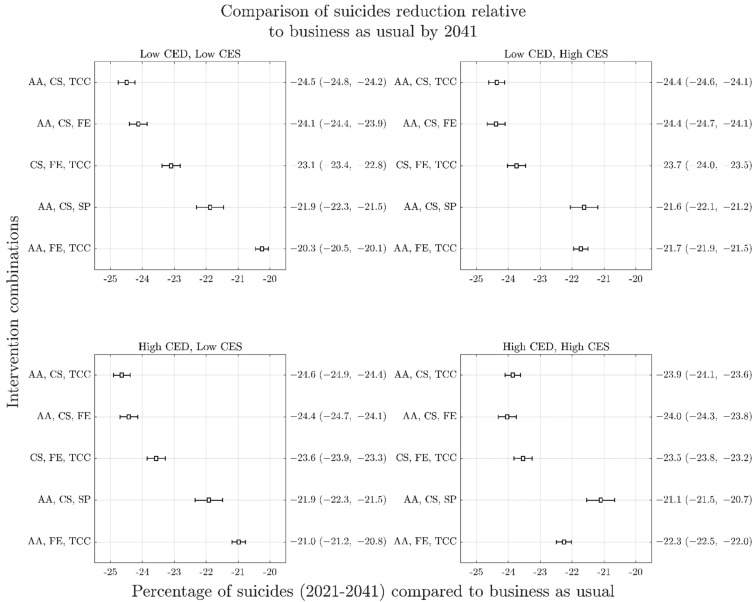
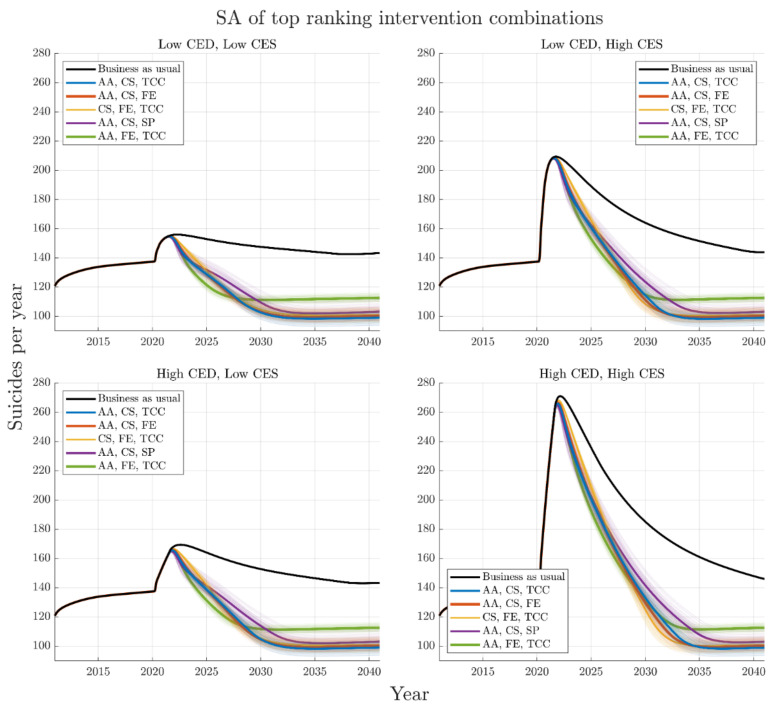
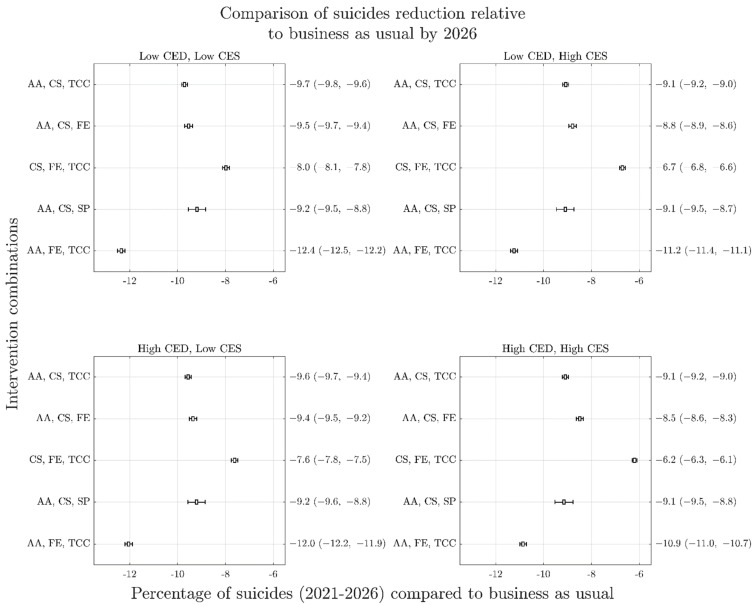
The COVID-19 pandemic demonstrated the significant value of systems modelling in supporting proactive and effective public health decision making despite the complexities and uncertainties that characterise an evolving crisis. The same approach is possible in the field of mental health. However, a commonly levelled (but misguided) criticism prevents systems modelling from being more routinely adopted, namely, that the presence of uncertainty around key model input parameters renders a model useless. This study explored whether radically different simulated trajectories of suicide would result in different advice to decision makers regarding the optimal strategy to mitigate the impacts of the pandemic on mental health. Using an existing system dynamics model developed in August 2020 for a regional catchment of Western Australia, four scenarios were simulated to model the possible effect of the COVID-19 pandemic on levels of psychological distress. The scenarios produced a range of projected impacts on suicide deaths, ranging from a relatively small to a dramatic increase. Discordance in the sets of best-performing intervention scenarios across the divergent COVID-mental health trajectories was assessed by comparing differences in projected numbers of suicides between the baseline scenario and each of 286 possible intervention scenarios calculated for two time horizons; 2026 and 2041. The best performing intervention combinations over the period 2021-2041 (i.e., post-suicide attempt assertive aftercare, community support programs to increase community connectedness, and technology enabled care coordination) were highly consistent across all four COVID-19 mental health trajectories, reducing suicide deaths by between 23.9-24.6% against the baseline. However, the ranking of best performing intervention combinations does alter depending on the time horizon under consideration due to non-linear intervention impacts. These findings suggest that systems models can retain value in informing robust decision making despite uncertainty in the trajectories of population mental health outcomes. It is recommended that the time horizon under consideration be sufficiently long to capture the full effects of interventions, and efforts should be made to achieve more timely tracking and access to key population mental health indicators to inform model refinements over time and reduce uncertainty in mental health policy and planning decisions.
尽管新冠疫情危机不断演变,具有复杂性和不确定性,但新冠疫情证明了系统建模在支持积极有效的公共卫生决策方面的重大价值。心理健康领域也可以采用同样的方法。然而,一种常见(但有误导性)的批评意见阻碍了系统建模的更常规采用,即关键模型输入参数存在不确定性会使模型毫无用处。本研究探讨了截然不同的自杀模拟轨迹是否会导致向决策者提供关于减轻疫情对心理健康影响的最优策略的不同建议。利用2020年8月为西澳大利亚一个地区集水区开发的现有系统动力学模型,模拟了四种情景,以模拟新冠疫情对心理困扰水平的可能影响。这些情景对自杀死亡产生了一系列预计影响,从相对较小的增加到急剧增加。通过比较基线情景与为两个时间范围(2026年和2041年)计算的286种可能干预情景中每一种情景之间预计自杀人数的差异,评估了不同新冠心理健康轨迹中最佳干预情景集之间的不一致性。2021年至2041年期间表现最佳的干预组合(即自杀未遂后的积极后续护理、增加社区联系的社区支持计划以及技术支持的护理协调)在所有四种新冠心理健康轨迹中高度一致,与基线相比,自杀死亡人数减少了23.9%-24.6%。然而,由于非线性干预影响,最佳干预组合的排名确实会根据所考虑的时间范围而改变。这些发现表明,尽管人群心理健康结果轨迹存在不确定性,但系统模型在为稳健决策提供信息方面仍具有价值。建议所考虑的时间范围足够长,以捕捉干预措施的全部效果,并应努力更及时地跟踪和获取关键人群心理健康指标,以便随着时间的推移改进模型,并减少心理健康政策和规划决策中的不确定性。