• 文献检索
  • 文档翻译
  • 深度研究
  • 学术资讯
  • Suppr Zotero 插件Zotero 插件
  • 邀请有礼
  • 套餐&价格
  • 历史记录
应用&插件
Suppr Zotero 插件Zotero 插件浏览器插件Mac 客户端Windows 客户端微信小程序
定价
高级版会员购买积分包购买API积分包
服务
文献检索文档翻译深度研究API 文档MCP 服务
关于我们
关于 Suppr公司介绍联系我们用户协议隐私条款
关注我们

Suppr 超能文献

核心技术专利:CN118964589B侵权必究
粤ICP备2023148730 号-1Suppr @ 2026

文献检索

告别复杂PubMed语法,用中文像聊天一样搜索,搜遍4000万医学文献。AI智能推荐,让科研检索更轻松。

立即免费搜索

文件翻译

保留排版,准确专业,支持PDF/Word/PPT等文件格式,支持 12+语言互译。

免费翻译文档

深度研究

AI帮你快速写综述,25分钟生成高质量综述,智能提取关键信息,辅助科研写作。

立即免费体验

技术支持的护理协调在复杂心理健康系统中的影响:一个局部系统动力学模型。

The Impact of Technology-Enabled Care Coordination in a Complex Mental Health System: A Local System Dynamics Model.

机构信息

Brain and Mind Centre, University of Sydney, Sydney, Australia.

Translational Health Research Institute, Western Sydney University, Sydney, Australia.

出版信息

J Med Internet Res. 2021 Jun 30;23(6):e25331. doi: 10.2196/25331.

DOI:10.2196/25331
PMID:34077384
原文链接:https://pmc.ncbi.nlm.nih.gov/articles/PMC8274674/
Abstract

BACKGROUND

Prior to the COVID-19 pandemic, major shortcomings in the way mental health care systems were organized were impairing the delivery of effective care. The mental health impacts of the pandemic, the recession, and the resulting social dislocation will depend on the extent to which care systems will become overwhelmed and on the strategic investments made across the system to effectively respond.

OBJECTIVE

This study aimed to explore the impact of strengthening the mental health system through technology-enabled care coordination on mental health and suicide outcomes.

METHODS

A system dynamics model for the regional population catchment of North Coast New South Wales, Australia, was developed that incorporated defined pathways from social determinants of mental health to psychological distress, mental health care, and suicidal behavior. The model reproduced historic time series data across a range of outcomes and was used to evaluate the relative impact of a set of scenarios on attempted suicide (ie, self-harm hospitalizations), suicide deaths, mental health-related emergency department (ED) presentations, and psychological distress over the period from 2021 to 2030. These scenarios include (1) business as usual, (2) increase in service capacity growth rate by 20%, (3) standard telehealth, and (4) technology-enabled care coordination. Each scenario was tested using both pre- and post-COVID-19 social and economic conditions.

RESULTS

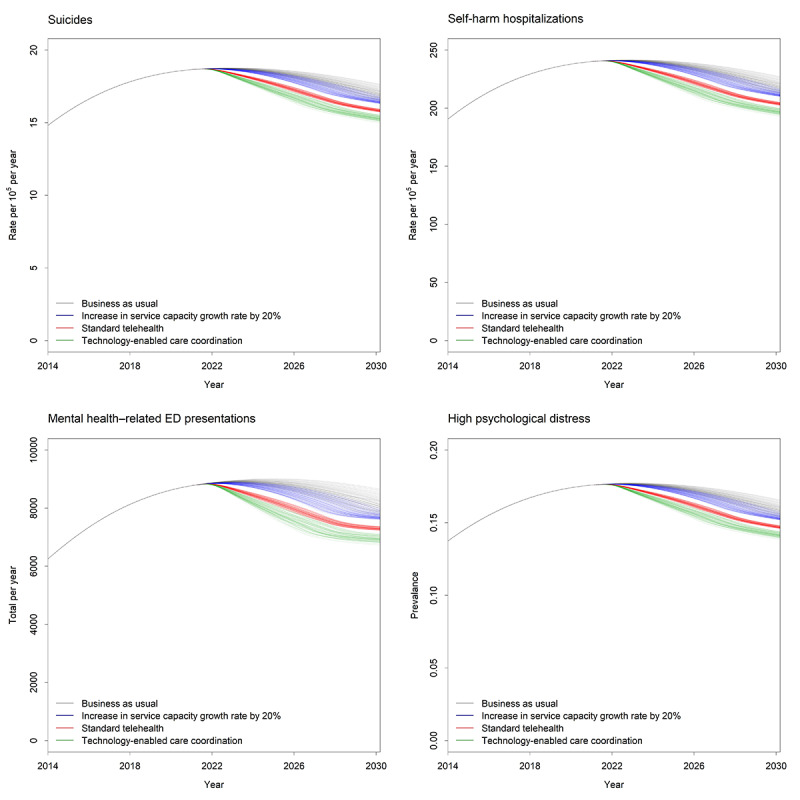
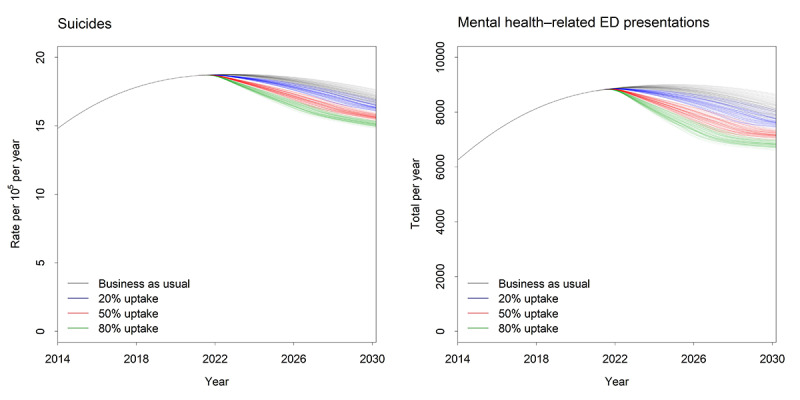
Technology-enabled care coordination was forecast to deliver a reduction in self-harm hospitalizations and suicide deaths by 6.71% (95% interval 5.63%-7.87%), mental health-related ED presentations by 10.33% (95% interval 8.58%-12.19%), and the prevalence of high psychological distress by 1.76 percentage points (95% interval 1.35-2.32 percentage points). Scenario testing demonstrated that increasing service capacity growth rate by 20% or standard telehealth had substantially lower impacts. This pattern of results was replicated under post-COVID-19 conditions with technology-enabled care coordination being the only tested scenario, which was forecast to reduce the negative impact of the pandemic on mental health and suicide.

CONCLUSIONS

The use of technology-enabled care coordination is likely to improve mental health and suicide outcomes. The substantially lower effectiveness of targeting individual components of the mental health system (ie, increasing service capacity growth rate by 20% or standard telehealth) reiterates that strengthening the whole system has the greatest impact on patient outcomes. Investments into more of the same types of programs and services alone will not be enough to improve outcomes; instead, new models of care and the digital infrastructure to support them and their integration are needed.
https://cdn.ncbi.nlm.nih.gov/pmc/blobs/a649/8274674/57387e3104b1/jmir_v23i6e25331_fig2.jpg
https://cdn.ncbi.nlm.nih.gov/pmc/blobs/a649/8274674/945df3cc77f2/jmir_v23i6e25331_fig1.jpg
https://cdn.ncbi.nlm.nih.gov/pmc/blobs/a649/8274674/57387e3104b1/jmir_v23i6e25331_fig2.jpg
https://cdn.ncbi.nlm.nih.gov/pmc/blobs/a649/8274674/945df3cc77f2/jmir_v23i6e25331_fig1.jpg
https://cdn.ncbi.nlm.nih.gov/pmc/blobs/a649/8274674/57387e3104b1/jmir_v23i6e25331_fig2.jpg
摘要

背景

在 COVID-19 大流行之前,精神卫生保健系统的组织方式存在重大缺陷,这影响了有效护理的提供。大流行、经济衰退以及由此导致的社会混乱对精神健康的影响将取决于护理系统承受能力的程度,以及整个系统为有效应对而进行的战略投资。

目的

本研究旨在探讨通过技术支持的护理协调来加强精神卫生系统对精神健康和自杀结果的影响。

方法

为澳大利亚新南威尔士州北岸地区的人口进行了系统动力学建模,该模型纳入了从精神健康的社会决定因素到心理困扰、精神卫生保健和自杀行为的明确途径。该模型再现了一系列结果的历史时间序列数据,并用于评估一组方案对企图自杀(即,自我伤害住院)、自杀死亡、与精神健康相关的急诊(ED)就诊和心理困扰的相对影响,时间范围为 2021 年至 2030 年。这些方案包括:(1)维持现状,(2)将服务能力增长率提高 20%,(3)标准远程医疗,和(4)技术支持的护理协调。在 COVID-19 前后的社会和经济条件下,对每个方案都进行了测试。

结果

预计技术支持的护理协调可将自我伤害住院和自杀死亡人数减少 6.71%(95%置信区间 5.63%-7.87%),与精神健康相关的 ED 就诊减少 10.33%(95%置信区间 8.58%-12.19%),以及高心理困扰的流行率降低 1.76 个百分点(95%置信区间 1.35%-2.32 个百分点)。方案测试表明,将服务能力增长率提高 20%或标准远程医疗的影响要低得多。在 COVID-19 条件下,该模式的结果得到了复制,技术支持的护理协调是唯一经过测试的方案,预计将减轻大流行对精神健康和自杀的负面影响。

结论

使用技术支持的护理协调可能会改善精神健康和自杀结果。针对精神卫生系统个别组成部分(即,将服务能力增长率提高 20%或标准远程医疗)的目标具有较低的效果,这再次强调了加强整个系统对患者结果的影响最大。仅投资于更多相同类型的计划和服务是不够的;相反,需要新的护理模式和支持它们的数字基础设施,以及它们的整合。

相似文献

1
The Impact of Technology-Enabled Care Coordination in a Complex Mental Health System: A Local System Dynamics Model.技术支持的护理协调在复杂心理健康系统中的影响:一个局部系统动力学模型。
J Med Internet Res. 2021 Jun 30;23(6):e25331. doi: 10.2196/25331.
2
Systems modelling and simulation to inform strategic decision making for suicide prevention in rural New South Wales (Australia).用于为澳大利亚新南威尔士州农村地区自杀预防的战略决策提供信息的系统建模与模拟。
Aust N Z J Psychiatry. 2020 Sep;54(9):892-901. doi: 10.1177/0004867420932639. Epub 2020 Jun 17.
3
Federal and state cooperation necessary but not sufficient for effective regional mental health systems: insights from systems modelling and simulation.联邦和州的合作对于有效的区域精神卫生系统是必要的,但不是充分的:系统建模和模拟的观点。
Sci Rep. 2021 May 27;11(1):11209. doi: 10.1038/s41598-021-90762-x.
4
Sound Decision Making in Uncertain Times: Can Systems Modelling Be Useful for Informing Policy and Planning for Suicide Prevention?不确定时期的明智决策:系统建模能否有助于为自杀预防政策和规划提供信息?
Int J Environ Res Public Health. 2022 Jan 27;19(3):1468. doi: 10.3390/ijerph19031468.
5
Reducing youth suicide: systems modelling and simulation to guide targeted investments across the determinants.减少青少年自杀:系统建模和仿真以指导跨决定因素的有针对性投资。
BMC Med. 2021 Mar 12;19(1):61. doi: 10.1186/s12916-021-01935-4.
6
Cost-effectiveness of system-level mental health strategies for young people in the Australian Capital Territory: a dynamic simulation modelling study.针对澳大利亚首都地区年轻人的系统层面心理健康策略的成本效益:一项动态模拟建模研究。
Lancet Psychiatry. 2024 Feb;11(2):123-133. doi: 10.1016/S2215-0366(23)00396-6.
7
Mental Health Service Use, Suicide Behavior, and Emergency Department Visits Among Rural US Veterans Who Received Video-Enabled Tablets During the COVID-19 Pandemic.在 COVID-19 大流行期间,美国农村退伍军人收到配备视频功能的平板电脑后,心理健康服务的使用、自杀行为和急诊就诊情况。
JAMA Netw Open. 2022 Apr 1;5(4):e226250. doi: 10.1001/jamanetworkopen.2022.6250.
8
Improving access to mental health care: a system dynamics model of direct access to specialist care and accelerated specialist service capacity growth.改善精神卫生保健服务的可及性:直接获得专家护理和加速专家服务能力增长的系统动力学模型。
Med J Aust. 2023 Apr 17;218(7):309-314. doi: 10.5694/mja2.51903. Epub 2023 Mar 27.
9
Informing the Future of Integrated Digital and Clinical Mental Health Care: Synthesis of the Outcomes From Project Synergy.为综合数字与临床心理健康护理的未来提供信息:协同项目成果综述
JMIR Ment Health. 2022 Mar 9;9(3):e33060. doi: 10.2196/33060.
10
Presentations to NSW emergency departments with self-harm, suicidal ideation, or intentional poisoning, 2010-2014.2010-2014 年,在新南威尔士州急诊部就诊的有自伤、自杀意念或故意中毒者。
Med J Aust. 2018 May 7;208(8):348-353. doi: 10.5694/mja17.00589. Epub 2018 Apr 23.

引用本文的文献

1
Young People's Experiences Using a Digital Mental Health Tool to Support Their Care in a Real-World Service: Lived Experience-Led Qualitative Study.年轻人在现实世界服务中使用数字心理健康工具来支持其护理的经历:基于真实体验的定性研究。
JMIR Ment Health. 2025 Jun 23;12:e70154. doi: 10.2196/70154.
2
Implementation of Clinical Services for Adults with Obesity in Different Health Systems: A Scoping Review and Causal Loop Diagram.不同卫生系统中为肥胖成年人提供临床服务的实施情况:一项范围综述和因果循环图
Diabetes Metab Syndr Obes. 2025 May 22;18:1695-1709. doi: 10.2147/DMSO.S501149. eCollection 2025.
3
Personalized and collaborative use of digital measurement-based care tools enhances engagement among young adults: a mixed-methods study.

本文引用的文献

1
Reducing youth suicide: systems modelling and simulation to guide targeted investments across the determinants.减少青少年自杀:系统建模和仿真以指导跨决定因素的有针对性投资。
BMC Med. 2021 Mar 12;19(1):61. doi: 10.1186/s12916-021-01935-4.
2
Technology-enabled collaborative care for youth with early psychosis: A protocol for a feasibility study to improve physical health behaviours.技术支持的青少年早期精神病协作式护理:改善身体健康行为的可行性研究方案。
Early Interv Psychiatry. 2021 Aug;15(4):828-836. doi: 10.1111/eip.13018. Epub 2020 Aug 3.
3
Mental Health and the Covid-19 Pandemic.
基于数字测量的护理工具的个性化和协作使用可提高年轻人的参与度:一项混合方法研究。
BMC Health Serv Res. 2025 May 26;25(1):752. doi: 10.1186/s12913-025-12889-1.
4
Providing digital mental health support and guidance across Colombia: An observational study.在哥伦比亚全国范围内提供数字心理健康支持与指导:一项观察性研究。
Digit Health. 2025 Apr 13;11:20552076251330766. doi: 10.1177/20552076251330766. eCollection 2025 Jan-Dec.
5
Organizational factors impacting the implementation of a digital mental health tool in Alberta's mental health care of youth and young adults.影响艾伯塔省青少年和青年心理健康护理中数字心理健康工具实施的组织因素。
Digit Health. 2025 Jan 9;11:20552076241310341. doi: 10.1177/20552076241310341. eCollection 2025 Jan-Dec.
6
Dynamic Simulation Models of Suicide and Suicide-Related Behaviors: Systematic Review.自杀及自杀相关行为的动态模拟模型:系统综述
JMIR Public Health Surveill. 2024 Dec 2;10:e63195. doi: 10.2196/63195.
7
Evaluating the tailored implementation of a multisite care navigation service for mental health in rural and remote Australia (The Bridging Study): protocol for a community-engaged hybrid effectiveness-implementation study.评估澳大利亚农村和偏远地区精神卫生多站点护理导航服务的定制实施情况(Bridging 研究):一项社区参与的混合有效性实施研究方案。
Implement Sci. 2024 Sep 4;19(1):62. doi: 10.1186/s13012-024-01391-7.
8
Digital therapeutics in the hospital for suicide crisis - content and design recommendations from young people and hospital staff.医院自杀危机中的数字疗法——来自年轻人和医院工作人员的内容与设计建议
Digit Health. 2024 Feb 14;10:20552076241230072. doi: 10.1177/20552076241230072. eCollection 2024 Jan-Dec.
9
Unpeeling the onion: Digital triage and monitoring of general practice, private psychiatry, and psychology.剖析核心:全科医疗、私人精神病学及心理学的数字化分诊与监测
Australas Psychiatry. 2024 Apr;32(2):118-120. doi: 10.1177/10398562231222826. Epub 2023 Dec 19.
10
Digital Application of Clinical Staging to Support Stratification in Youth Mental Health Services: Validity and Reliability Study.临床分期在青少年心理健康服务中支持分层的数字应用:效度与信度研究
JMIR Form Res. 2023 Sep 8;7:e45161. doi: 10.2196/45161.
心理健康与新冠疫情
N Engl J Med. 2020 Aug 6;383(6):510-512. doi: 10.1056/NEJMp2008017. Epub 2020 Apr 13.
4
Co-designing the InnoWell Platform to deliver the right mental health care first time to regional youth.共同设计 InnoWell 平台,以首次为地区青年提供正确的心理健康护理。
Aust J Rural Health. 2020 Apr;28(2):190-194. doi: 10.1111/ajr.12617. Epub 2020 Apr 12.
5
Suicide Mortality and Coronavirus Disease 2019-A Perfect Storm?自杀死亡率与2019年冠状病毒病——一场完美风暴?
JAMA Psychiatry. 2020 Nov 1;77(11):1093-1094. doi: 10.1001/jamapsychiatry.2020.1060.
6
The role of new technologies in monitoring the evolution of psychopathology and providing measurement-based care in young people.新技术在监测青少年精神病理学发展及提供基于测量的照护中的作用。
World Psychiatry. 2020 Feb;19(1):38-39. doi: 10.1002/wps.20697.
7
Right care, first time: a highly personalised and measurement-based care model to manage youth mental health.精准医疗,首次就诊:高度个性化和基于评估的青少年心理健康管理医疗模式。
Med J Aust. 2019 Nov;211 Suppl 9:S3-S46. doi: 10.5694/mja2.50383.
8
Project Synergy: co-designing technology-enabled solutions for Australian mental health services reform.项目协同:为澳大利亚精神卫生服务改革共同设计技术赋能的解决方案。
Med J Aust. 2019 Oct;211 Suppl 7:S3-S39. doi: 10.5694/mja2.50349.
9
Clinical Stage Transitions in Persons Aged 12 to 25 Years Presenting to Early Intervention Mental Health Services With Anxiety, Mood, and Psychotic Disorders.12 至 25 岁人群出现焦虑、心境和精神病性障碍时向早期干预心理健康服务机构转介的临床阶段变化。
JAMA Psychiatry. 2019 Nov 1;76(11):1167-1175. doi: 10.1001/jamapsychiatry.2019.2360.
10
The evidence-based group-level symptom-reduction model as the organizing principle for mental health care: time for change?基于证据的群体层面症状减轻模型作为精神卫生保健的组织原则:变革的时候到了吗?
World Psychiatry. 2019 Feb;18(1):88-96. doi: 10.1002/wps.20609.