Department of Biological Sciences and Bioengineering, NanoBio High-Tech Materials Research Center, Inha University, Inha-ro 100, Incheon 22212, Korea.
Int J Mol Sci. 2022 Jan 26;23(3):1402. doi: 10.3390/ijms23031402.
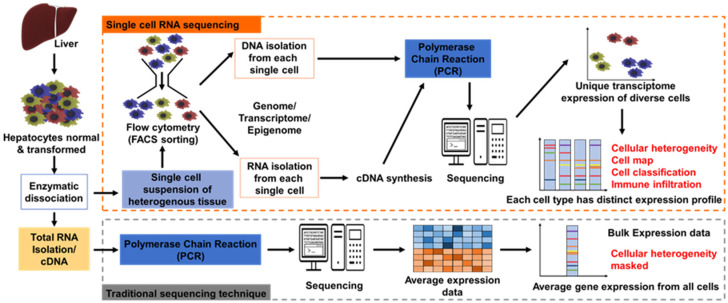
Hepatocellular carcinoma is a primary liver cancer caused by the accumulation of genetic mutation patterns associated with epidemiological conditions. This lethal malignancy exhibits tumor heterogeneity, which is considered as one of the main reasons for drug resistance development and failure of clinical trials. Recently, single-cell technology (SCT), a new advanced sequencing technique that analyzes every single cell in a tumor tissue specimen, aids complete insight into the genetic heterogeneity of cancer. This helps in identifying and assessing rare cell populations by analyzing the difference in gene expression pattern between individual cells of single biopsy tissue which normally cannot be identified from pooled cell gene expression pattern (traditional sequencing technique). Thus, SCT improves the clinical diagnosis, treatment, and prognosis of hepatocellular carcinoma as the limitations of other techniques impede this cancer research progression. Application of SCT at the genomic, transcriptomic, and epigenomic levels to promote individualized hepatocellular carcinoma diagnosis and therapy. The current review has been divided into ten sections. Herein we deliberated on the SCT, hepatocellular carcinoma diagnosis, tumor microenvironment analysis, single-cell genomic sequencing, single-cell transcriptomics, single-cell omics sequencing for biomarker development, identification of hepatocellular carcinoma origination and evolution, limitations, challenges, conclusions, and future perspectives.
肝细胞癌是一种原发性肝癌,由与流行病学条件相关的遗传突变模式的积累引起。这种致命的恶性肿瘤表现出肿瘤异质性,这被认为是药物耐药性发展和临床试验失败的主要原因之一。最近,单细胞技术(SCT)是一种新的先进测序技术,可分析肿瘤组织标本中的每个单细胞,有助于全面了解癌症的遗传异质性。通过分析单个活检组织中单细胞之间的基因表达模式差异,可以识别和评估罕见细胞群体,而这些差异通常无法从汇集的细胞基因表达模式(传统测序技术)中识别出来。因此,SCT 提高了肝细胞癌的临床诊断、治疗和预后,因为其他技术的局限性阻碍了这一癌症研究的进展。在基因组、转录组和表观基因组水平上应用 SCT 以促进个体化肝细胞癌的诊断和治疗。本综述分为十个部分。在这里,我们讨论了 SCT、肝细胞癌诊断、肿瘤微环境分析、单细胞基因组测序、单细胞转录组学、单细胞组学测序用于生物标志物开发、鉴定肝细胞癌的起源和进化、局限性、挑战、结论和未来展望。