Service de Recherche en Radiobiologie et en Médecine Régénérative (SERAMED), Laboratoire de Radiobiologie des Expositions Médicales (LRMED), Institut de Radioprotection et de Sûreté Nucléaire (IRSN), 31 Avenue de la Division Leclerc, Fontenay-aux-Roses, 92260 Paris, France.
APHP, Hôpital Universitaire Pitié-Salpêtrière, Radiotherapy-Oncology Department, 47-83 Boulevard de l'Hôpital, CEDEX 13, 75651 Paris, France.
Int J Mol Sci. 2022 Feb 6;23(3):1836. doi: 10.3390/ijms23031836.
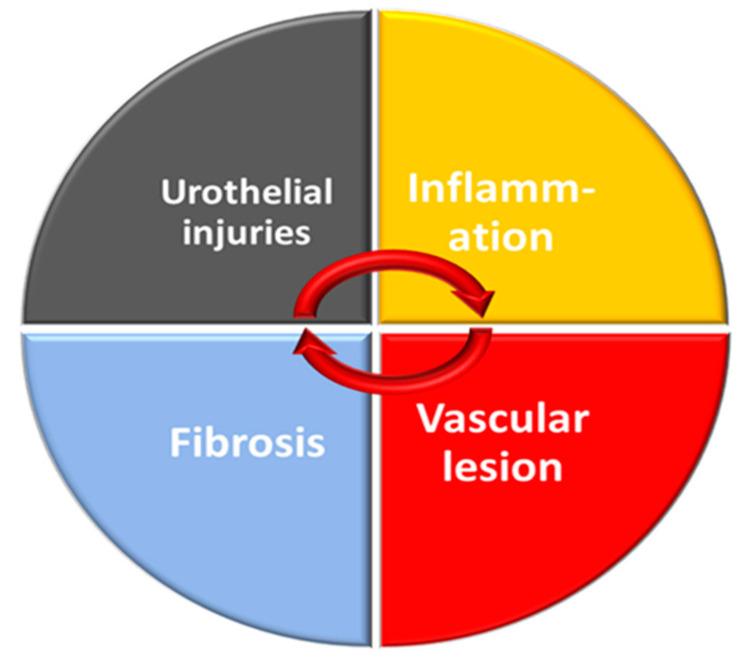
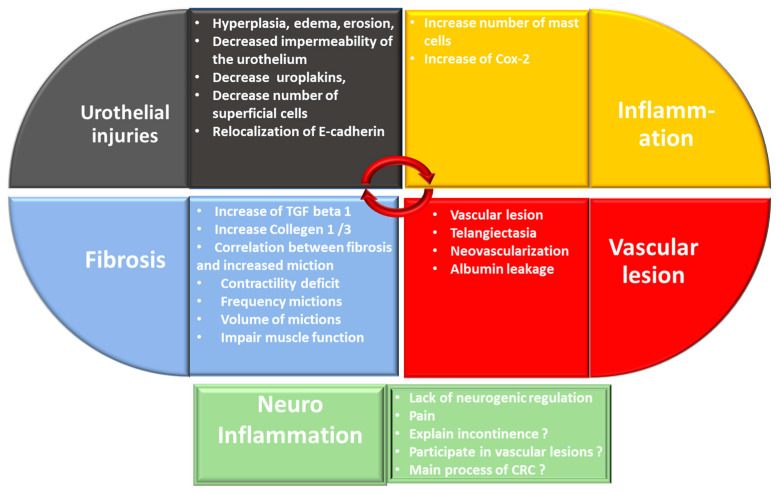
Chronic radiation cystitis (CRC) is a consequence of pelvic radiotherapy and affects 5-10% of patients. The pathology of CRC is without curative treatment and is characterized by incontinence, pelvic pain and hematuria, which severely degrades patients' quality of life. Current management strategies rely primarily on symptomatic measures and have certain limitations. Thanks to a better understanding of the pathophysiology of radiation cystitis, studies targeting key manifestations such as inflammation, neovascularization and cell atrophy have emerged and are promising avenues for future treatment. However, the mechanisms of CRC are still better described in animal models than in human models. Preclinical studies conducted to elucidate the pathophysiology of CRC use distinct models and are most often limited to specific processes, such as fibrosis, vascular damage and inflammation. This review presents a synthesis of experimental studies aimed at improving our understanding of the molecular mechanisms at play and identifying key processes in CRC.
慢性放射性膀胱炎(CRC)是盆腔放疗的后果,影响 5-10%的患者。CRC 的病理特征是无法治愈,其表现为尿失禁、骨盆疼痛和血尿,严重降低了患者的生活质量。目前的管理策略主要依赖于对症治疗,存在一定的局限性。由于对放射性膀胱炎病理生理学的认识不断加深,针对炎症、新生血管形成和细胞萎缩等关键表现的研究已经出现,为未来的治疗提供了有希望的途径。然而,CRC 的发病机制在动物模型中描述得比在人体模型中更为详细。为阐明 CRC 的病理生理学而进行的临床前研究使用了不同的模型,并且通常仅限于特定的过程,如纤维化、血管损伤和炎症。本综述总结了旨在提高我们对发挥作用的分子机制的理解和确定 CRC 中关键过程的实验研究。