Université Côte d'Azur, CNRS, INSERM, Institute of Biology Valrose, Nice, France.
Université Côte d'Azur, CCMA, Nice, France.
mBio. 2021 Feb 22;13(1):e0387321. doi: 10.1128/mbio.03873-21. Epub 2022 Feb 15.
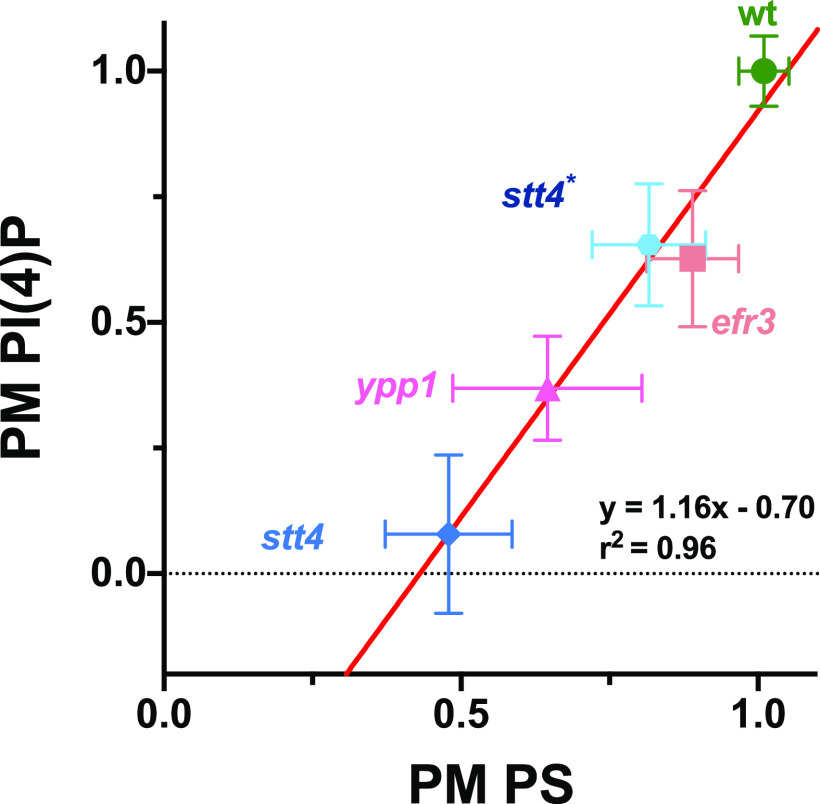
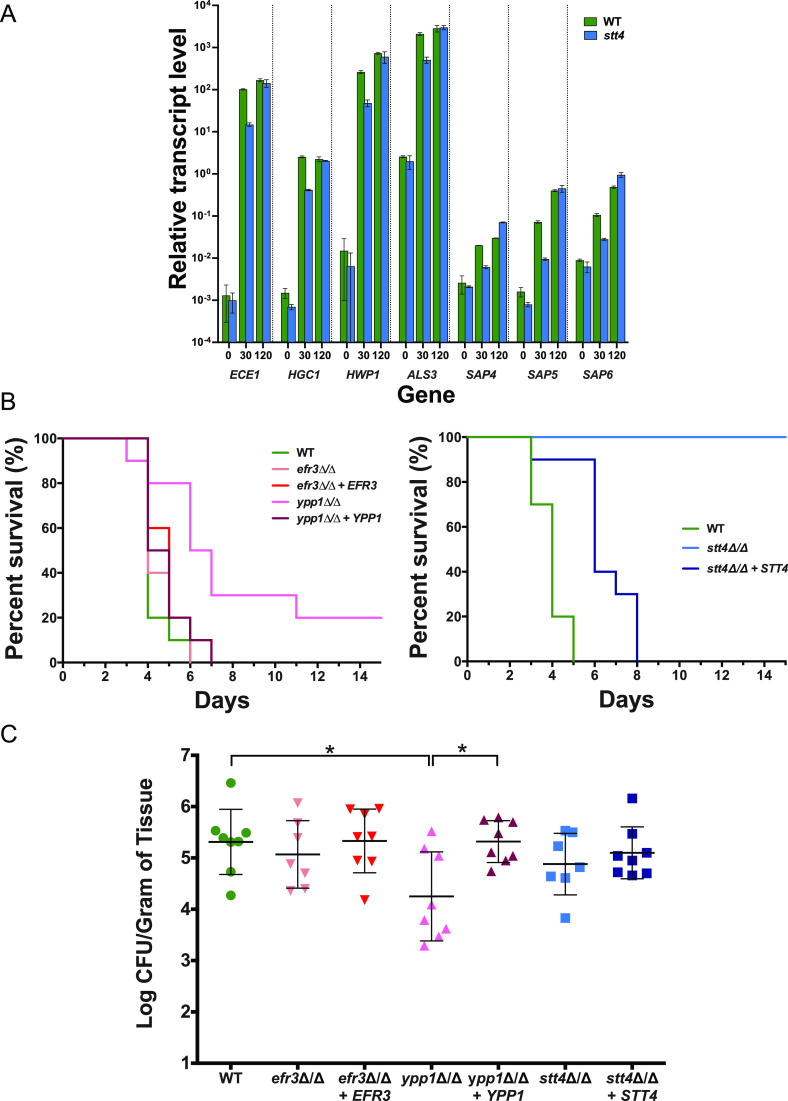
Phosphatidylinositol phosphates are key phospholipids with a range of regulatory roles, including membrane trafficking and cell polarity. Phosphatidylinositol-4-phosphate [PI(4)P] at the Golgi apparatus is required for the budding-to-filamentous-growth transition in the human-pathogenic fungus Candida albicans; however, the role of plasma membrane PI(4)P is unclear. We have investigated the importance of this phospholipid in C. albicans growth, stress response, and virulence by generating mutant strains with decreased levels of plasma membrane PI(4)P, via deletion of components of the PI-4-kinase complex, i.e., Efr3, Ypp1, and Stt4. The amounts of plasma membrane PI(4)P in the Δ/Δ and Δ/Δ mutants were ∼60% and ∼40%, respectively, of that in the wild-type strain, whereas it was nearly undetectable in the Δ/Δ mutant. All three mutants had reduced plas7ma membrane phosphatidylserine (PS). Although these mutants had normal yeast-phase growth, they were defective in filamentous growth, exhibited defects in cell wall integrity, and had an increased exposure of cell wall β(1,3)-glucan, yet they induced a range of hyphal-specific genes. In a mouse model of hematogenously disseminated candidiasis, fungal plasma membrane PI(4)P levels directly correlated with virulence; the Δ/Δ mutant had wild-type virulence, the Δ/Δ mutant had attenuated virulence, and the Δ/Δ mutant caused no lethality. In the mouse model of oropharyngeal candidiasis, only the Δ/Δ mutant had reduced virulence, indicating that plasma membrane PI(4)P is less important for proliferation in the oropharynx. Collectively, these results demonstrate that plasma membrane PI(4)P levels play a central role in filamentation, cell wall integrity, and virulence in C. albicans. While the PI-4-kinases Pik1 and Stt4 both produce PI(4)P, the former generates PI(4)P at the Golgi apparatus and the latter at the plasma membrane, and these two pools are functionally distinct. To address the importance of plasma membrane PI(4)P in Candida albicans, we generated deletion mutants of the three putative plasma membrane PI-4-kinase complex components and quantified the levels of plasma membrane PI(4)P in each of these strains. Our work reveals that this phosphatidylinositol phosphate is specifically critical for the yeast-to-hyphal transition, cell wall integrity, and virulence in a mouse systemic infection model. The significance of this work is in identifying a plasma membrane phospholipid that has an infection-specific role, which is attributed to the loss of plasma membrane PI(4)P resulting in β(1,3)-glucan unmasking.
磷脂酰肌醇磷酸是一类具有多种调节作用的关键磷脂,包括膜运输和细胞极性。在人类致病性真菌白念珠菌中,高尔基体上的磷脂酰肌醇-4-磷酸[PI(4)P]对于出芽到丝状生长的转变是必需的;然而,质膜 PI(4)P 的作用尚不清楚。我们通过删除 PI-4-激酶复合物的成分,即 Efr3、Ypp1 和 Stt4,生成了质膜 PI(4)P 水平降低的突变株,从而研究了这种磷脂在白念珠菌生长、应激反应和毒力中的重要性。与野生型菌株相比,Δ/Δ 和 Δ/Δ 突变株的质膜 PI(4)P 含量分别约为 60%和 40%,而Δ/Δ 突变株中的质膜 PI(4)P 几乎无法检测到。这三种突变株的质膜磷脂酰丝氨酸(PS)含量均减少。尽管这些突变株具有正常的酵母相生长,但它们在丝状生长中存在缺陷,表现出细胞壁完整性缺陷,并增加了细胞壁β(1,3)-葡聚糖的暴露,但它们诱导了一系列菌丝特异性基因。在血源性播散性念珠菌病的小鼠模型中,真菌质膜 PI(4)P 水平与毒力直接相关;Δ/Δ 突变株具有野生型毒力,Δ/Δ 突变株的毒力减弱,而Δ/Δ 突变株没有致死性。在口咽念珠菌病的小鼠模型中,只有Δ/Δ 突变株的毒力降低,表明质膜 PI(4)P 对口腔增殖的重要性较低。总之,这些结果表明,质膜 PI(4)P 水平在白念珠菌的丝状形成、细胞壁完整性和毒力中起着核心作用。虽然 PI-4-激酶 Pik1 和 Stt4 都能产生 PI(4)P,但前者在高尔基体上产生 PI(4)P,后者在质膜上产生 PI(4)P,这两个池具有不同的功能。为了研究质膜 PI(4)P 在白念珠菌中的重要性,我们生成了三个假定的质膜 PI-4-激酶复合物成分的缺失突变体,并定量了每个菌株中质膜 PI(4)P 的水平。我们的工作表明,这种磷酸肌醇磷脂对于酵母到菌丝的转变、细胞壁完整性和小鼠全身感染模型中的毒力特别关键。这项工作的意义在于确定了一种具有感染特异性作用的质膜磷脂,这归因于质膜 PI(4)P 的丧失导致β(1,3)-葡聚糖暴露。