Emergency Medicine, University of Helsinki and Department of Emergency Medicine and Services, Helsinki University Hospital, Helsinki, Finland.
Cardiology, University of Helsinki and Heart and Lung Cent, Helsinki University Hospital, Helsinki, Finland.
BMC Emerg Med. 2022 Feb 14;22(1):27. doi: 10.1186/s12873-022-00574-z.
Acute heart failure patients are often encountered in emergency departments (ED) from 11% to 57% using emergency medical services (EMS). Our aim was to evaluate the association of EMS use with acute heart failure patients' ED management and short-term outcomes.
This was a sub-analysis of a European EURODEM study. Data on patients presenting with dyspnoea were collected prospectively from European EDs. Patients with ED diagnosis of acute heart failure were categorized into two groups: those using EMS and those self-presenting (non- EMS). The independent association between EMS use and 30-day mortality was evaluated with logistic regression.
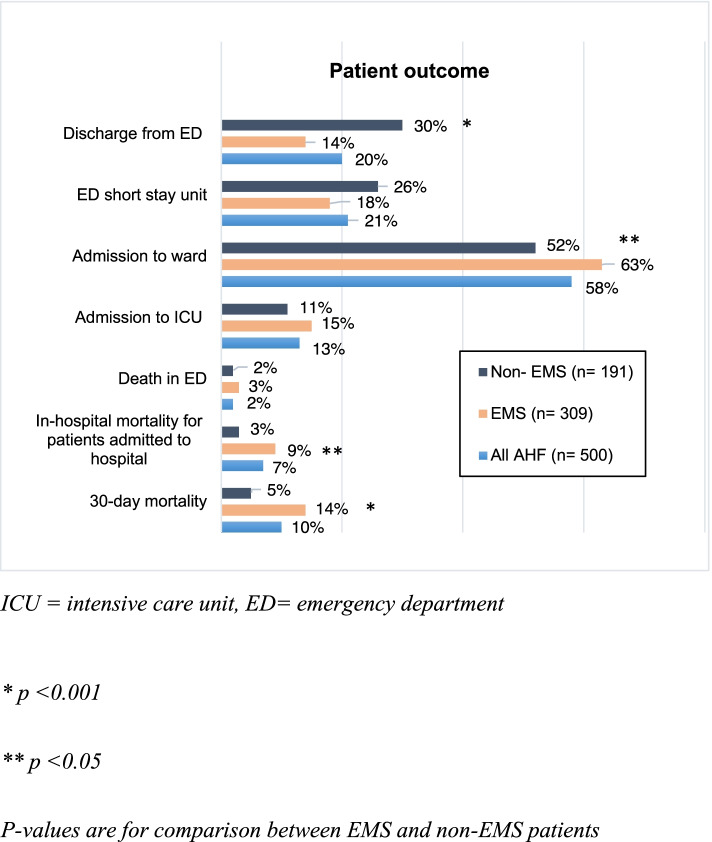
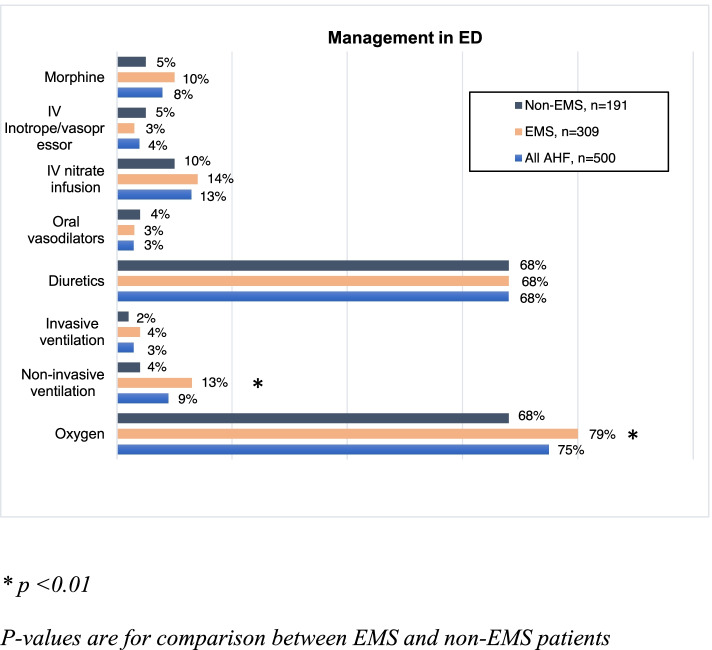
Of the 500 acute heart failure patients, with information about the arrival mode to the ED, 309 (61.8%) arrived by EMS. These patients were older (median age 80 vs. 75 years, p < 0.001), more often female (56.4% vs. 42.1%, p = 0.002) and had more dementia (18.7% vs. 7.2%, p < 0.001). On admission, EMS patients had more often confusion (14.2% vs. 2.1%, p < 0.001) and higher respiratory rate (24/min vs. 21/min, p = 0.014; respiratory rate > 30/min in 17.1% patients vs. 7.5%, p = 0.005). The only difference in ED management appeared in the use of ventilatory support: 78.3% of EMS patients vs. 67.5% of non- EMS patients received supplementary oxygen (p = 0.007), and non-invasive ventilation was administered to 12.5% of EMS patients vs. 4.2% non- EMS patients (p = 0.002). EMS patients were more often hospitalized (82.4% vs. 65.9%, p < 0.001), had higher in-hospital mortality (8.7% vs. 3.1%, p = 0.014) and 30-day mortality (14.3% vs. 4.9%, p < 0.001). The use of EMS was an independent predictor of 30-day mortality (OR = 2.54, 95% CI 1.11-5.81, p = 0.027).
Most acute heart failure patients arrive at ED by EMS. These patients suffer from more severe respiratory distress and receive more often ventilatory support. EMS use is an independent predictor of 30-day mortality.
使用急救医疗服务(EMS)的急性心力衰竭患者在急诊科的占比为 11%至 57%。我们的目的是评估 EMS 使用与急性心力衰竭患者急诊科管理和短期预后之间的关联。
这是一项欧洲 EURODEM 研究的子分析。从欧洲急诊科前瞻性收集呼吸困难患者的数据。将急诊科诊断为急性心力衰竭的患者分为两组:使用 EMS 的患者和自行就诊(非 EMS)的患者。使用逻辑回归评估 EMS 使用与 30 天死亡率之间的独立关联。
在 500 名急性心力衰竭患者中,有 309 名(61.8%)通过 EMS 到达急诊科,这些患者年龄更大(中位数年龄 80 岁 vs. 75 岁,p<0.001),更常见为女性(56.4% vs. 42.1%,p=0.002),且痴呆症更多(18.7% vs. 7.2%,p<0.001)。入院时,EMS 患者更常出现意识混乱(14.2% vs. 2.1%,p<0.001)和更高的呼吸频率(24/min vs. 21/min,p=0.014;呼吸频率>30/min 的患者比例为 17.1% vs. 7.5%,p=0.005)。在急诊科管理方面,唯一的差异在于通气支持的使用:78.3%的 EMS 患者 vs. 67.5%的非 EMS 患者接受补充氧气(p=0.007),12.5%的 EMS 患者接受无创通气,而非 EMS 患者为 4.2%(p=0.002)。EMS 患者更常住院(82.4% vs. 65.9%,p<0.001),院内死亡率更高(8.7% vs. 3.1%,p=0.014)和 30 天死亡率更高(14.3% vs. 4.9%,p<0.001)。使用 EMS 是 30 天死亡率的独立预测因子(OR=2.54,95%CI 1.11-5.81,p=0.027)。
大多数急性心力衰竭患者通过 EMS 到达急诊科。这些患者呼吸窘迫更严重,更常接受通气支持。EMS 使用是 30 天死亡率的独立预测因子。