Ibragimov Khasan, Palma Miguel, Keane Gregory, Ousley Janet, Crowe Madeleine, Carreño Cristina, Casas German, Mills Clair, Llosa Augusto
Epicentre, Paris, France.
Médecins Sans Frontières, 34 Avenue Jean Jaurès, 75019, Paris, France.
Confl Health. 2022 Feb 14;16(1):6. doi: 10.1186/s13031-022-00437-1.
'Tele-Mental Health (MH) services,' are an increasingly important way to expand care to underserved groups in low-resource settings. In order to continue providing psychiatric, psychotherapeutic and counselling care during COVID-19-related movement restrictions, Médecins Sans Frontières (MSF), a humanitarian medical organization, abruptly transitioned part of its MH activities across humanitarian and resource-constrained settings to remote format.
From June-July of 2020, investigators used a mixed method, sequential explanatory study design to assess MSF staff perceptions of tele-MH services. Preliminary quantitative results influenced qualitative question guide design. Eighty-one quantitative online questionnaires were collected and a subset of 13 qualitative follow-up in-depth interviews occurred.
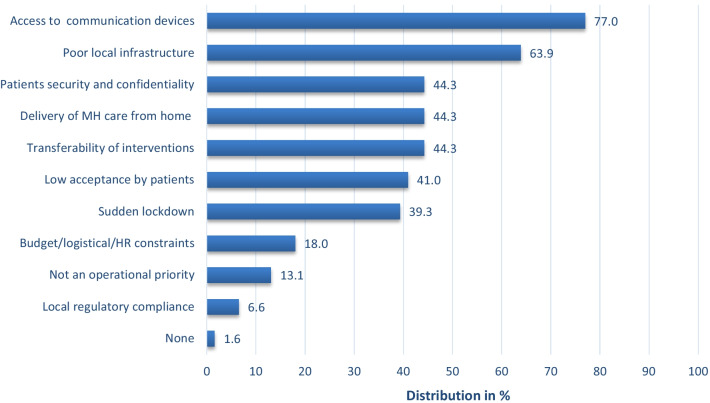
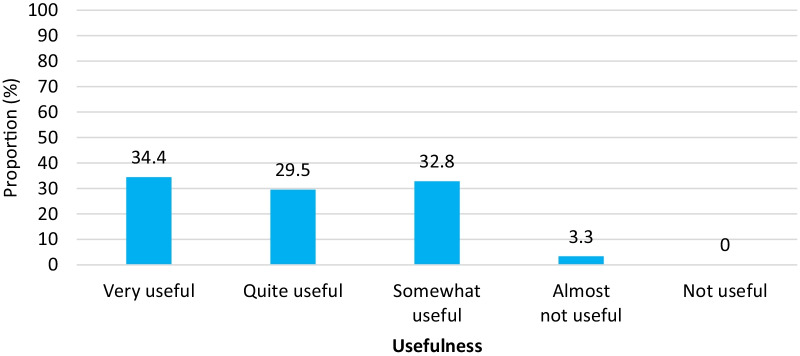
Respondents in 44 countries (6 geographic regions), mostly from Sub-Saharan Africa (39.5%), the Middle East and North Africa (18.5%) and Asia (13.6%) participated. Most tele-MH interventions depended on audio-only platforms (80%). 30% of respondents reported that more than half of their patients were unreachable using these interventions, usually because of poor network coverage (73.8%), a lack of communication devices (72.1%), or a lack of a private space at home (67.2%). Nearly half (47.5%) of respondents felt their staff had a decreased ability to provide comprehensive MH care using telecommunication platforms. Most respondents thought MH staff had a negative (46%) or mixed (42%) impression of remote care. Nevertheless, almost all respondents (96.7%) thought tele-MH services had some degree of usefulness, notably improved access to care (37.7%) and time efficiency (32.8%). Qualitative results outlined a myriad of challenges, notably in establishing therapeutic alliance, providing care for vulnerable populations and those inherent to the communications infrastructure.
Tele-MH services were perceived to be a feasible alternative solution to in-person therapeutic interventions in humanitarian settings during the COVID-19 pandemic. However, they were not considered suitable for all patients in the contexts studied, especially survivors of sexual or interpersonal violence, pediatric and geriatric cases, and patients with severe MH conditions. Audio-only technologies that lacked non-verbal cues were particularly challenging and made risk assessment and emergency care more difficult. Prior to considering tele-MH services, communications infrastructure should be assessed, and comprehensive, context-specific protocols should be developed.
“远程心理健康(MH)服务”是在资源匮乏地区向服务不足群体扩大护理范围的一种日益重要的方式。为了在与COVID-19相关的行动限制期间继续提供精神病学、心理治疗和咨询护理,人道主义医疗组织无国界医生组织(MSF)突然将其在人道主义和资源受限环境中的部分MH活动转变为远程形式。
2020年6月至7月,研究人员采用混合方法、序列解释性研究设计来评估无国界医生组织工作人员对远程MH服务的看法。初步定量结果影响定性问题指南的设计。收集了81份定量在线问卷,并进行了13次定性后续深入访谈。
来自44个国家(6个地理区域)的受访者参与了调查,其中大多数来自撒哈拉以南非洲(39.5%)、中东和北非(18.5%)以及亚洲(13.6%)。大多数远程MH干预依赖于仅音频平台(80%)。30%的受访者报告说,使用这些干预措施无法联系到超过一半的患者,通常是因为网络覆盖差(73.8%)、缺乏通信设备(72.1%)或家中缺乏私人空间(67.2%)。近一半(47.5%)的受访者认为他们的工作人员使用电信平台提供全面MH护理的能力有所下降。大多数受访者认为MH工作人员对远程护理的印象为负面(46%)或好坏参半(42%)。然而,几乎所有受访者(96.7%)都认为远程MH服务有一定程度的用处,特别是改善了护理可及性(37.7%)和时间效率(32.8%)。定性结果概述了众多挑战,特别是在建立治疗联盟方面,为弱势群体以及通信基础设施固有的挑战提供护理。
在COVID-19大流行期间,远程MH服务被认为是人道主义环境中面对面治疗干预的可行替代解决方案。然而,在所研究的背景下,它们并不被认为适用于所有患者,特别是性暴力或人际暴力幸存者、儿科和老年病例以及患有严重MH疾病的患者。缺乏非语言线索的仅音频技术尤其具有挑战性,使风险评估和紧急护理更加困难。在考虑远程MH服务之前,应评估通信基础设施,并制定全面的、针对具体情况的协议。