Mathis-Edenhofer Stefan, Röthlin Florian, Wachabauer David, Haneef Romana, Ventura Ilana, Fülöp Gerhard
The Austrian National Public Health Institute (Gesundheit Österreich GmbH, GÖG), Stubenring 6, 1010, Vienna, Austria.
Department of Non-Communicable Diseases and Injuries, Santé Publique France, 12 rue du Val d'Osne, 94415, Saint-Maurice, France.
Arch Public Health. 2022 Feb 14;80(1):50. doi: 10.1186/s13690-022-00821-6.
The recent Austrian Primary Care Act established new primary health care units (PHCUs) and obliged them to draw up a "care strategy" specifying their focal care tasks and objectives and emphasizing the health care needs of the population in their catchment area with its specific local health and epidemiological profile. The main purpose of these care strategies is thus to ensure that care-providers meet the local needs, but they also provide a rationale for evaluation and organizational development. To assist new PHCUs in establishing care strategies it was necessary to develop a method for automatically generating comprehensive local case studies for any freely definable location in Austria.
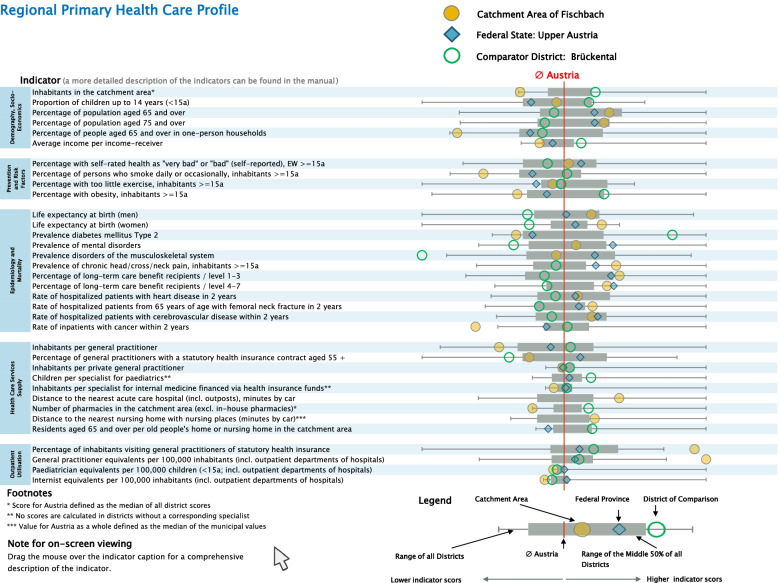
We designed an interactive report generator capable of producing location-specific regional health care profiles for a PHCU located in any of Austria's 2122 municipalities and of calculating the radius of its catchment area (defined by different levels of maximum car-travelling times). The reports so generated, called "regional health care profiles for primary health care" (RHCPs/PHC), are in comprehensive PDF report format. The core of each report is a set of 35 indicators, classified under five health and health service domains. The reports include an introductory text, definitions, a map, a graphic and tabular presentation of all indicator values, including information on local, supra-regional and national value distribution, a ranking, and numbers of service providers (e.g. pharmacies, surgeries, nursing homes) located within the catchment area.
The RHCPs/PHC support primary health care planning, efforts to improve care-effectiveness, and strategic organizational development by providing comprehensive information on the health of the population, the utilization of health services and the health care structures within the catchment area. In addition to revealing the scope and nature of the health care needed, they also provide information on what public health approaches are necessary. RHCPs/PHC for different locations have already been distributed to numerous stakeholders and primary health care providers in Austria.
奥地利最近颁布的《初级保健法》设立了新的初级卫生保健单位(PHCU),并要求它们制定“护理策略”,明确其重点护理任务和目标,并根据其特定的当地健康和流行病学特征,强调其服务区域内人群的医疗保健需求。因此,这些护理策略的主要目的是确保护理提供者满足当地需求,但它们也为评估和组织发展提供了依据。为了帮助新的初级卫生保健单位制定护理策略,有必要开发一种方法,以便为奥地利任何可自由定义的地点自动生成全面的当地案例研究。
我们设计了一个交互式报告生成器,它能够为奥地利2122个市镇中任何一个的初级卫生保健单位生成特定地点的区域医疗保健概况,并计算其服务区域半径(由不同级别的最大驾车出行时间定义)。生成的报告称为“初级卫生保健区域医疗保健概况”(RHCPs/PHC),采用全面的PDF报告格式。每份报告的核心是一组35项指标,分为五个健康和卫生服务领域。报告包括引言、定义、地图、所有指标值的图形和表格展示,包括关于当地、区域以上和国家值分布的信息、排名以及服务区域内的服务提供者数量(如药店、诊所、疗养院)。
RHCPs/PHC通过提供关于服务区域内人口健康、卫生服务利用和医疗保健结构的全面信息,支持初级卫生保健规划、提高护理效果的努力以及战略组织发展。除了揭示所需医疗保健的范围和性质外,它们还提供了关于哪些公共卫生方法是必要的信息。不同地点的RHCPs/PHC已经分发给奥地利的众多利益相关者和初级卫生保健提供者。