School of Medicine, Keele University, Newcastle under Lyme, ST5 5BG, UK.
MRC Versus Arthritis Centre for Musculoskeletal Health and Work, University of Southampton, Southampton, SO17 1BJ, UK.
Sci Rep. 2022 Feb 14;12(1):2408. doi: 10.1038/s41598-022-06490-3.
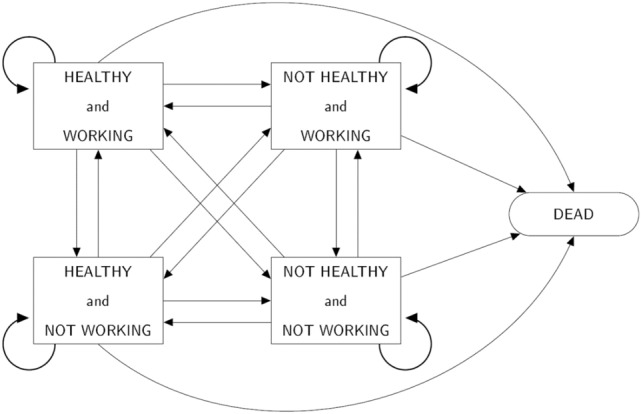
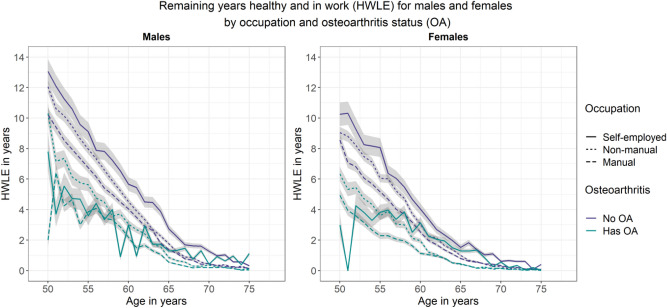
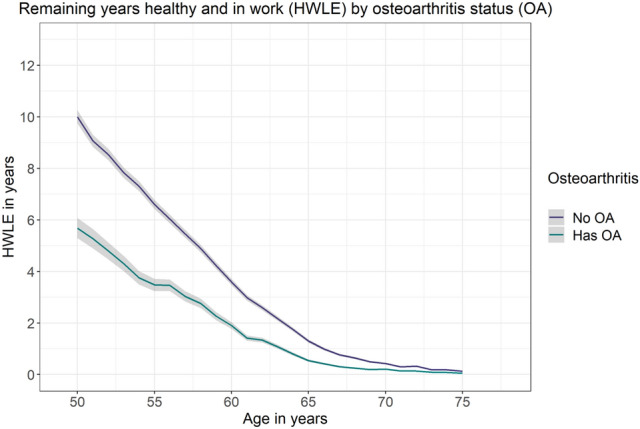
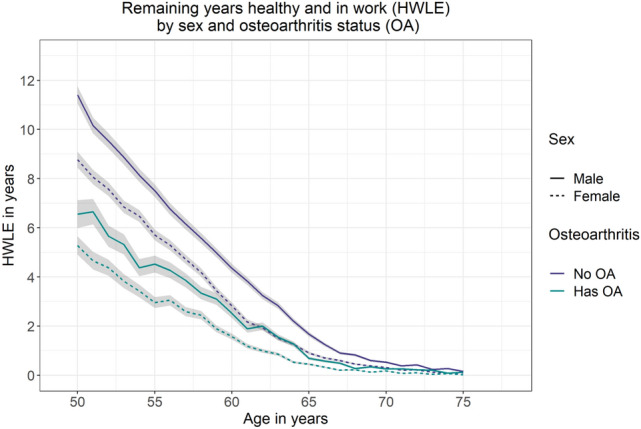
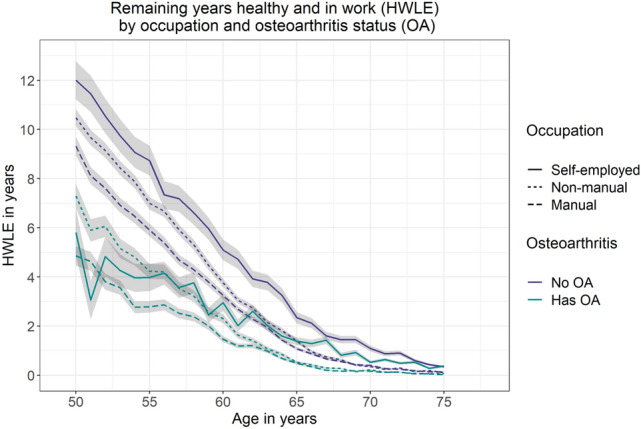
Retirement ages are rising in many countries to offset the challenges of population ageing, but osteoarthritis is an age-associated disease that is becoming more prevalent and may limit capacity to work until older ages. We aimed to assess the impact of osteoarthritis on healthy working life expectancy (HWLE) by comparing HWLE for people with and without osteoarthritis from ages 50 and 65 nationally and in a local area in England. Mortality-linked data for adults aged ≥ 50 years were used from six waves (2002-13) of the English Longitudinal Study of Ageing and from three time points of the North Staffordshire Osteoarthritis Project. HWLE was defined as the average number of years expected to be spent healthy (no limiting long-standing illness) and in paid work (employment or self-employment), and was estimated for people with and without osteoarthritis and by sex and occupation type using interpolated Markov chain multi-state modelling. HWLE from age 50 years was a third lower for people with osteoarthritis compared to people without osteoarthritis both nationally (5.68 95% CI [5.29, 6.07] years compared to 10.00 [9.74, 10.26]) and in North Staffordshire (4.31 [3.68, 4.94] years compared to 6.90 [6.57, 7.24]). HWLE from age 65 years for self-employed people with osteoarthritis exceeded HWLE for people without osteoarthritis in manual or non-manual occupations. Osteoarthritis was associated with a significantly shorter HWLE. People with osteoarthritis are likely to have significantly impaired working ability and capacity to work until older ages, especially in regions with poorer health and work outcomes.
许多国家正在提高退休年龄,以应对人口老龄化带来的挑战,但骨关节炎是一种与年龄相关的疾病,其发病率正变得越来越高,并可能限制人们在老年时的工作能力。我们旨在通过比较全国范围内和英格兰一个地区 50 岁和 65 岁人群中有无骨关节炎的人健康工作预期寿命(HWLE),评估骨关节炎对 HWLE 的影响。使用来自六个波次(2002-13 年)的英国老龄化纵向研究和北斯塔福德郡骨关节炎项目三个时间点的≥50 岁成年人的与死亡率相关的数据。HWLE 被定义为预计在健康状态(无长期限制疾病)和有偿工作(受雇或自营职业)中度过的平均年数,通过插补马尔可夫链多状态模型,根据性别和职业类型,对有和没有骨关节炎的人进行估计。在全国范围内(骨关节炎患者为 5.68 [5.29, 6.07] 年,无骨关节炎患者为 10.00 [9.74, 10.26] 年)和在北斯塔福德郡(骨关节炎患者为 4.31 [3.68, 4.94] 年,无骨关节炎患者为 6.90 [6.57, 7.24] 年),与无骨关节炎的人相比,50 岁时患有骨关节炎的人的 HWLE 低三分之一。对于自雇人员,有骨关节炎的人从 65 岁开始的 HWLE 超过了从事体力或非体力劳动的人无骨关节炎的 HWLE。骨关节炎与 HWLE 显著缩短显著相关。患有骨关节炎的人可能工作能力和工作能力显著受损,直到老年,尤其是在健康和工作结果较差的地区。