Kim Chi-Son, Akers Aletha, Muraleetharan Daenuka, Skolnik Ava, Garney Whitney, Wilson Kelly, Rao Aditi Sameer, Li Yan
Department of Obstetrics and Gynecology, Stamford Hospital, Stamford, CT, United States.
Vice President for Research, The Guttmacher Institute, New York, NY, United States.
Prev Med Rep. 2022 Jan 29;26:101716. doi: 10.1016/j.pmedr.2022.101716. eCollection 2022 Apr.
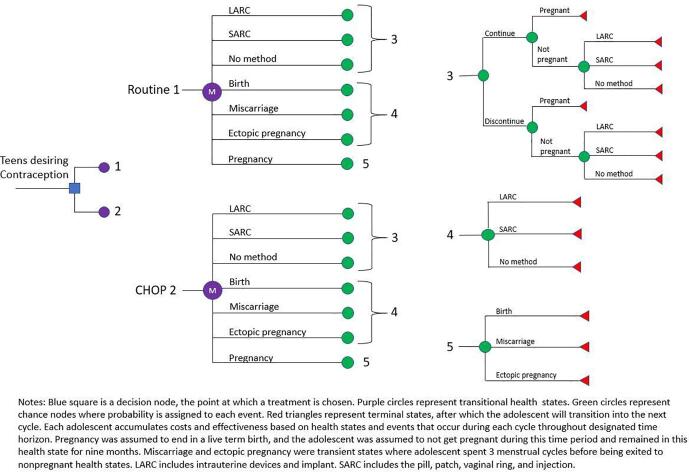
Teenage pregnancy is an important public health issue in the United States, presenting significant health and economic risks to adolescents and the society. Health coaching is a potentially effective intervention in preventing teen pregnancy. In 2017, the Children's Hospital of Philadelphia implemented a health coaching program among sexually active teenage girls, which improved their contraceptive continuation rates. However, the cost-effectiveness of the health coaching program is not clear. We developed a microsimulation model of teen pregnancy that can predict the number of teen pregnancies and related birth outcomes. Model parameters were estimated from the literature and the health coaching program. The teen pregnancy model was used to assess how the program could influence direct health care costs and pregnancy outcomes. Our model projected that the health coaching program could prevent 15 teen pregnancies per 1000 adolescents compared to no intervention. The incremental cost-effectiveness ratio (ICER) for the intervention was $309 per pregnancy prevented, which was less than the willingness-to-pay threshold of $4,206 per pregnancy. Thus, the health coaching intervention was cost-effective. Our study provides promising data on the effectiveness and cost-effectiveness of a health coaching intervention to reduce the burden of teen pregnancies. Health practitioners should consider implementing the program for a longer term and at a larger scale.
青少年怀孕是美国一个重要的公共卫生问题,给青少年及其所在社会带来了重大的健康和经济风险。健康指导是预防青少年怀孕的一种潜在有效干预措施。2017年,费城儿童医院在有性活动的少女中实施了一项健康指导计划,该计划提高了她们的避孕措施持续使用率。然而,该健康指导计划的成本效益尚不清楚。我们开发了一个青少年怀孕微观模拟模型,该模型可以预测青少年怀孕的数量及相关生育结果。模型参数是根据文献和该健康指导计划估算得出的。青少年怀孕模型用于评估该计划如何影响直接医疗保健成本和怀孕结果。我们的模型预测,与不进行干预相比,该健康指导计划每1000名青少年中可预防15例青少年怀孕。该干预措施的增量成本效益比(ICER)为每预防一例怀孕309美元,低于每例怀孕4206美元的支付意愿阈值。因此,健康指导干预措施具有成本效益。我们的研究为健康指导干预措施减少青少年怀孕负担的有效性和成本效益提供了有前景的数据。健康从业者应考虑长期且大规模地实施该计划。