Facebook AI Research, Paris, France.
Université Paris-Saclay, Inria, CEA, Palaiseau, France.
Commun Biol. 2022 Feb 16;5(1):134. doi: 10.1038/s42003-022-03036-1.
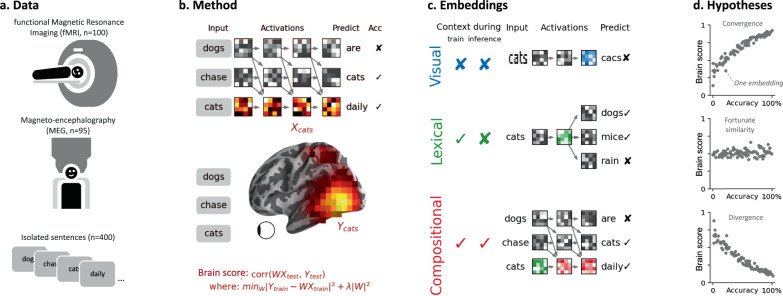
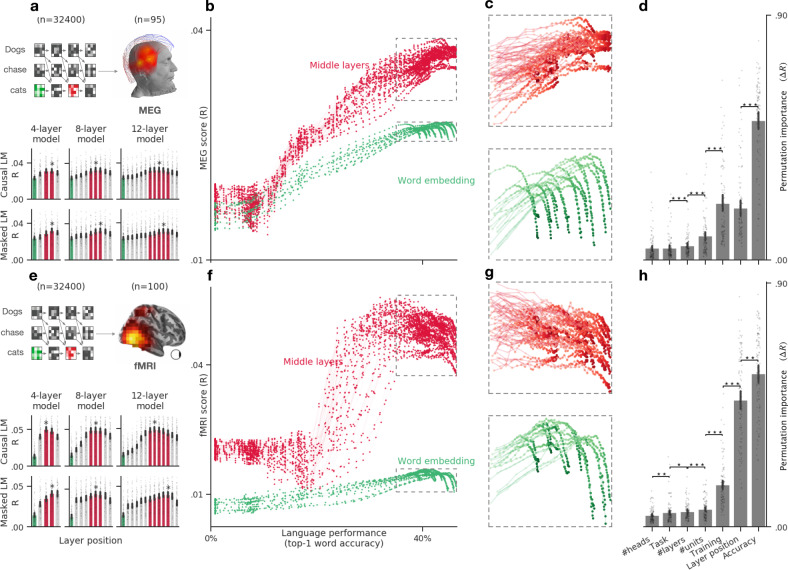
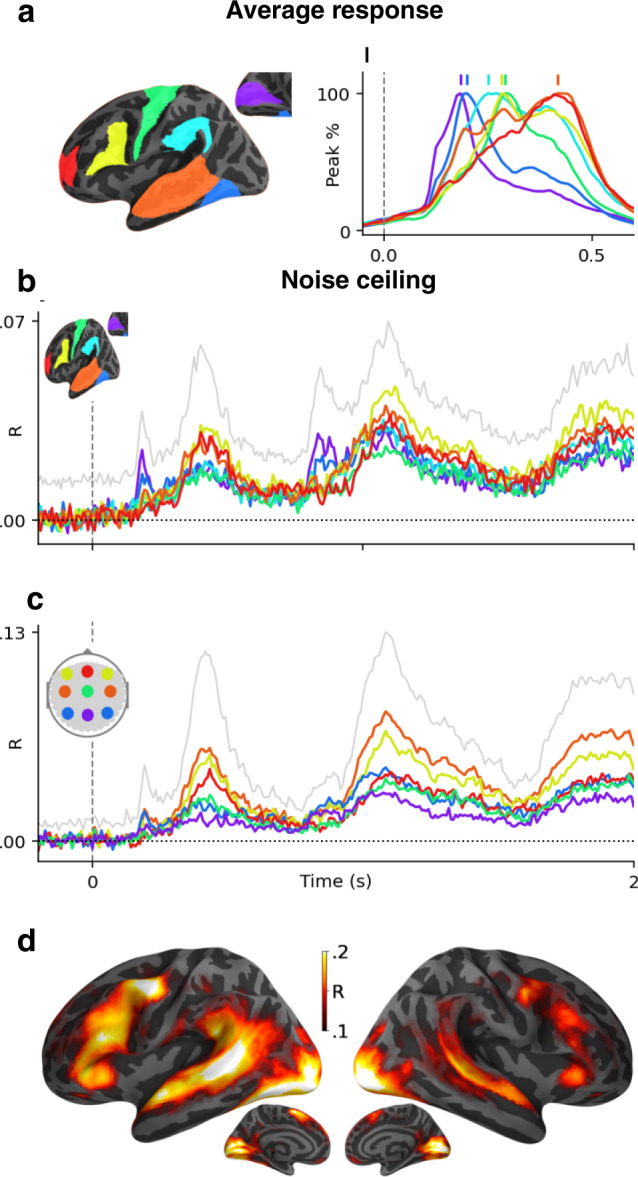
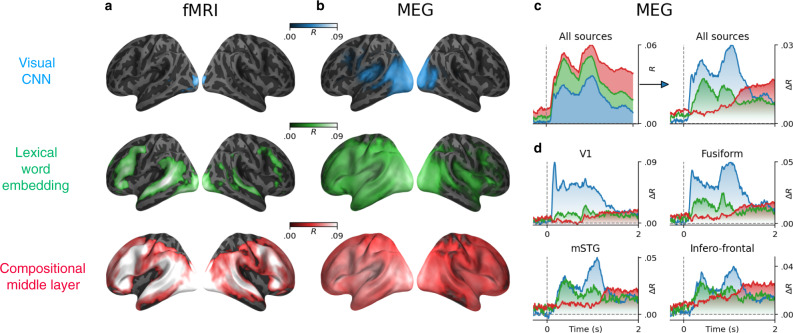
Deep learning algorithms trained to predict masked words from large amount of text have recently been shown to generate activations similar to those of the human brain. However, what drives this similarity remains currently unknown. Here, we systematically compare a variety of deep language models to identify the computational principles that lead them to generate brain-like representations of sentences. Specifically, we analyze the brain responses to 400 isolated sentences in a large cohort of 102 subjects, each recorded for two hours with functional magnetic resonance imaging (fMRI) and magnetoencephalography (MEG). We then test where and when each of these algorithms maps onto the brain responses. Finally, we estimate how the architecture, training, and performance of these models independently account for the generation of brain-like representations. Our analyses reveal two main findings. First, the similarity between the algorithms and the brain primarily depends on their ability to predict words from context. Second, this similarity reveals the rise and maintenance of perceptual, lexical, and compositional representations within each cortical region. Overall, this study shows that modern language algorithms partially converge towards brain-like solutions, and thus delineates a promising path to unravel the foundations of natural language processing.
最近的研究表明,经过大量文本训练的深度学习算法可以生成与人类大脑相似的激活模式。然而,目前尚不清楚是什么驱动了这种相似性。在这里,我们系统地比较了各种深度语言模型,以确定导致它们生成类似大脑的句子表示的计算原理。具体来说,我们分析了 102 名受试者中 400 个孤立句子的大脑反应,每个句子都使用功能磁共振成像 (fMRI) 和脑磁图 (MEG) 记录了两个小时。然后,我们测试这些算法中的每一个在何时何地映射到大脑反应上。最后,我们估计这些模型的架构、训练和性能如何独立解释大脑样表示的生成。我们的分析揭示了两个主要发现。首先,算法与大脑之间的相似性主要取决于它们从上下文预测单词的能力。其次,这种相似性揭示了每个皮质区域内感知、词汇和组合表示的出现和维持。总的来说,这项研究表明,现代语言算法部分趋向于类似大脑的解决方案,因此为揭示自然语言处理的基础提供了一条有前途的途径。