Lum Danny, Comfort Paul, Barbosa Tiago M, Balasekaran Govindasamy
Sport Science and Sport Medicine, Singapore Sport Institute, Singapore, Singapore.
Physical Education and Sports Science, National Institute of Education, Nanyang Technological University, Singapore, Singapore.
Biol Sport. 2022 Jan;39(1):189-197. doi: 10.5114/biolsport.2022.103575. Epub 2021 Mar 7.
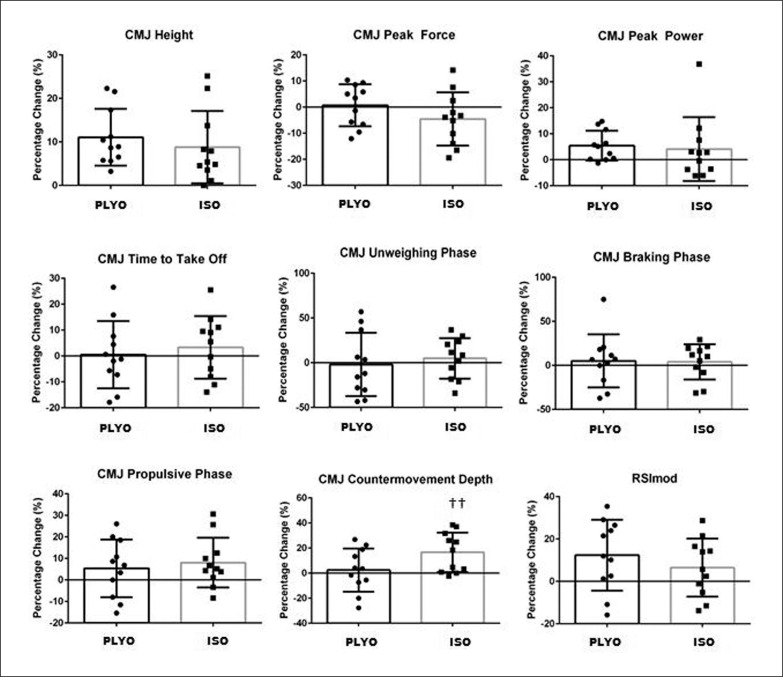
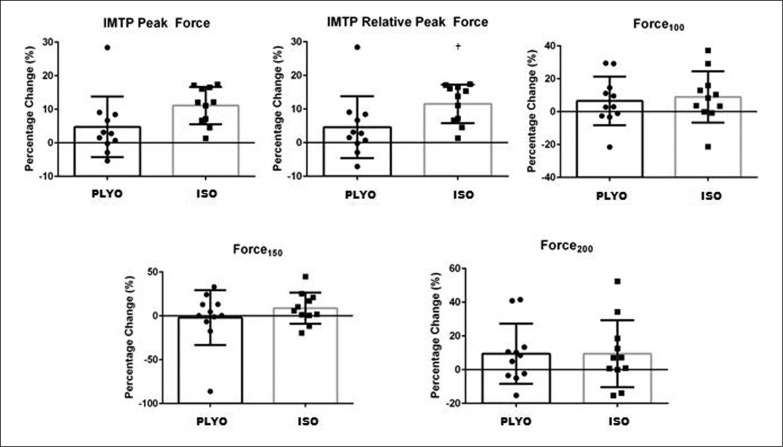
The purpose of the study was to compare the change in dynamic and isometric force-time characteristics after plyometric (PLYO) or isometric strength training (ISO). Twenty-two endurance runners (age = 37 ± 6 years, stature = 1.71 ± 0.05 m, body mass = 62.7 ± 8.6 kg, weekly mileage = 47.3 ± 10.8 km) performed a countermovement jump (CMJ) and isometric mid-thigh pull (IMTP) test during pre- and post-tests. They were then randomly assigned to either PLYO or ISO group and completed 12 sessions of intervention over six weeks. The PLYO included drop jump, single leg bounding and split jump, and the ISO included IMTP and isometric ankle plantar flexion. Significant and large time x group interactions were observed for CMJ countermovement depth ( = 0.037, ƞ² = 0.21) and IMTP and relative peak force (PF) ( = 0.030, ƞ = 0.22). Significant and large main effects for time were observed in CMJ height, peak power, propulsive phase duration, countermovement depth, reactive strength index modified, IMTP PF and relative PF ( < 0.05, 0.20 ≤ ƞ² ≤ 0.65). Effect for time showed small improvement in CMJ height for both PLYO ( < 0.001, = 0.48) and ISO ( = 0.009, = 0.47), small improvement in CMJ PP in PLYO ( = 0.020, = 0.21), large increase in countermovement depth ( = 0.004, = 1.02) and IMTP relative PF ( < 0.001, = 0.87), and moderate increase in propulsive phase duration ( = 0.038, = 0.65) and IMTP PF ( < 0.001, = 0.55) in ISO. There were large differences between groups for percentage change in countermovement depth ( = 0.003, = 0.96) and IMTP relative PF ( = 0.047, = 0.90). In conclusion, both PLYO and ISO improved CMJ jump height via different mechanisms, while only ISO resulted in improved IMTP PF and relative PF.
本研究的目的是比较增强式训练(PLYO)或等长力量训练(ISO)后动态和等长力-时间特征的变化。22名耐力跑者(年龄=37±6岁,身高=1.71±0.05米,体重=62.7±8.6千克,每周里程数=47.3±10.8千米)在测试前和测试后进行了反向纵跳(CMJ)和等长大腿中部拉力(IMTP)测试。然后他们被随机分配到PLYO组或ISO组,并在六周内完成12次干预课程。PLYO训练包括跳深、单腿跳和分腿跳,ISO训练包括IMTP和等长踝关节跖屈。观察到CMJ反向运动深度(=0.037,ƞ²=0.21)、IMTP和相对峰值力(PF)(=0.030,ƞ=0.22)存在显著且较大的时间×组交互作用。在CMJ高度、峰值功率、推进阶段持续时间、反向运动深度、改良反应力量指数、IMTP PF和相对PF方面观察到时间的显著且较大的主效应(<0.05,0.20≤ƞ²≤0.65)。时间效应显示,PLYO组(<0.001,=0.48)和ISO组(=0.009,=0.47)的CMJ高度均有小幅提高,PLYO组的CMJ峰值功率有小幅提高(=0.020,=0.21),反向运动深度(=0.004,=1.02)和IMTP相对PF(<0.001,=0.87)有大幅增加,ISO组的推进阶段持续时间(=0.038,=0.65)和IMTP PF(<0.001,=0.55)有中度增加。反向运动深度的百分比变化(=0.003,=0.96)和IMTP相对PF(=0.047,=0.90)在组间存在较大差异。总之,PLYO和ISO均通过不同机制提高了CMJ跳跃高度,而只有ISO导致IMTP PF和相对PF提高。