Patzer E J, Nakamura G R, Simonsen C C, Levinson A D, Brands R
J Virol. 1986 Jun;58(3):884-92. doi: 10.1128/JVI.58.3.884-892.1986.
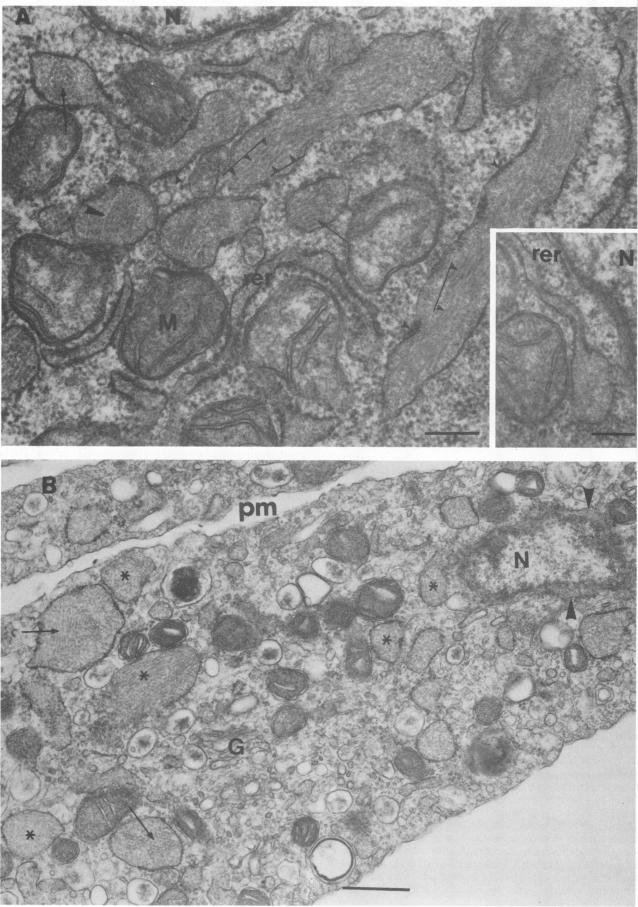
Hepatitis B surface antigen (HBsAg) particles are secreted by Chinese hamster ovary cells that are stably transfected with the S gene of hepatitis B virus. The assembly of HBsAg into cylindrical and spherical particles occurred intracellularly within the endoplasmic reticulum. HBsAg particles accumulated within large dilated areas of the endoplasmic reticulum and remained within these structures for most of the time prior to secretion from the cells. Once the particles were formed, the HBsAg polypeptides did not appear to become associated with subsequent intracellular organelle membranes or the plasma membrane. HBsAg within the dilated structures did not bind wheat germ agglutinin, indicating that its oligosaccharide chains had not yet been processed to the complex form (containing terminal sialic acid-N-acetylglucosamine residues). The oligosaccharide chains of HBsAg are processed to the complex form and can be detected on the HBsAg after secretion, but this event was not detected within cells. In addition, HBsAg was not observed on the cell surface by indirect immunofluorescence or immunoprecipitation, although immunoelectron microscopy revealed some staining at or near the cell surface. These results suggested that HBsAg was either secreted from cells without being incorporated into the plasma membrane, or that the levels of HBsAg in the plasma membrane were below the limits of detection.
乙肝表面抗原(HBsAg)颗粒由稳定转染乙肝病毒S基因的中国仓鼠卵巢细胞分泌。HBsAg在内质网内于细胞内组装成圆柱形和球形颗粒。HBsAg颗粒在内质网的大扩张区域内积累,并在从细胞分泌之前的大部分时间内保留在这些结构中。一旦颗粒形成,HBsAg多肽似乎不会与随后的细胞内膜或质膜结合。扩张结构内的HBsAg不与麦胚凝集素结合,表明其寡糖链尚未加工成复杂形式(含有末端唾液酸-N-乙酰葡糖胺残基)。HBsAg的寡糖链被加工成复杂形式,分泌后可在HBsAg上检测到,但在细胞内未检测到这一事件。此外,尽管免疫电子显微镜显示在细胞表面或其附近有一些染色,但通过间接免疫荧光或免疫沉淀在细胞表面未观察到HBsAg。这些结果表明,HBsAg要么在不整合到质膜的情况下从细胞中分泌出来,要么质膜中HBsAg的水平低于检测限。