Clinic for Gastroenterology, Hepatology and Infectious Diseases, University Hospital Düsseldorf, Medical Faculty of Heinrich Heine University Düsseldorf, Moorenstraße 5, 40225, Düsseldorf, Germany.
Internal Medicine I, Central Hospital Bremerhaven, Bremerhaven, Germany.
Sci Rep. 2022 Feb 17;12(1):2670. doi: 10.1038/s41598-022-06618-5.
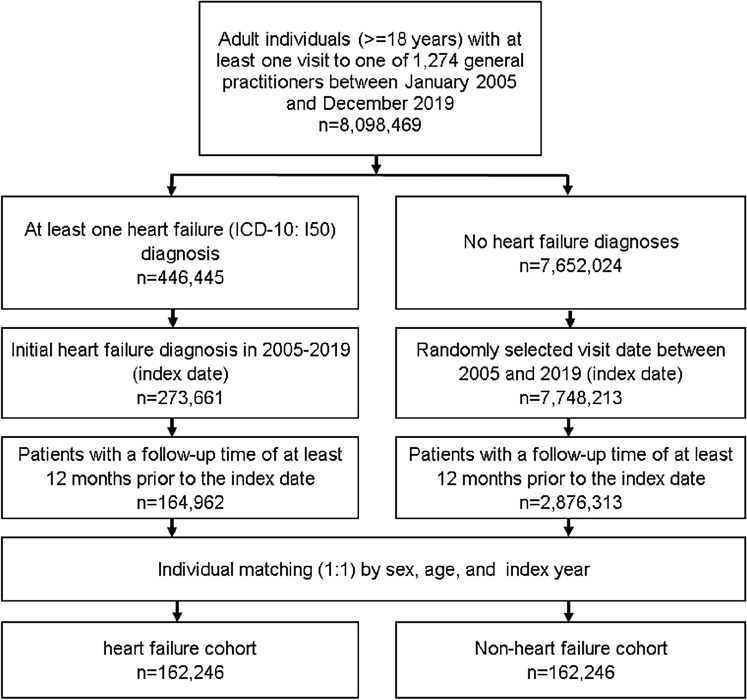
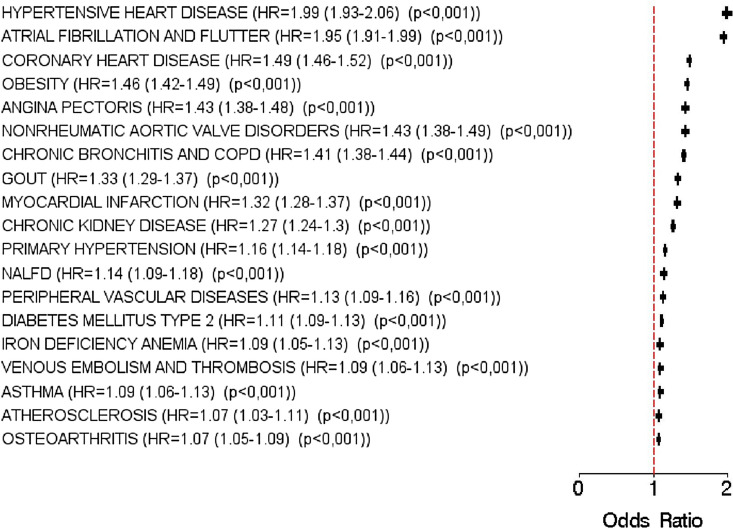
The prognosis of heart failure (HF) patients is determined to a decisive extent by comorbidities. The present study investigates the association between a broad spectrum of diseases and the occurrence of HF in a large collective of outpatients. This retrospective case control study assessed the prevalence of 37 cardiac and extracardiac diseases in patients with an initial diagnosis of heart failure (ICD-10: I50) in 1,274 general practices in Germany between January 2005 and December 2019. The study is based on the Disease Analyzer database (IQVIA), which contains drug prescriptions, diagnoses, and basic medical and demographic data. Patients with and without heart failure were matched by sex, age, and index year. Hazard regression models were conducted to evaluate the association between different disease entities and heart failure. The present study included 162,246 patients with heart failure and 162,246 patients without heart failure. Mean age [SD] was 73.7 [12.1] years; 52.6% were women. Out of 37 predefined diagnoses, 36 were more prevalent in HF patients. The highest prevalence was primary hypertension (63.4% in HF patients vs. 53.3% in controls, p < 0.001) followed by lipid metabolism disorders (34.6% in HF patients vs. 29.1% in HF patients p < 0.001) and diabetes mellitus type II (32.2% in HF patients vs. 25.2% in controls, p < 0.001). In the regression analysis, 19 diseases were significantly associated with heart failure. Non-cardiovascular diagnoses strongly associated with HF were obesity (HR = 1.46), chronic bronchitis and COPD (HR = 1.41), gout (HR: 1.41), and chronic kidney disease (HR = 1.27). In the present study, we identified a variety of cardiac and extracardiac diseases associated with heart failure. Our data underscore the immense importance of comorbidities, even as early as at the stage of initial diagnosis of heart failure.
心力衰竭(HF)患者的预后在很大程度上取决于合并症。本研究调查了广泛的疾病与大量门诊患者 HF 发生之间的关联。本回顾性病例对照研究评估了 2005 年 1 月至 2019 年 12 月期间德国 1274 家普通诊所中初始诊断为心力衰竭(ICD-10:I50)的患者中 37 种心脏和心脏外疾病的患病率。该研究基于包含药物处方、诊断以及基本医疗和人口统计数据的疾病分析器数据库(IQVIA)。心力衰竭患者和无心力衰竭患者按性别、年龄和索引年进行匹配。使用风险回归模型评估不同疾病实体与心力衰竭之间的关联。本研究包括 162246 例心力衰竭患者和 162246 例无心力衰竭患者。平均年龄[标准差]为 73.7[12.1]岁;52.6%为女性。在 37 种预先定义的诊断中,有 36 种在心力衰竭患者中更为常见。患病率最高的是原发性高血压(心力衰竭患者中为 63.4%,对照组中为 53.3%,p<0.001),其次是脂质代谢紊乱(心力衰竭患者中为 34.6%,对照组中为 29.1%,p<0.001)和 II 型糖尿病(心力衰竭患者中为 32.2%,对照组中为 25.2%,p<0.001)。在回归分析中,有 19 种疾病与心力衰竭显著相关。与心力衰竭强烈相关的非心血管诊断包括肥胖症(HR=1.46)、慢性支气管炎和 COPD(HR=1.41)、痛风(HR:1.41)和慢性肾脏病(HR=1.27)。在本研究中,我们确定了多种与心力衰竭相关的心脏和心脏外疾病。我们的数据强调了合并症的重要性,即使在心力衰竭的初始诊断阶段也是如此。