Ji Peng, Li Hongyuan, Jin Yushan, Peng Yinghua, Zhao Lihui, Wang Xiaohui
College of Life Science and Technology, Changchun University of Science and Technology, Changchun, China.
Laboratory of Chemical Biology, Changchun Institute of Applied Chemistry (CIAC), Chinese Academy of Sciences (CAS), Changchun, China.
PeerJ. 2022 Feb 1;10:e12866. doi: 10.7717/peerj.12866. eCollection 2022.
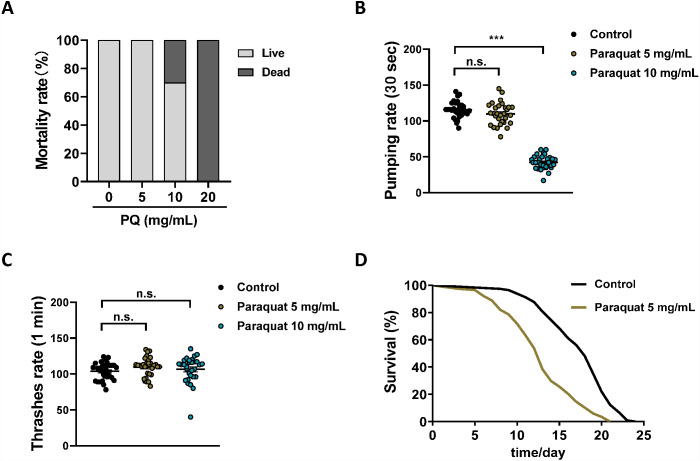
Paraquat (PQ) is an effective and widely used herbicide and causes numerous fatalities by accidental or voluntary ingestion. However, neither the final cytotoxic mechanism nor effective treatments for PQ poisoning have been discovered. Phenotypic drug discovery (PDD), which does not rely on the molecular mechanism of the diseases, is having a renaissance in recent years owing to its potential to address the incompletely understood complexity of diseases. Herein, the PDD model was established to pave the way for the future phenotypic discovery of potential agents for treating PQ poisoning.
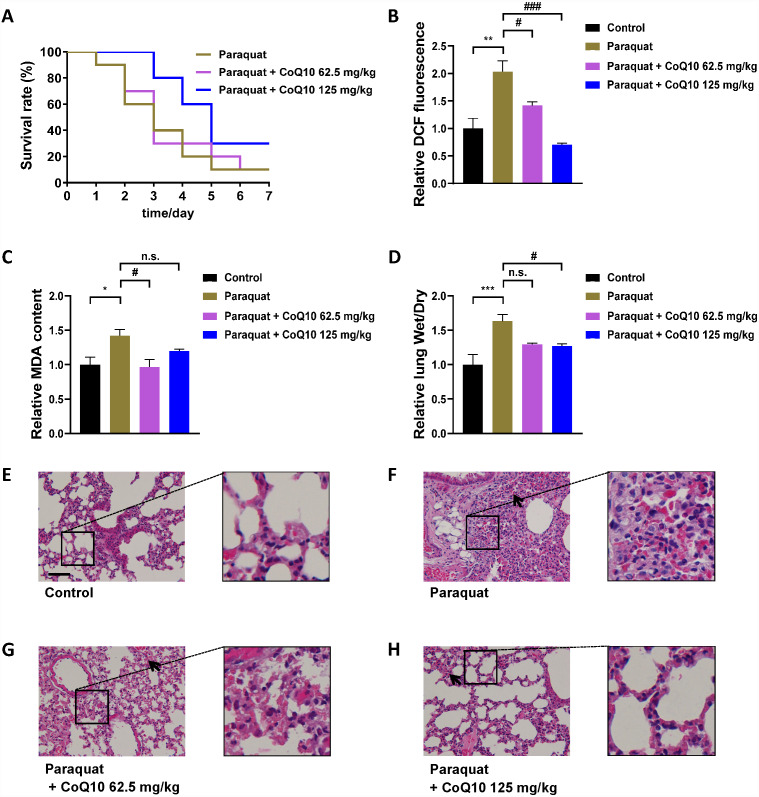
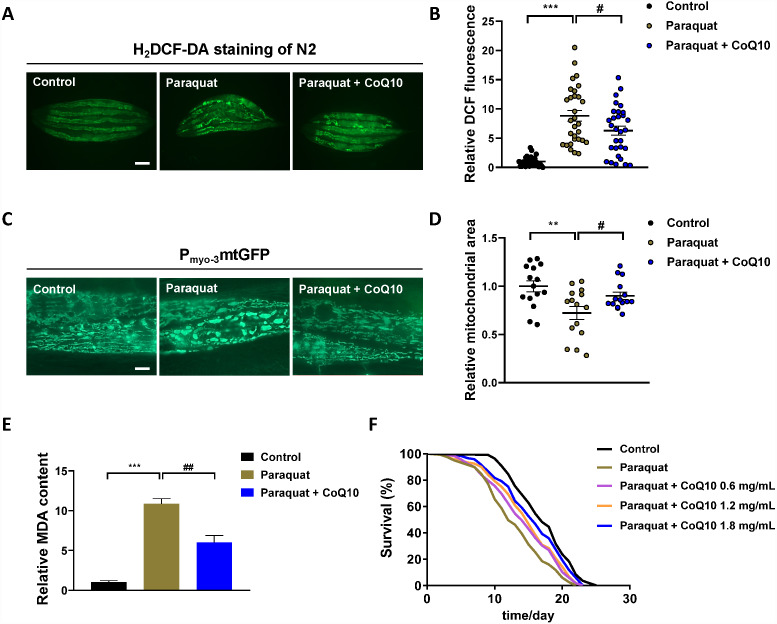
were treated with PQ-containing solid medium followed by statistical analysis of worm survival, pharyngeal pumping, and movement ability. Furthermore, coenzyme Q10 (CoQ10) was used to test the model of PQ poisoning by measuring the levels of reactive oxygen species (ROS) and malondialdehyde (MDA), mitochondrial morphology, and worm survival rate. Additionally, we used the classic mice model of PQ intoxication to evaluate the validity of the model of PQ poisoning by measuring the effect of CoQ10 as a potential antidote for PQ poisoning.
In the model of PQ poisoning, 5 mg/mL PQ increased the levels of ROS, MDA content, mitochondrial fragments, which significantly shortened the lifespan, while CoQ10 alleviated these phenotypes. In the mice model of PQ poisoning, CoQ10 increased the chance of survival in PQ poisoned mice while reducing ROS, MDA content in lung tissue and inhibiting PQ-induced lung edema. Moreover, CoQ10 alleviated the lung morphopathological changes induced by PQ.
Here we established a model of PQ poisoning, whose validity was confirmed by the classic mice model of PQ intoxication.
百草枯(PQ)是一种广泛使用的有效除草剂,可因意外或故意摄入导致众多死亡。然而,尚未发现PQ中毒的最终细胞毒性机制和有效治疗方法。表型药物发现(PDD)不依赖于疾病的分子机制,由于其有潜力解决对疾病理解不完全的复杂性问题,近年来正在复兴。在此,建立了PDD模型,为未来表型发现治疗PQ中毒的潜在药物铺平道路。
用含PQ的固体培养基处理,随后对蠕虫的存活、咽部抽动和运动能力进行统计分析。此外,通过测量活性氧(ROS)和丙二醛(MDA)水平、线粒体形态和蠕虫存活率,使用辅酶Q10(CoQ10)来测试PQ中毒模型。另外,我们使用经典的PQ中毒小鼠模型,通过测量CoQ10作为PQ中毒潜在解毒剂的效果来评估PQ中毒模型的有效性。
在PQ中毒模型中,5mg/mL的PQ增加了ROS水平、MDA含量和线粒体片段,显著缩短了寿命,而CoQ10减轻了这些表型。在PQ中毒小鼠模型中,CoQ10增加了PQ中毒小鼠的存活机会,同时降低了肺组织中的ROS、MDA含量,并抑制了PQ诱导的肺水肿。此外,CoQ10减轻了PQ诱导的肺形态病理学变化。
在此我们建立了一个PQ中毒模型,其有效性通过经典的PQ中毒小鼠模型得到证实。