Klinik und Hochschulambulanz für Neurologie, Charité - Universitätsmedizin Berlin, Corporate Member of Freie Universität Berlin, Humboldt-Universität zu Berlin, and Berlin Institute of Health (BIH), Berlin, Germany.
German Center for Neurodegenerative Diseases (DZNE), Partner Site Berlin, Berlin, Germany.
J Neurol. 2022 Jul;269(7):3745-3751. doi: 10.1007/s00415-022-11001-5. Epub 2022 Feb 19.
Myocardial injury as indicated by cardiac troponin elevation is associated with poor prognosis in acute stroke patients. Coronary angiography (CAG) is the diagnostic gold-standard to rule-out underlying obstructive coronary artery disease (CAD) in these patients. However, weighing risks and benefits of coronary angiography (CAG) against each other is particularly challenging, because stroke patients undergoing CAG may have a higher risk for secondary intracranial bleeding. Current guidelines remain vague. Thus, the aim of this study was to analyze frequency of pathological findings of CAG and associated clinical factors.
We analyzed indications and frequency of CAG performed in acute ischemic stroke patients in clinical routine in two European tertiary care hospitals from 2011 to 2018. All data were obtained retrospectively. Multiple logistic regression analyses were performed to identify variables associated with absence of obstructive coronary artery disease defined as presence of at least one coronary vessel stenosis ≥ 50%.
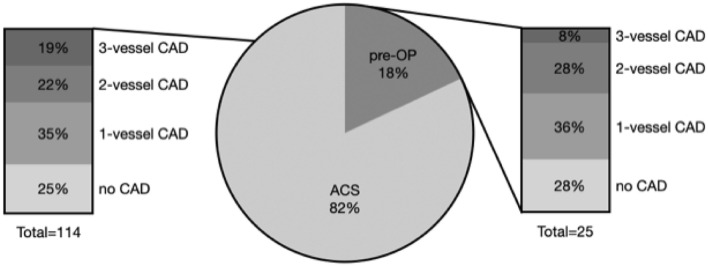
A total of 139 AIS patients underwent CAG. Frequent indications for CAG were suspected acute coronary syndrome (N = 114) or scheduled cardiac surgery (N = 25). Acute coronary stenting was applied in 51/139 patients. Among patients with suspected acute coronary syndrome, no obstructive CAD was found in 27/114 patients. Absence of obstructive CAD was associated with insular cortex lesions, no clinical symptoms for ACS, less than three cardiovascular risk factors, younger age and normal wall motion.
Several variables suggest absence of CAD in AIS patients and may help in clinical decision making in stroke patients with myocardial injury.
肌钙蛋白升高提示心肌损伤与急性脑卒中患者的不良预后相关。冠状动脉造影(CAG)是排除这些患者潜在阻塞性冠状动脉疾病(CAD)的诊断金标准。然而,权衡 CAG 的风险和益处是特别具有挑战性的,因为接受 CAG 的脑卒中患者可能有更高的继发性颅内出血风险。目前的指南仍然模糊不清。因此,本研究旨在分析 CAG 的病理发现频率及其相关临床因素。
我们分析了 2011 年至 2018 年期间两家欧洲三级护理医院急性缺血性脑卒中患者在临床常规中进行 CAG 的指征和频率。所有数据均为回顾性收集。采用多因素逻辑回归分析来确定与无阻塞性冠状动脉疾病(定义为至少一条冠状动脉狭窄≥50%)相关的变量。
共有 139 例 AIS 患者接受了 CAG。CAG 的常见指征为疑似急性冠状动脉综合征(N=114)或计划心脏手术(N=25)。139 例患者中有 51 例行急性冠状动脉支架置入术。在疑似急性冠状动脉综合征的患者中,114 例患者中有 27 例未发现阻塞性 CAD。无阻塞性 CAD 与岛叶皮质病变、无 ACS 临床症状、心血管危险因素少于三个、年龄较小和正常壁运动有关。
几个变量提示 AIS 患者 CAD 缺失,并可能有助于有心肌损伤的脑卒中患者的临床决策。