Satish Shruthi, Perlin David S
Center for Discovery and Innovation, Hackensack Meridian Health, Nutley, NJ, USA.
Microbiol Insights. 2019 Dec 31;12:1178636119897034. doi: 10.1177/1178636119897034. eCollection 2019.
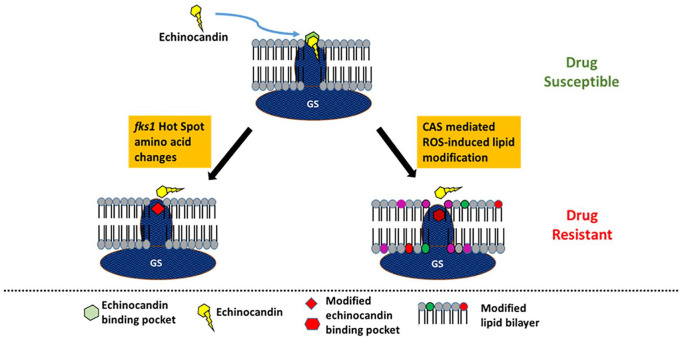
Echinocandin drugs target the fungal enzyme β-(1,3)-glucan synthase (GS), which is required for the synthesis of cell wall component β-(1,3)-d-glucan. They are first-line therapy for infections but are increasingly used as second-line therapy for infections. Resistance to echinocandins has been mainly studied in and occurs due to mutations in genes encoding GS. In our recent report, we identified a novel mechanism of echinocandin resistance in . We showed that caspofungin exposure modifies GS, rendering it insensitive to echinocandins. This mechanism of resistance involved alteration of the GS lipid microenvironment and was mediated via an off-target effect on mitochondria leading to increased reactive oxygen species (ROS). We hypothesized that caspofungin-induced ROS alters the lipid composition around GS, changing its conformation and making it insensitive to echinocandins. In this commentary, we review both dependent and -independent mechanisms of echinocandin resistance in . We believe this new resistance mechanism is also conserved among spp. with implications for drug tolerance and/or resistance. Furthermore, we propose that ROS acts as a signaling molecule regulating lipid biogenesis, which impacts the structure-function of membrane proteins with implications for other types of drug-target interactions.
棘白菌素类药物作用于真菌酶β-(1,3)-葡聚糖合酶(GS),该酶是细胞壁成分β-(1,3)-D-葡聚糖合成所必需的。它们是[具体感染类型1]感染的一线治疗药物,但越来越多地被用作[具体感染类型2]感染的二线治疗药物。对棘白菌素类药物的耐药性主要在[具体研究对象]中进行了研究,其发生是由于编码GS的[具体基因]发生突变。在我们最近的报告中,我们在[具体研究对象]中发现了一种新的棘白菌素耐药机制。我们发现卡泊芬净暴露会改变GS,使其对棘白菌素类药物不敏感。这种耐药机制涉及GS脂质微环境的改变,并通过对线粒体的脱靶效应介导,导致活性氧(ROS)增加。我们推测卡泊芬净诱导的ROS会改变GS周围的脂质组成,改变其构象并使其对棘白菌素类药物不敏感。在这篇评论中,我们回顾了[具体研究对象]中棘白菌素耐药的依赖和非依赖机制。我们认为这种新的耐药机制在[具体菌种]中也保守存在,对药物耐受性和/或耐药性有影响。此外,我们提出ROS作为一种信号分子调节脂质生物合成,这会影响膜蛋白的结构功能,对其他类型的药物-靶点相互作用有影响。