López-Gil José Francisco, Mesas Arthur Eumann, Álvarez-Bueno Celia, Pascual-Morena Carlos, Saz-Lara Alicia, Cavero-Redondo Iván
Health and Social Research Center, Universidad de Castilla-La Mancha, Cuenca, Spain.
Postgraduate Program in Public Health, Universidade Estadual de Londrina, Londrina, Brazil.
Front Nutr. 2022 Feb 3;9:797415. doi: 10.3389/fnut.2022.797415. eCollection 2022.
This study analyzed the association between selected self-reported eating habits and perceived school performance in adolescents by gender.
A cross-sectional analysis was conducted with data from a large representative sample of adolescents from 42 different countries. Participants answered questions about their weekly frequency of fruit, vegetable, sweets, and soft drink consumption, as well as the frequency of breakfast consumption and family meals. The adolescents subjectively rated their school performance compared to that of their classmates. Logistic regression models were adjusted for region, age, body mass index (z-score), socioeconomic status, physical activity, recreational screen time, and sleep difficulties.
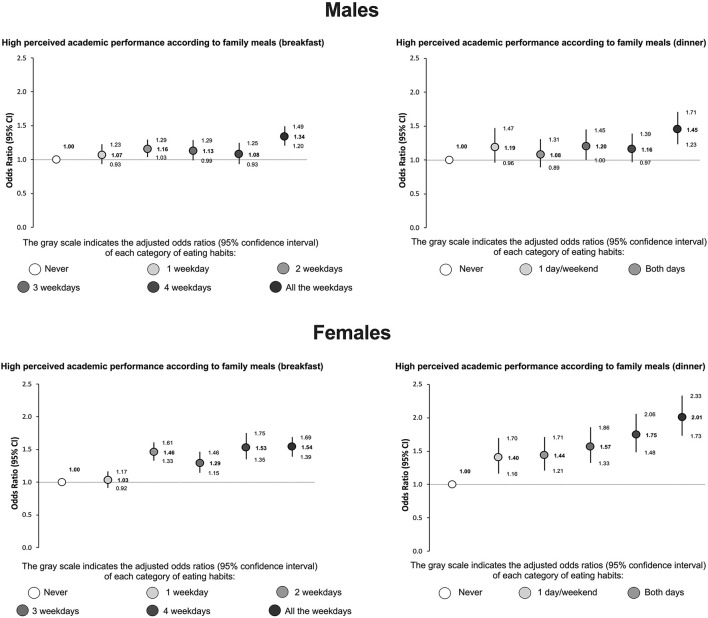
Among the 46,455 (53.5% female, mean age of 13.7 ± 1.6 years) adolescents studied, 20.6% of males and 25.5% of females reported high perceived school performance. In the results of the fully adjusted analyses, the higher the frequency of all healthy eating habits studied, the higher the perceived school performance in both males and females. Specifically, both males and females reporting a higher frequency of fruit and vegetable consumption, a lower frequency of sweets and soft drink consumption, more frequent breakfast consumption, and more frequent family meals (breakfast and dinner) were more likely to perceive their school performance as higher compared to their classmates. In addition, having breakfast regularly on weekends and the frequency of family dinner were associated with better school performance in both males and females.
In summary, this study provide cross-sectional evidence on the association between healthy eating habits and perceived school performance. Considering that school performance is an indicator of healthy development in adolescence, our findings reinforce and extend the evidence on the importance of healthy eating at this stage of life.
本研究按性别分析了青少年自我报告的特定饮食习惯与感知到的学业成绩之间的关联。
对来自42个不同国家的具有广泛代表性的大量青少年样本数据进行了横断面分析。参与者回答了有关他们每周食用水果、蔬菜、甜食和软饮料的频率,以及吃早餐的频率和家庭聚餐情况的问题。青少年将自己的学业成绩与同学进行主观评分。逻辑回归模型针对地区、年龄、体重指数(z分数)、社会经济地位、体育活动、娱乐屏幕时间和睡眠困难进行了调整。
在研究的46455名青少年(53.5%为女性,平均年龄13.7±1.6岁)中,20.6%的男性和25.5%的女性报告称学业成绩较高。在完全调整分析的结果中,所研究的所有健康饮食习惯的频率越高,男性和女性感知到的学业成绩就越高。具体而言,报告水果和蔬菜消费频率较高、甜食和软饮料消费频率较低、早餐消费更频繁以及家庭聚餐(早餐和晚餐)更频繁的男性和女性,与同学相比,更有可能认为自己的学业成绩更高。此外,周末定期吃早餐以及家庭晚餐的频率与男性和女性更好的学业成绩相关。
总之,本研究提供了关于健康饮食习惯与感知到的学业成绩之间关联的横断面证据。鉴于学业成绩是青少年健康发展的一个指标,我们的研究结果强化并扩展了关于生命这个阶段健康饮食重要性的证据。