European Translational Oncology Prevention and Screening (EUTOPS) Institute, Milser Str. 10, 6060, Hall in Tirol, Austria.
Research Institute for Biomedical Aging Research, Universität Innsbruck, 6020, Innsbruck, Austria.
Genome Biol. 2022 Feb 22;23(1):52. doi: 10.1186/s13059-022-02603-3.
A variety of epigenetic clocks utilizing DNA methylation changes have been developed; these clocks are either tissue-independent or designed to predict chronological age based on blood or saliva samples. Whether discordant tick rates between tissue-specific and general epigenetic clocks play a role in health and disease has not yet been explored.
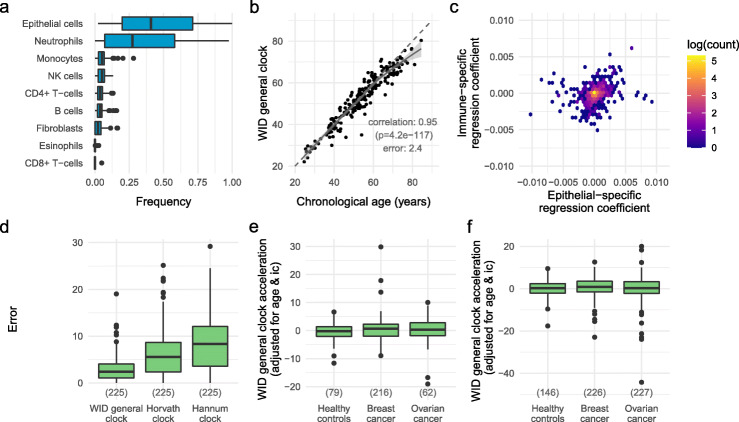
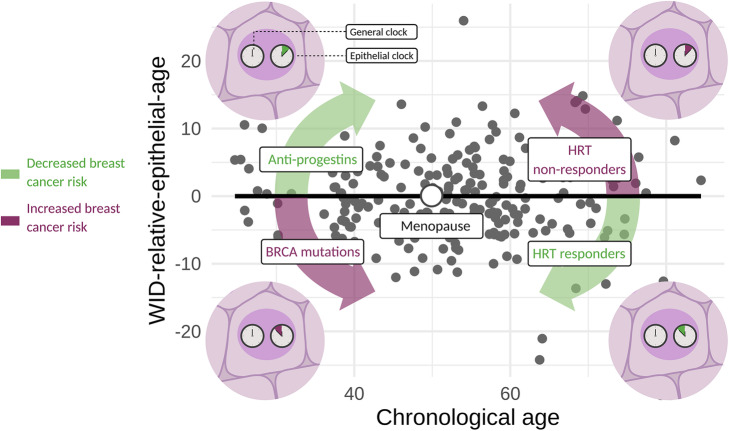
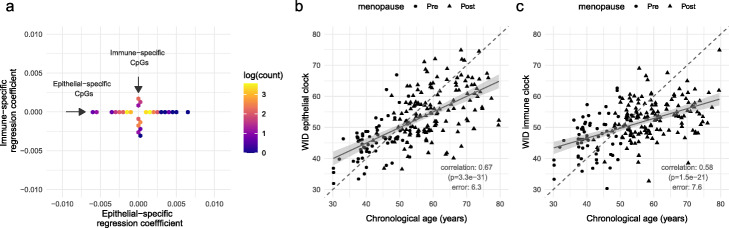
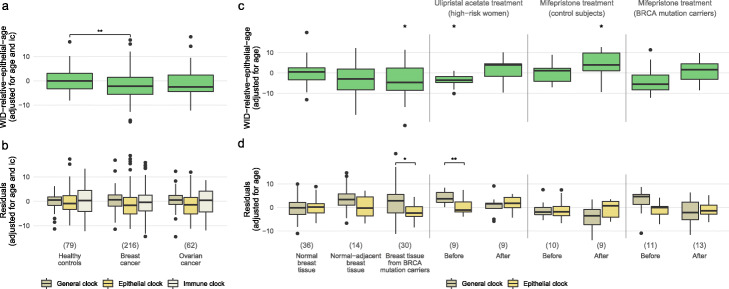
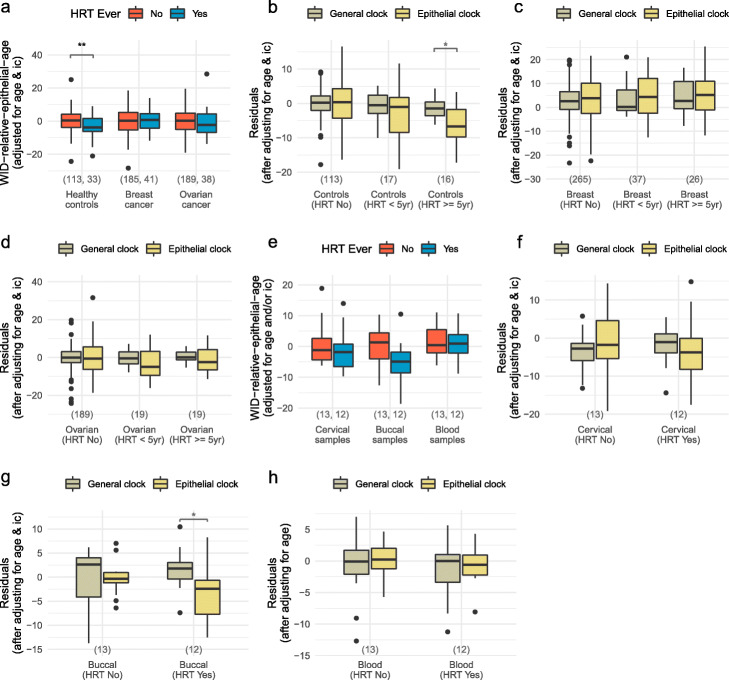
Here we analyze 1941 cervical cytology samples, which contain a mixture of hormone-sensitive cervical epithelial cells and immune cells, and develop the WID general clock (Women's IDentification of risk), an epigenetic clock that is shared by epithelial and immune cells and optimized for cervical samples. We then develop the WID epithelial clock and WID immune clock, which define epithelial- and immune-specific clocks, respectively. We find that the WID-relative-epithelial-age (WID-REA), defined as the difference between the epithelial and general clocks, is significantly reduced in cervical samples from pre-menopausal women with breast cancer (OR 2.7, 95% CI 1.28-5.72). We find the same effect in normal breast tissue samples from pre-menopausal women at high risk of breast cancer and show that potential risk reducing anti-progesterone drugs can reverse this. In post-menopausal women, this directionality is reversed. Hormone replacement therapy consistently leads to a significantly lower WID-REA in cancer-free women, but not in post-menopausal women with breast or ovarian cancer.
Our findings imply that there are multiple epigenetic clocks, many of which are tissue-specific, and that the differential tick rate between these clocks may be an informative surrogate measure of disease risk.
已经开发出了多种利用 DNA 甲基化变化的表观遗传时钟;这些时钟要么是组织独立的,要么是根据血液或唾液样本设计的,用于预测实际年龄。组织特异性和一般表观遗传时钟之间不同的计时率是否在健康和疾病中发挥作用尚未得到探索。
在这里,我们分析了 1941 个宫颈细胞学样本,其中包含混合的激素敏感宫颈上皮细胞和免疫细胞,并开发了 WID 一般时钟(女性识别风险),这是一种上皮细胞和免疫细胞共享的表观遗传时钟,针对宫颈样本进行了优化。然后,我们开发了 WID 上皮细胞时钟和 WID 免疫细胞时钟,分别定义上皮细胞和免疫细胞特异性时钟。我们发现,WID-相对上皮年龄(WID-REA),定义为上皮和一般时钟之间的差异,在乳腺癌的绝经前妇女的宫颈样本中显著降低(OR 2.7,95%CI 1.28-5.72)。我们在高乳腺癌风险的绝经前妇女的正常乳腺组织样本中发现了同样的效果,并表明潜在的风险降低孕激素药物可以逆转这种情况。在绝经后妇女中,这种方向性是相反的。激素替代疗法在无癌症的妇女中一致导致 WID-REA 显著降低,但在患有乳腺癌或卵巢癌的绝经后妇女中则没有。
我们的研究结果表明存在多种表观遗传时钟,其中许多是组织特异性的,并且这些时钟之间的差异计时率可能是疾病风险的一种信息替代指标。