
单髁膝关节置换联合手术:僵硬风险高,但在特定适应症中概念前景良好。
Combined procedures with unicompartmental knee arthroplasty: High risk of stiffness but promising concept in selected indications.
作者信息
Derreveaux Vianney, Schmidt Axel, Shatrov Jobe, Sappey-Marinier Elliot, Batailler Cécile, Servien Elvire, Lustig Sébastien
机构信息
FIFA Medical Center of Excellence, Orthopaedics Surgery and Sports Medicine Department, Croix-Rousse Hospital, Hospices Civils de Lyon, 103 Grande rue de la Croix Rousse, 69004 Lyon, France.
Sydney Orthopaedic Research Institute, Chatswood, Sydney 2067, Australia - University of Notre Dame Australia Orthopaedic Research Institute, Sydney 2007, Australia - Hornsby and Ku-Ring Hospital, Sydney 2077, Australia.
出版信息
SICOT J. 2022;8:4. doi: 10.1051/sicotj/2022002. Epub 2022 Feb 22.
INTRODUCTION
Unicompartmental knee arthroplasty (UKA) has traditionally been contraindicated in the presence of an ACL deficient knee, bi-compartmental disease, or significant coronal deformity due to concerns regarding increased risk of persisted pain, knee instability, tibial loosening, or progression of osteoarthritis. The aim of this study was to evaluate the outcomes of patients undergoing UKA with an associated surgical procedure in these specific indications.
METHOD
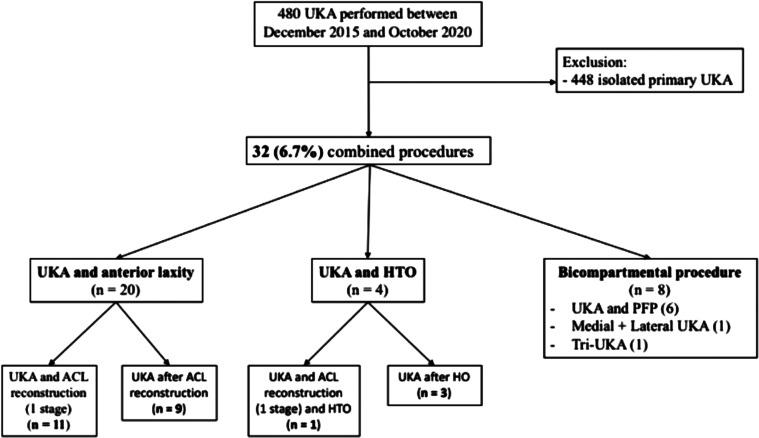
This was a retrospective cohort study of patients undergoing UKA between December 2015 and October 2020. Patients were categorized into groups based on associated procedures: UKA + ACL, UKA + HTO, and bicompartmental arthroplasty. Outcomes were assessed using the Knee Society Score (KSS) knee and function scores and the Forgotten Joint Score. Radiological and complication analysis was performed at the last clinical follow-up.
RESULTS
Thirty-two patients (13 men and 19 women) were included. The mean age was 56.2 years ± 11.1 (range, 33-84) with a mean follow-up of 26.3 months ± 15 (7.3-61.1). There was a significant improvement between the pre-and postoperative KSS Knee (+34.3 ± 16.5 [12-69]), Function (+34.3 ± 18.6 [0-75]), and Total scores (+68.5 ± 29.4 [24-129]) (p = 0.001). Seven patients (21.8%) required an arthroscopic arthrolysis for persistent stiffness. Two patients (UKA + PFA and UKA + ACL) underwent revision to TKA. Patient satisfaction was 90%, and mean flexion at last follow-up was 122° ± 6 (120-140). The implant survival rate was 94%.
DISCUSSION
This study found performing UKA with an additional procedure to address relative contraindications to the arthroplasty in physically active patients with monocompartmental knee arthritis is an efficient strategy with good results at short-term follow-up. It should be reserved for patients where TKA is likely to have unsatisfactory results, and the patient has been fully counseled regarding the management options. Even if there is a high rate of complications with stiffness requiring a re-intervention, the final results are very satisfying with no impact of the reintervention on the clinical result in the short term.
引言
传统上,单间室膝关节置换术(UKA)在存在前交叉韧带(ACL)缺失、双间室疾病或严重冠状面畸形的膝关节时被视为禁忌,因为担心持续疼痛、膝关节不稳定、胫骨松动或骨关节炎进展的风险增加。本研究的目的是评估在这些特定适应症下接受UKA并伴有相关手术的患者的治疗效果。
方法
这是一项对2015年12月至2020年10月期间接受UKA的患者进行的回顾性队列研究。根据相关手术将患者分为几组:UKA + ACL、UKA + 高位胫骨截骨术(HTO)和双间室关节置换术。使用膝关节协会评分(KSS)的膝关节和功能评分以及遗忘关节评分来评估治疗效果。在最后一次临床随访时进行影像学和并发症分析。
结果
纳入32例患者(13例男性和19例女性)。平均年龄为56.2岁±11.1岁(范围33 - 84岁),平均随访时间为26.3个月±15个月(7.3 - 61.1个月)。术前和术后KSS膝关节评分(+34.3 ± 16.5 [12 - 69])、功能评分(+34.3 ± 18.6 [0 - 75])和总分(+68.5 ± 29.4 [24 - 129])有显著改善(p = 0.001)。7例患者(21.8%)因持续性僵硬需要进行关节镜下松解术。2例患者(UKA + 髌股关节置换术(PFA)和UKA + ACL)接受了转为全膝关节置换术(TKA)的翻修手术。患者满意度为90%,最后一次随访时的平均屈曲度为122°±6°(120 - 140°)。植入物生存率为94%。
讨论
本研究发现,对于患有单间室膝关节关节炎的活跃患者,采用额外手术来解决关节置换术的相对禁忌症进行UKA是一种有效的策略,在短期随访中效果良好。它应保留给那些TKA可能效果不佳的患者,并且已就管理选择向患者进行了充分咨询。即使因僵硬导致并发症的发生率较高,需要再次干预,但最终结果非常令人满意,短期内再次干预对临床结果没有影响。



 Zotero 插件