Bu Xiaoyun, Ma Luyao, Liu Shuang, Wen Dongsheng, Kan Anna, Xu Yujie, Lin Xuanjia, Shi Ming
Department of Liver Surgery, Sun Yat-Sen University Cancer Center, Guangzhou, China.
State Key Laboratory of Oncology in South China, Collaborative Innovation Center for Cancer Medicine, 651 Dongfeng East Road, Guangzhou, 510060, China.
Cancer Cell Int. 2022 Feb 22;22(1):95. doi: 10.1186/s12935-022-02507-z.
Prognostic assessment is imperative for clinical management of patients with hepatocellular carcinoma (HCC). Most reported prognostic signatures are based on risk scores summarized from quantitative expression level of candidate genes, which are vulnerable against experimental batch effects and impractical for clinical application. We aimed to develop a robust qualitative signature to assess individual survival risk for HCC patients.
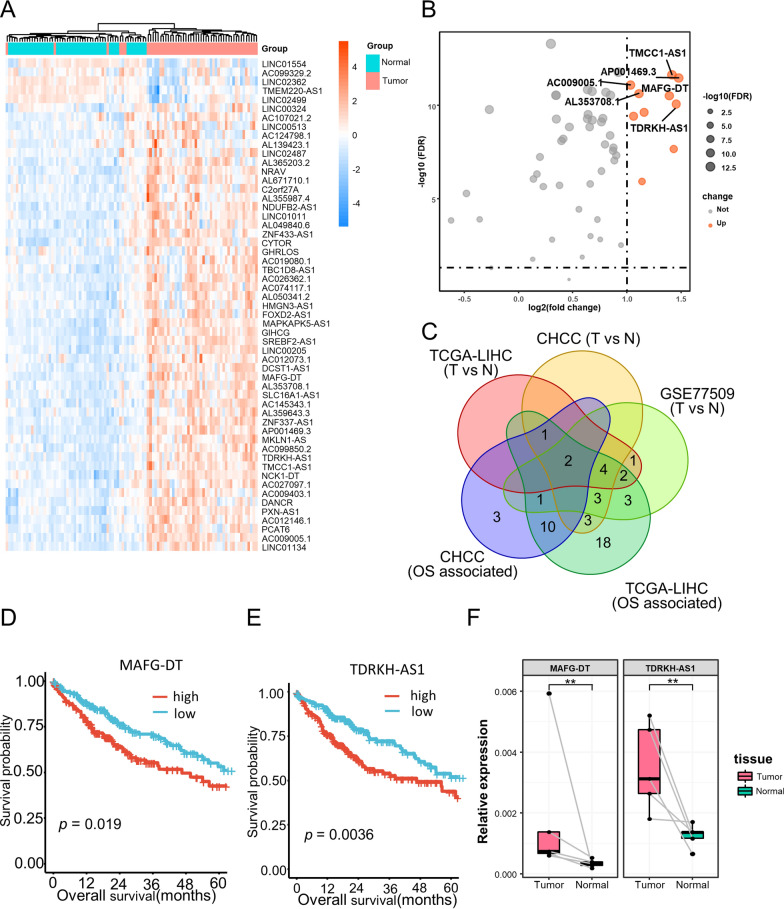
Long non-coding RNA (lncRNA) pairs correlated with overall survival (OS) were identified and an optimal combination of lncRNA pairs based on the majority voting rule was selected as a classification signature to predict the overall survival risk in the cancer genome atlas (TCGA). Then, the signature was further validated in two external datasets. Besides, biomolecular characteristics, immune infiltration status, and chemotherapeutics efficacy of different risk groups were further compared. Finally, we performed key lncRNA screening and validated it in vitro.
A signature consisting of 50 lncRNA pairs (50-LPS) was identified in TCGA and successfully validated in external datasets. Patients in the high-risk group, when at least 25 of the 50-LPS voted for high risk, had significantly worse OS than the low-risk group. Multivariate Cox, receiver operating characteristic (ROC) curve and decision curve analyses (DCA) demonstrated that the 50-LPS was an independent prognostic factor and more powerful than other available clinical factors in OS prediction. Comparison analyses indicated that different risk groups had distinct biomolecular characteristics, immune infiltration status, and chemotherapeutics efficacy. TDRKH-AS1 was confirmed as a key lncRNA and associated with cell growth of HCC.
The 50-LPS could not only predict the prognosis of HCC patients robustly and individually, but also provide theoretical basis for therapy. Besides, TDRKH-AS1 was identified as a key lncRNA in the proliferation of HCC. The 50-LPS might guide personalized therapy for HCC patients in clinical practice.
预后评估对于肝细胞癌(HCC)患者的临床管理至关重要。大多数报道的预后特征基于候选基因定量表达水平汇总的风险评分,这些评分易受实验批次效应影响且在临床应用中不实用。我们旨在开发一种强大的定性特征来评估HCC患者的个体生存风险。
鉴定与总生存期(OS)相关的长链非编码RNA(lncRNA)对,并基于多数投票规则选择lncRNA对的最佳组合作为分类特征,以预测癌症基因组图谱(TCGA)中的总生存风险。然后,在两个外部数据集中进一步验证该特征。此外,进一步比较不同风险组的生物分子特征、免疫浸润状态和化疗疗效。最后,我们进行关键lncRNA筛选并在体外进行验证。
在TCGA中鉴定出由50个lncRNA对组成的特征(50-LPS),并在外部数据集中成功验证。当50-LPS中至少25个投票为高风险时,高风险组患者的OS明显低于低风险组。多变量Cox、受试者工作特征(ROC)曲线和决策曲线分析(DCA)表明,50-LPS是一个独立的预后因素,在OS预测中比其他可用临床因素更具预测力。比较分析表明,不同风险组具有不同的生物分子特征、免疫浸润状态和化疗疗效。TDRKH-AS1被确认为关键lncRNA,并与HCC细胞生长相关。
50-LPS不仅可以可靠地、个体化地预测HCC患者的预后,还可为治疗提供理论依据。此外,TDRKH-AS1被确定为HCC增殖中的关键lncRNA。50-LPS可能在临床实践中指导HCC患者的个性化治疗。