MRC/CSO Social & Public Health Sciences Unit, Institute of Wellbeing, University of Glasgow, Glasgow, United Kingdom.
PLoS One. 2022 Feb 23;17(2):e0262248. doi: 10.1371/journal.pone.0262248. eCollection 2022.
Adolescence is characterized by identity formation, exploration and initiation of intimate relationships. Much of this occurs at school, making schools key sites of sexual harassment. Schools often lack awareness and understanding of the issue, and UK research on the topic is scarce. We explored prevalence and perceptions of sexual harassment in a school-based mixed-methods study of 13-17 year-old Scottish adolescents.
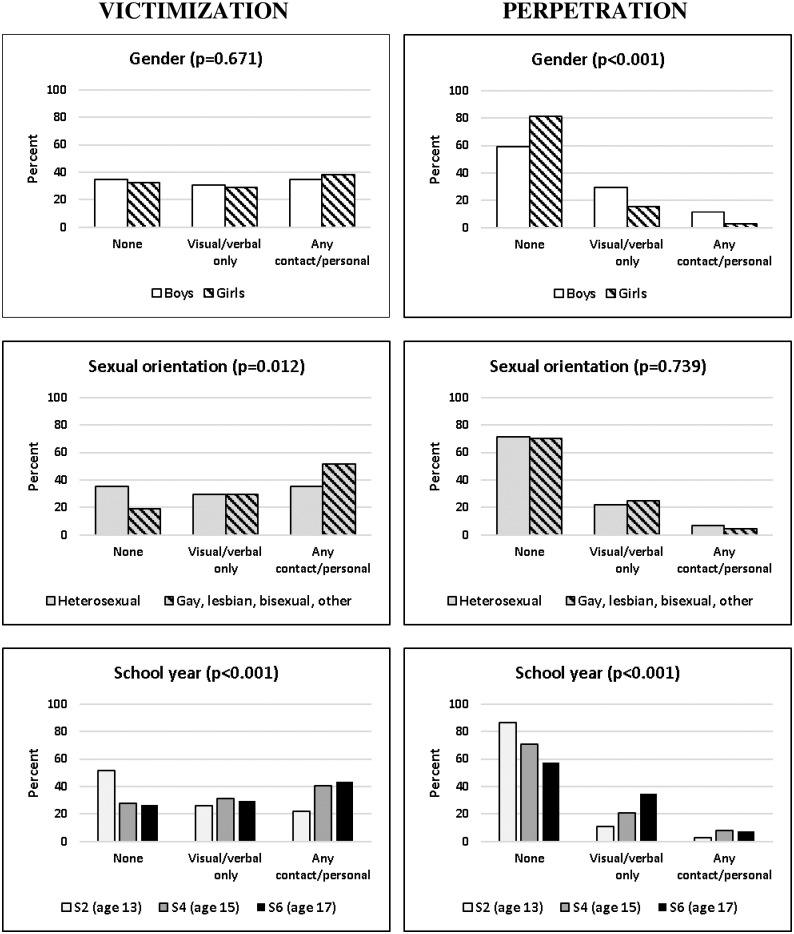
A student survey (N = 638) assessed past 3-months school-based victimization and perpetration prevalence via 17 behavioral items based on the most commonly used school-based sexual harassment measure ('Hostile Hallways'). Eighteen focus groups (N = 119 students) explored which of 10 behaviors were perceived as harassing/unacceptable and why.
Two-thirds reported any victimization: 64.7% 'visual/verbal' (e.g. sexual jokes) and 34.3% 'contact/personally-invasive' behaviors (e.g. sexual touching; most of whom also reported experiencing visual/verbal types) in the past 3-months. Data suggested a gateway effect, such that contact/personally-invasive behaviors are more likely to be reported by those also reporting more common visual/verbal behaviors. Some survey participants reported being unsure about whether they had experienced certain behaviors; and in focus groups, participants expressed uncertainty regarding the acceptability of most behaviors. Ambiguities centered on behavioral context and enactment including: degree of pressure, persistence and physicality; degree of familiarity between the instigator-recipient; and perception of the instigator's intent. In attempting to resolve ambiguities, students applied normative schemas underpinned by rights (to dignity, respect and equality) and 'knowingness', usually engendered by friendship.
Our study confirms school-based sexual harassment is common but also finds significant nuance in the ways in which students distinguish between acceptable and harassing. School-based strategies to tackle sexual harassment must engage with this complexity.
青春期的特点是身份认同的形成、亲密关系的探索和开始。这些大多发生在学校,这使得学校成为性骚扰的主要场所。学校往往缺乏对这个问题的认识和理解,而英国在这一主题上的研究也很少。我们在一项针对苏格兰 13-17 岁青少年的基于学校的混合方法研究中,探讨了性骚扰的流行程度和看法。
一项学生调查(N=638)通过基于最常用的基于学校的性骚扰衡量标准(“敌对走廊”)的 17 项行为项目,评估了过去 3 个月内基于学校的受害和实施的普遍性。18 个焦点小组(N=119 名学生)探讨了 10 种行为中哪些被认为是骚扰/不可接受的,以及原因。
三分之二的人报告了任何受害:64.7%的人经历过“视觉/言语”(如性笑话),34.3%的人经历过“接触/个人侵犯”行为(如性接触;其中大多数人也报告了经历过视觉/言语类型的行为)在过去 3 个月内。数据表明存在一种门户效应,即接触/个人侵犯行为更有可能被那些也报告更常见的视觉/言语行为的人报告。一些调查参与者报告说他们不确定自己是否经历过某些行为;在焦点小组中,参与者对大多数行为的可接受性表示不确定。这些模糊性集中在行为背景和实施方面,包括:压力、持续时间和身体性的程度;煽动者-接受者之间的熟悉程度;以及煽动者意图的感知。在试图解决这些模糊性时,学生们应用了基于权利(尊严、尊重和平等)和“知晓”的规范性模式,通常是由友谊产生的。
我们的研究证实,基于学校的性骚扰很常见,但也发现了学生在区分可接受和骚扰行为方面存在显著的细微差别。针对性骚扰的基于学校的策略必须应对这种复杂性。