Sakellari Evanthia, Berglund Mari, Santala Elina, Bacatum Claudia Mariana Juliao, Sousa Jose Edmundo Xavier Furtado, Aarnio Heli, Kubiliutė Laura, Prapas Christos, Lagiou Areti
Department of Public and Community Health, School of Public Health, University of West Attica, 11521 Athens, Greece.
Laboratory of Hygiene and Epidemiology, School of Public Health, University of West Attica, 11521 Athens, Greece.
Children (Basel). 2022 Oct 13;9(10):1551. doi: 10.3390/children9101551.
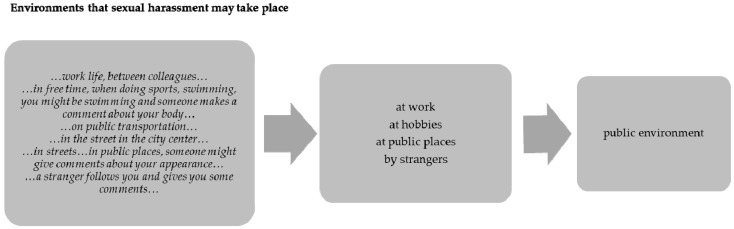
Sexual harassment is a crucial public health issue among adolescents. In order to develop school health promotion programs, there is a need to involve adolescents themselves paying particular attention to their perceptions, beliefs, attitudes and practices. Therefore, the aim of this study was to explore the adolescents' perceptions about sexual harassment as well as the ways it could be prevented. Four focus groups were conducted during an online "camp" in autumn 2021, facilitated by members of SHEHAP project research team. Participants were secondary school students from Finland, Greece, Lithuania and Portugal. The qualitative data was analyzed using content analysis. Concerning how participants perceive sexual harassment, the themes that emerged were: physically expressed sexual harassment; verbally expressed sexual harassment; virtually expressed sexual harassment; violation of self-determination. Virtual environment; school environment; public environment; familiar environment, were identified as the places where sexual harassment may occur. Finally, in regard to the participants' views on the prevention of sexual harassment, the following themes emerged: youth education; adult education aiming teachers and parents; professional, peer and family support; official consequences; health education methods. The findings of the current study can be used for the development of school-based programs aiming to prevent sexual harassment among adolescents.
性骚扰是青少年中一个至关重要的公共卫生问题。为了制定学校健康促进计划,有必要让青少年自身参与进来,尤其要关注他们的认知、信念、态度和行为。因此,本研究的目的是探讨青少年对性骚扰的认知以及预防性骚扰的方法。2021年秋季,在一个在线“营地”期间开展了四个焦点小组讨论,由SHEHAP项目研究团队的成员主持。参与者是来自芬兰、希腊、立陶宛和葡萄牙的中学生。使用内容分析法对定性数据进行了分析。关于参与者对性骚扰的认知,出现的主题有:身体表现的性骚扰;言语表现的性骚扰;虚拟表现的性骚扰;对自决权的侵犯。虚拟环境、学校环境、公共环境、熟悉的环境,被确定为可能发生性骚扰的场所。最后,关于参与者对预防性骚扰的看法,出现了以下主题:青少年教育;针对教师和家长的成人教育;专业、同伴和家庭支持;官方处罚;健康教育方法。本研究的结果可用于制定旨在预防青少年性骚扰的校本课程。