Department of Ophthalmology, University of Pittsburgh, Pittsburgh, PA, United States.
Department of Preventive and Restorative Dental Sciences, UCSF, San Francisco, CA, United States.
Acta Biomater. 2022 Apr 15;143:72-86. doi: 10.1016/j.actbio.2022.02.021. Epub 2022 Feb 20.
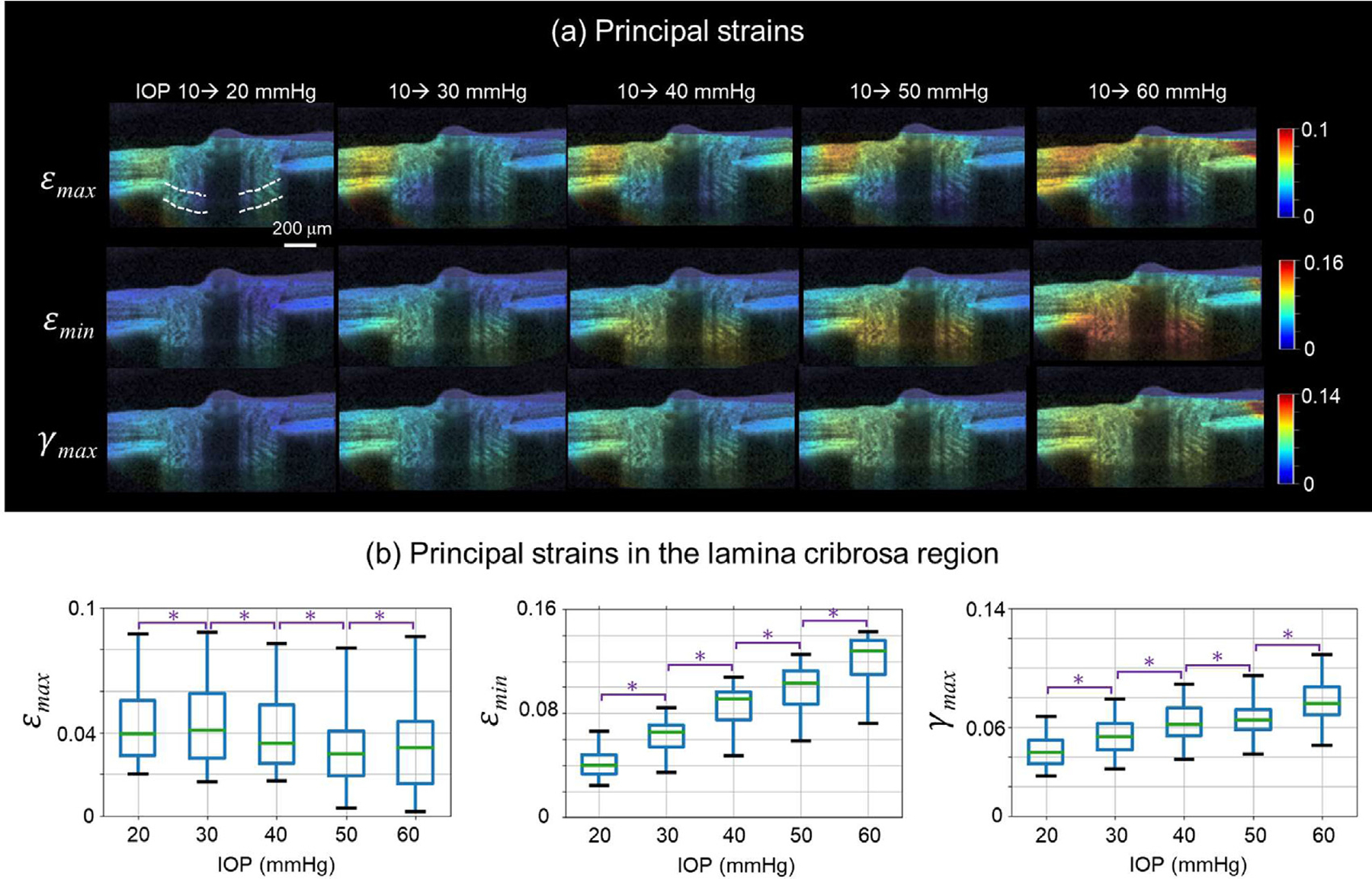
In-vivo optic nerve head (ONH) biomechanics characterization is emerging as a promising way to study eye physiology and pathology. We propose a high-accuracy and high-efficiency digital volume correlation (DVC) method to characterize the in-vivo ONH deformation from optical coherence tomography (OCT) volumes. Using a combination of synthetic tests and analysis of OCTs from monkey ONHs subjected to acutely elevated intraocular pressure, we demonstrate that our proposed methodology overcame several challenges for conventional DVC methods: First, a pre-registration technique was used to remove large ONH rigid body motion in OCT volumes which could lead to analysis failure; second, a modified 3D inverse-compositional Gaussian Newton method was used to ensure sub-voxel accuracy of displacement calculations despite high noise and low image contrast of some OCT volumes; third, a tricubic B-spline interpolation method was applied to improve computational efficiency; fourth, a confidence parameter was introduced to guide the searching path in the displacement calculation; fifth, a confidence-weighted strain calculation method was applied to further improve the accuracy. The proposed DVC method had displacement errors smaller than 0.037 and 0.028 voxels with Gaussian and speckle noises, respectively. The strain errors in the three directions were less than 0.0045 and 0.0018 with Gaussian and speckle noises, respectively. Compared with the conventional DVC method, the proposed method reduced the errors of displacement and strain calculations by up to 70% under large body motions, with 75% lower computation time, while saving about 30% memory. Our study demonstrates the potential of the proposed technique to investigate ONH biomechanics. STATEMENT OF SIGNIFICANCE: The biomechanics of the optic nerve head (ONH) in the posterior pole of the globe play a central role in eye physiology and pathology. The application of digital volume correlation (DVC) to the analysis of optical coherence tomography (OCT) images of the ONH has emerged as a promising way to quantify ONH biomechanics. Conventional DVC methods, however, face several important challenges when analyzing OCT images of the ONH. We introduce a high-accuracy and high-efficiency DVC method to characterize in vivo ONH deformations from OCT volumes. We demonstrate the new method using synthetic tests and actual OCT data from monkey ONHs. The new method also has the potential to be used to study other tissues, as OCT applications continue to expand.
在体视神经头(ONH)生物力学特征分析作为研究眼睛生理和病理的一种有前途的方法正在出现。我们提出了一种高精度、高效率的数字体相关(DVC)方法,用于从光学相干断层扫描(OCT)体积中描述在体 ONH 变形。通过对受急性眼内压升高影响的猴 ONH 的 OCT 进行综合测试和分析,我们证明了我们提出的方法克服了传统 DVC 方法的几个挑战:首先,使用预配准技术去除 OCT 体积中大的 ONH 刚体运动,这可能导致分析失败;其次,使用改进的三维逆复合高斯牛顿法确保了位移计算的亚像素精度,尽管一些 OCT 体积的噪声和图像对比度低;第三,应用三次 B 样条插值方法提高计算效率;第四,引入置信参数来指导位移计算中的搜索路径;第五,应用置信加权应变计算方法进一步提高精度。所提出的 DVC 方法在具有高斯和散斑噪声的情况下,位移误差分别小于 0.037 和 0.028 体素。三个方向的应变误差分别小于 0.0045 和 0.0018,具有高斯和散斑噪声。与传统的 DVC 方法相比,在大刚体运动下,该方法将位移和应变计算的误差减少了多达 70%,计算时间降低了 75%,同时节省了约 30%的内存。我们的研究表明,该技术具有研究 ONH 生物力学的潜力。
眼球后极的视神经头(ONH)的生物力学在眼睛的生理和病理中起着核心作用。数字体相关(DVC)在分析 ONH 的光学相干断层扫描(OCT)图像中的应用已经成为定量 ONH 生物力学的一种有前途的方法。然而,当分析 ONH 的 OCT 图像时,传统的 DVC 方法面临着几个重要的挑战。我们提出了一种高精度、高效率的 DVC 方法,用于从 OCT 体积中描述在体 ONH 变形。我们使用合成测试和来自猴 ONH 的实际 OCT 数据来证明新方法。该新方法也有可能用于研究其他组织,因为 OCT 应用继续扩展。