Fuentes Bárbara, Choque Alessandra, Gómez Francisco, Alarcón Jaime, Castro-Nallar Eduardo, Arenas Franko, Contreras Daniel, Mörchen Ramona, Amelung Wulf, Knief Claudia, Moradi Ghazal, Klumpp Erwin, Saavedra Claudia P, Prietzel Jörg, Klysubun Wantana, Remonsellez Francisco, Bol Roland
Departamento de Ingeniería Química, Universidad Católica del Norte, Antofagasta, Chile.
Programa de Doctorado en Ciencias Mención Geología, Universidad Católica del Norte, Antofagasta, Chile.
Front Microbiol. 2022 Feb 7;12:794743. doi: 10.3389/fmicb.2021.794743. eCollection 2021.
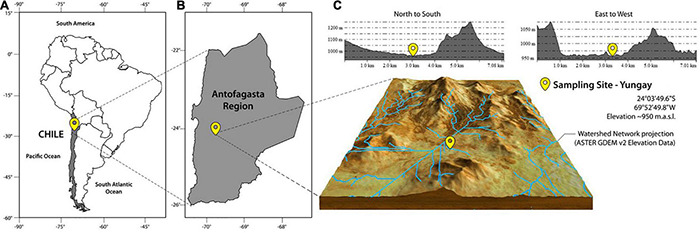
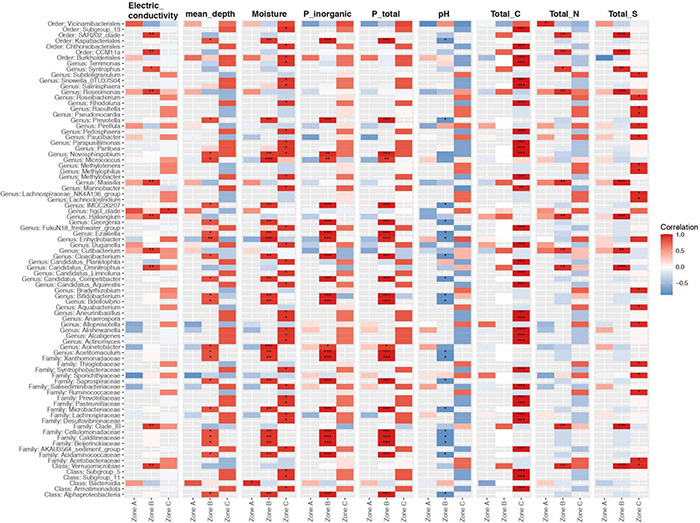
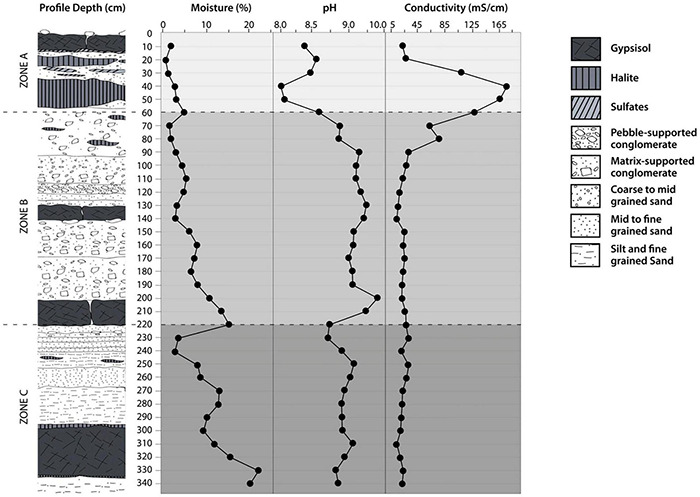
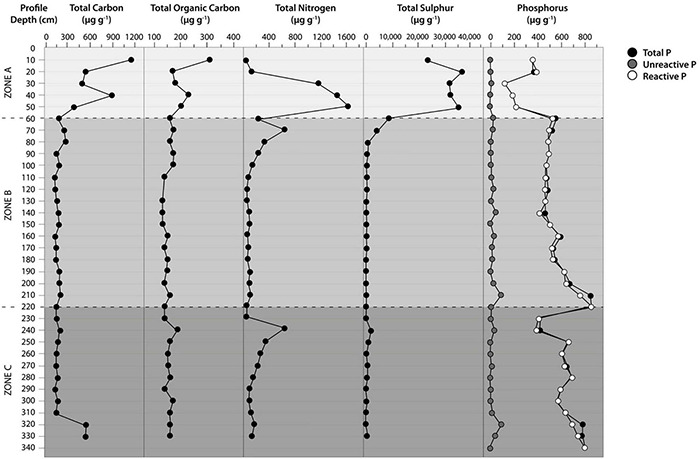
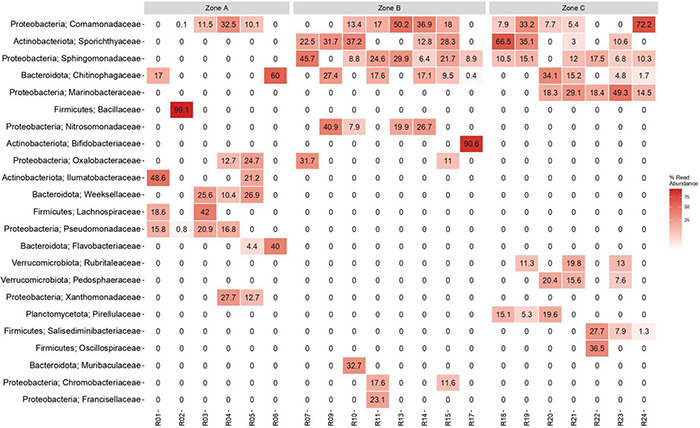
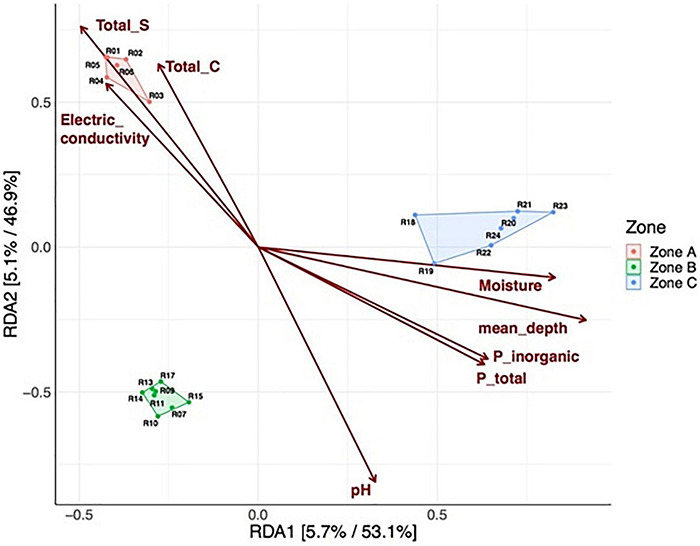
The extreme environmental conditions and lack of water on the soil surface in hyperarid deserts hamper microbial life, allowing only highly specialized microbial communities to the establish colonies and survive. Until now, the microbial communities that inhabit or have inhabited soils of hyperarid environments at greater depths have been poorly studied. We analyzed for the first time the variation in microbial communities down to a depth of 3.4 m in one of the driest places of the world, the hyperarid Yungay region in the Atacama Desert, and we related it to changes in soil physico-chemical characteristics. We found that the moisture content changed from 2 to 11% with depth and enabled the differentiation of three depth intervals: (i) surface zone A (0-60 cm), (ii) intermediate zone B (60-220 cm), and (iii) deep zone C (220-340 cm). Each zone showed further specific physicochemical and mineralogical features. Likewise, some bacterial phyla were unique in each zone, i.e., members of the taxa , , and in zone A; , , and Sva0485 in zone B; and and in zone C, which indicates taxon-specific preferences in deep soil habitats. Differences in the microbiota between the zones were rather abrupt, which is concomitant with abrupt changes in the physical-chemical parameters. Overall, moisture content, total carbon (TC), pH, and electric conductivity (EC) were most predictive of microbial richness and diversity, while total sulfur (TS) and total phosphorous (TP) contents were additionally predictive of community composition. We also found statistically significant associations between taxa and soil properties, most of which involved moisture and TC contents. Our findings show that under-explored habitats for microbial survival and existence may prevail at greater soil depths near water or within water-bearing layers, a valuable substantiation also for the ongoing search for biosignatures on other planets, such as Mars.
极端干旱沙漠的极端环境条件以及土壤表面缺水的状况阻碍了微生物的生存,只有高度专业化的微生物群落才能建立菌落并存活下来。到目前为止,对居住在超干旱环境较深处土壤中或曾经居住过的微生物群落的研究还很少。我们首次分析了世界上最干旱的地区之一——阿塔卡马沙漠超干旱的永盖伊地区深度达3.4米的微生物群落变化,并将其与土壤物理化学特征的变化联系起来。我们发现,水分含量随深度从2%变化到11%,并由此区分出三个深度区间:(i) 表层A区(0 - 60厘米),(ii) 中间B区(60 - 220厘米),以及(iii) 深层C区(220 - 340厘米)。每个区域都呈现出进一步的特定物理化学和矿物学特征。同样,一些细菌门类在每个区域都是独特的,即A区中的 、 和 类群的成员;B区中的 、 和Sva0485类群;以及C区中的 和 类群,这表明在深层土壤栖息地存在分类群特异性偏好。不同区域之间微生物群的差异相当突然,这与物理化学参数的突然变化相伴。总体而言,水分含量、总碳(TC)、pH值和电导率(EC)对微生物丰富度和多样性的预测性最强,而总硫(TS)和总磷(TP)含量对群落组成也有额外的预测作用。我们还发现分类群与土壤性质之间存在统计学上的显著关联,其中大多数涉及水分和TC含量。我们的研究结果表明,在靠近水源或含水层的较深土壤层中,可能存在尚未充分探索的微生物生存和存在的栖息地,这也为正在进行的在其他行星(如火星)上寻找生物特征提供了有价值的证据。