Department of Hepatobiliary Surgery, Xi-Jing Hospital, Fourth Military Medical University, Xi'an 710032, China.
School of Basic Medicine, Fourth Military Medical University, Xi'an 710032, China.
Theranostics. 2022 Jan 24;12(4):1816-1828. doi: 10.7150/thno.69885. eCollection 2022.
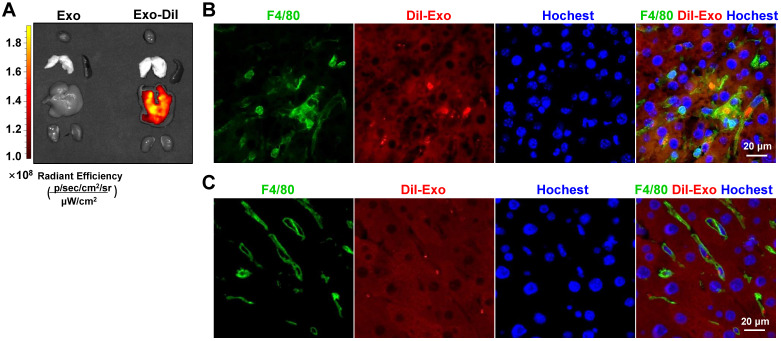
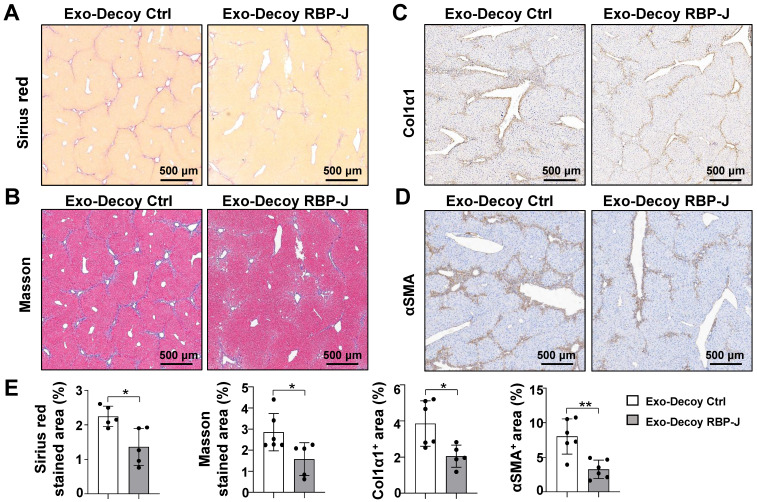
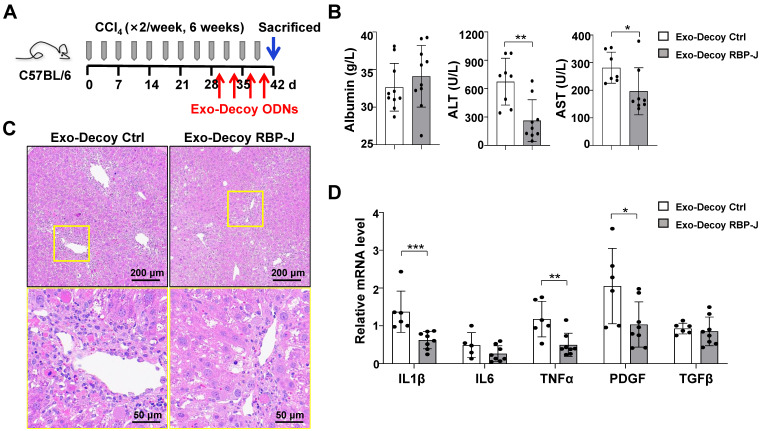
Macrophages play multi-dimensional roles in hepatic fibrosis. Studies have implicated Notch signaling mediated by the transcription factor RBP-J in macrophage activation and plasticity. Additionally, we have previously shown that myeloid-specific disruption of RBP-J can ameliorate hepatic fibrosis in mice. Accordingly, we next asked whether blocking Notch signaling in macrophages could serve as a therapeutic strategy to treat hepatic fibrosis. In this study, we used a combination of transcription factor decoy oligodeoxynucleotides (ODNs) and exosomes to test this possibility. Hairpin-type decoy oligodeoxynucleotides (ODNs) were designed for the transcription factor RBP-J. The effects of RBP-J decoy ODNs on Notch signaling were evaluated by western blot, quantitative RT-PCR, luciferase reporter assays, and electrophoretic mobility shift assays. ODNs were loaded into HEK293T-derived exosomes by electroporation. A hepatic fibrosis mouse model was established by the intraperitoneal injection of carbon tetrachloride or bile duct ligation. Mice with hepatic fibrosis were administered exosomes loaded with RBP-J decoy ODNs tail vein injection. The distribution of exosomes was analyzed by fluorescence labeling and imaging. Liver histology was examined using hematoxylin and eosin, Sirius red, and Masson staining, as well as immunohistochemical staining for Col1α1 and αSMA. We found that RBP-J decoy ODNs could be efficiently loaded into exosomes and inhibit the activation of Notch signaling. Furthermore, exosomes administered the tail vein were found to be primarily taken up by hepatic macrophages in mice with liver fibrosis. Importantly, RBP-J decoy ODNs delivered by exosomes could efficiently inhibit Notch signaling in macrophages and ameliorate hepatic fibrosis in mice. Combined, our data showed that the infusion of exosomes loaded with RBP-J decoy ODNs represents a promising therapeutic strategy for the treatment of hepatic fibrosis.
巨噬细胞在肝纤维化中发挥多维作用。研究表明,转录因子 RBP-J 介导的 Notch 信号在巨噬细胞激活和可塑性中起作用。此外,我们之前的研究表明,骨髓细胞特异性敲除 RBP-J 可以改善小鼠的肝纤维化。因此,我们接下来询问阻断巨噬细胞中的 Notch 信号是否可以作为治疗肝纤维化的一种治疗策略。在这项研究中,我们使用转录因子诱饵寡核苷酸 (ODN) 和外泌体的组合来测试这种可能性。 发夹型诱饵寡核苷酸 (ODN) 是为转录因子 RBP-J 设计的。通过 Western blot、定量 RT-PCR、荧光素酶报告基因测定和电泳迁移率变动测定评估 RBP-J 诱饵 ODN 对 Notch 信号的影响。通过电穿孔将 ODN 加载到 HEK293T 衍生的外泌体中。通过腹腔注射四氯化碳或胆管结扎建立肝纤维化小鼠模型。通过尾静脉注射给予携带 RBP-J 诱饵 ODN 的外泌体治疗肝纤维化小鼠。通过荧光标记和成像分析外泌体的分布。通过苏木精和伊红、天狼星红和 Masson 染色以及 Col1α1 和 αSMA 的免疫组织化学染色检查肝组织学。 我们发现 RBP-J 诱饵 ODN 可以有效地加载到外泌体中并抑制 Notch 信号的激活。此外,静脉注射的外泌体被发现主要被肝纤维化小鼠的肝巨噬细胞摄取。重要的是,外泌体递送的 RBP-J 诱饵 ODN 可以有效地抑制巨噬细胞中的 Notch 信号,并改善小鼠的肝纤维化。 综上所述,我们的数据表明,输注负载 RBP-J 诱饵 ODN 的外泌体代表了治疗肝纤维化的一种有前途的治疗策略。