Parker Gwendolyn H, Gillie Caroline E, Miller Julie V, Badger Deanna E, Kreider Marisa L
Cardno ChemRisk now Stantec, Houston, TX, USA.
Cardno ChemRisk now Stantec, Pittsburgh, PA, USA.
Toxicol Rep. 2022 Feb 4;9:238-249. doi: 10.1016/j.toxrep.2022.02.001. eCollection 2022.
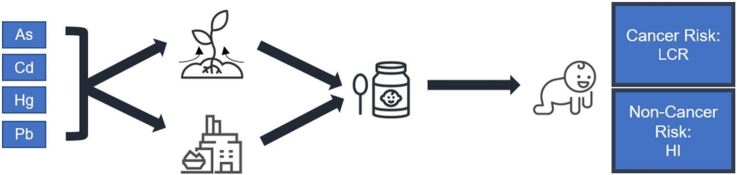
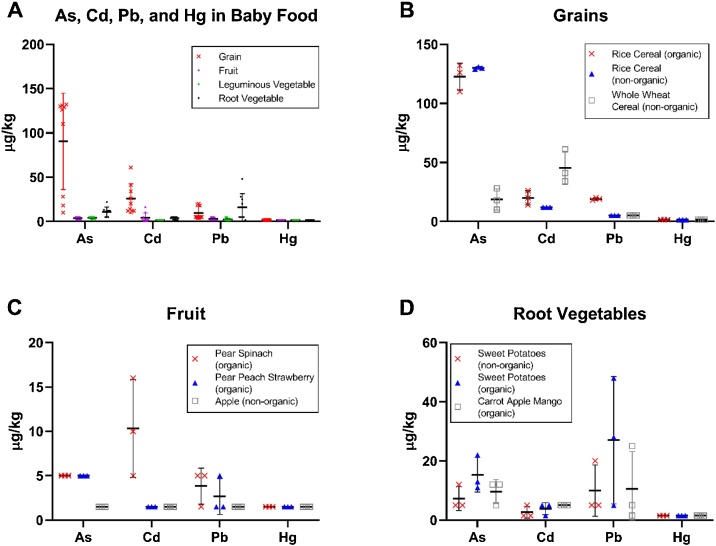
Recently, the U.S. House of Representatives reported on the presence of heavy metals in raw ingredients used in baby foods and in finished baby food products themselves. In light of these concerns, this study aimed to evaluate potential risks associated with the presence of heavy metals in baby food products. We analyzed 36 baby food samples representing four ingredient categories (fruit; leguminous vegetable; root vegetable; or grain) for arsenic (As), cadmium (Cd), mercury (Hg), and lead (Pb). We assessed the potential lifetime cancer and non-cancer health risks posed to infants and toddlers following daily consumption of these chemicals in each food type, based on established daily food-specific ingestion rates. Daily doses were compared against selected reference values and oral slope factors to determine non-cancer hazard indices (HIs) and lifetime cancer risks. Hazard indices indicated a potential for non-cancer risk (e.g., HIs > 1.0) under only a few exposure scenarios, including for As and Pb under selected product type and age/concentration assumptions. Increases in lifetime cancer risks for all analytes across the ingredient categories evaluated ranged from 3.75 × 10 to 5.54 × 10; cancer risks were primarily driven by As from grain products. Though a limited set of exposure scenarios indicated a potential for health risk, the exposure assumptions in this assessment were conservative, and the heavy metal concentrations we found in baby foods are similar to those observed in similar whole foods. Based on these findings and the limited scenarios under which risks were identified, this study indicates that an infant's typical intake of baby food is unlikely to pose health risks from heavy metals above accepted tolerable risk levels under most exposure scenarios.
最近,美国众议院报告了婴儿食品的原材料以及成品婴儿食品中存在重金属的情况。鉴于这些担忧,本研究旨在评估婴儿食品中重金属存在所带来的潜在风险。我们分析了36份婴儿食品样本,这些样本代表了四类食材(水果;豆科蔬菜;块根类蔬菜;或谷物),检测其中的砷(As)、镉(Cd)、汞(Hg)和铅(Pb)含量。我们根据既定的特定食物每日摄入量,评估了婴儿和幼儿每日食用每种食物类型中的这些化学物质后,可能面临的终生癌症和非癌症健康风险。将每日摄入量与选定的参考值和口服斜率因子进行比较,以确定非癌症危害指数(HIs)和终生癌症风险。危害指数表明,仅在少数暴露情况下存在非癌症风险的可能性(例如,HIs>1.0),包括在选定的产品类型以及年龄/浓度假设下,砷和铅的情况。在所评估的各类食材中,所有分析物的终生癌症风险增加范围为3.75×10至5.54×10;癌症风险主要由谷物产品中的砷驱动。尽管有限的一组暴露情况表明存在健康风险的可能性,但本评估中的暴露假设较为保守,而且我们在婴儿食品中发现的重金属浓度与在类似的天然食品中观察到的浓度相似。基于这些发现以及识别出风险的有限情况,本研究表明,在大多数暴露情况下,婴儿通常摄入的婴儿食品不太可能因重金属而带来高于可接受风险水平的健康风险。