Alharbi Najla S, Akamsiei Rawdah M, Almaiman Lama A, Al-Samti Mostafa A, Al-Mutairi Hamad S, Al-Owais Bandar S, Alkhalaf Majid M, Bineid Mohammed A
Executive Department of Monitoring and Risk Assessment, Food Sector Saudi Food and Drug Authority Riyadh Saudi Arabia.
Reference Laboratory for Food Chemistry Saudi Food and Drug Authority Riyadh Saudi Arabia.
Food Sci Nutr. 2023 Jun 8;11(9):5270-5282. doi: 10.1002/fsn3.3485. eCollection 2023 Sep.
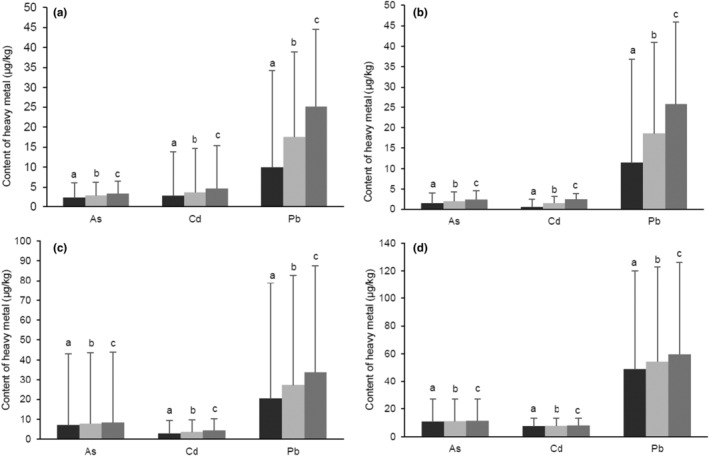
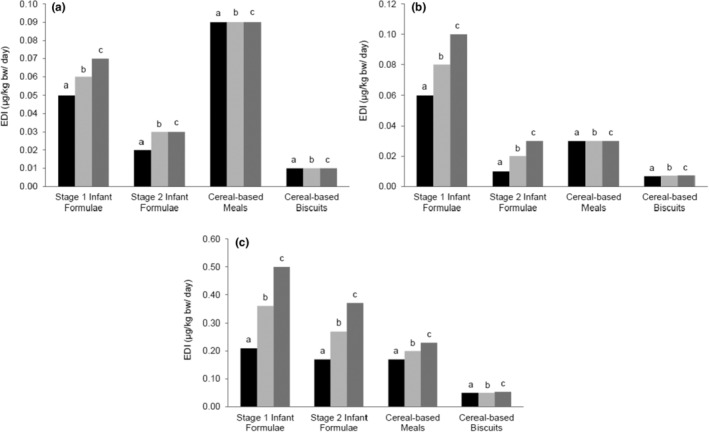
Early childhood exposure to heavy metals like arsenic (As), cadmium (Cd), and lead (Pb) through baby foods unfolds many concerns about their toxic effects on growth and health. In this study, occurrence and dietary intake of As, Cd, and Pb in stage 1 infant formula (0-6 months), stage 2 infant formula (7-12 months), cereal-based meals, and biscuits were estimated. First, the levels of As, Cd, and Pb were determined with ICP-MS, followed by the calculation of estimated daily intake (EDI), target hazard quotient (THQ), and hazard index (HI) for As and Cd, and margin of exposure (MoE) for Pb. Mean levels of As, Cd, and Pb were the highest in cereal-based meals and biscuits as 15.5-11.1, 5.18-8.76, and 35.2-53.8 μg/kg, respectively. Newborns to 6 months old infants were estimated to be the highest exposed population to Cd and Pb (0.08 and 0.36 μg/kg bw/day), while infants aged 7-12 months old were exposed the highest to As. Based on the THQ, HI, and MoE findings, the current exposure levels from the selected baby foods to As, Cd, and Pb pose low potential chronic risks to both infant age groups. This research provides a roadmap for future investigations in chemical contaminants often detected in baby foods consumed regularly by Saudi infants.
婴幼儿通过婴儿食品接触砷(As)、镉(Cd)和铅(Pb)等重金属引发了许多关于它们对生长和健康的毒性影响的担忧。在本研究中,对1阶段婴儿配方奶粉(0 - 6个月)、2阶段婴儿配方奶粉(7 - 12个月)、谷物类食品和饼干中As、Cd和Pb的含量及膳食摄入量进行了估算。首先,用ICP - MS测定As、Cd和Pb的含量,随后计算As和Cd的估计每日摄入量(EDI)、目标危害商(THQ)和危害指数(HI),以及Pb的暴露边际(MoE)。谷物类食品和饼干中As、Cd和Pb的平均含量最高,分别为15.5 - 11.1、5.18 - 8.76和35.2 - 53.8μg/kg。据估计,6个月以下的新生儿是Cd和Pb暴露量最高的人群(0.08和0.36μg/kg体重/天),而7 - 12个月大的婴儿As暴露量最高。基于THQ、HI和MoE的研究结果,所选婴儿食品中As、Cd和Pb的当前暴露水平对这两个婴儿年龄组构成的慢性风险较低。本研究为未来调查沙特婴儿经常食用的婴儿食品中经常检测到的化学污染物提供了路线图。