Department of Epidemiology and Biostatistics, School of Public Health, Peking University Health Science Center, Beijing, China.
Clinical Trial Service Unit & Epidemiological Studies Unit (CTSU), Nuffield Department of Population Health, University of Oxford, Oxford, UK.
Int J Cancer. 2022 Jul 15;151(2):181-190. doi: 10.1002/ijc.33977. Epub 2022 Mar 3.
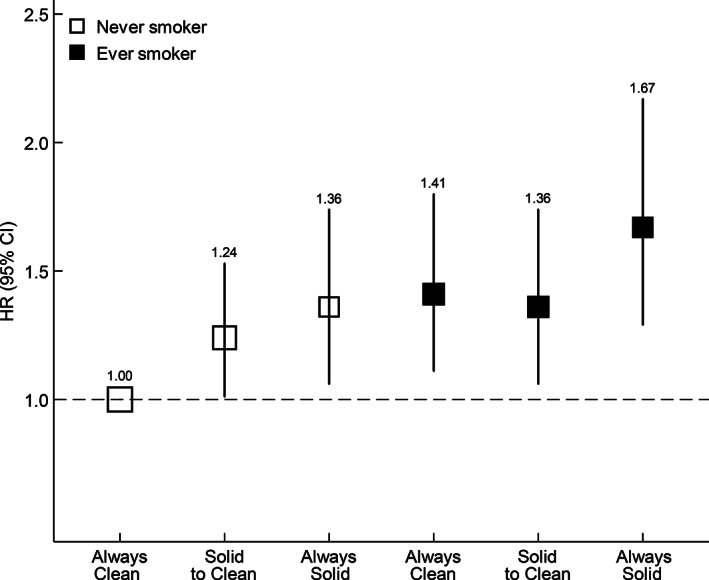
Previous research found tobacco smoking and solid fuel use for cooking to increase the risk of chronic liver disease mortality, but previous cohort studies have not investigated their independent and joint associations with liver cancer incidence in contemporary China. The China Kadoorie Biobank (CKB) study recruited 0.5 million adults aged 30 to 79 years from 10 areas across China during 2004 to 2008. Participants reported detailed smoking and fuel use information at baseline. After an 11.1-year median follow-up via electronic record linkage, we recorded 2997 liver cancer cases. Overall, 29.4% participants were current smokers. Among those who cooked at least once per month, 48.8% always used solid fuels (ie, coal or wood) for cooking. Tobacco smoking and solid fuel use for cooking were independently associated with increased risks of liver cancer, with hazard ratios (95% confidence intervals [CIs]) of 1.28 (1.15-1.42) and 1.25 (1.03-1.52), respectively. The more cigarettes consumed each day, the earlier the age of starting smoking or the longer duration of solid fuels exposure, the higher the risk (P < .001, =.001, =.018, respectively). Compared with never smokers who had always used clean fuels (ie, gas or electricity), ever-smokers who had always used solid fuels for cooking had a 67% (95% CIs: 1.29-2.17) higher risk. Among Chinese adults, tobacco smoking and solid fuel use for cooking were independently associated with higher risk of liver cancer incidence. Stronger association was observed with higher number of daily cigarette consumption, the earlier age of starting smoking and longer duration of solid fuel use.
先前的研究发现,吸烟和使用固体燃料烹饪会增加慢性肝病死亡率的风险,但先前的队列研究并未调查它们在中国当代与肝癌发病率的独立和共同关联。中国慢性病前瞻性研究(CKB)于 2004 年至 2008 年期间在中国 10 个地区招募了 50 万名年龄在 30 至 79 岁的成年人。参与者在基线时报告了详细的吸烟和燃料使用信息。通过电子记录链接进行了 11.1 年的中位随访后,我们记录了 2997 例肝癌病例。总体而言,29.4%的参与者为当前吸烟者。在那些每月至少烹饪一次的人中,48.8%的人总是使用固体燃料(即煤或木柴)烹饪。吸烟和使用固体燃料烹饪与肝癌风险增加独立相关,风险比(95%置信区间[CI])分别为 1.28(1.15-1.42)和 1.25(1.03-1.52)。每天吸烟量越多,开始吸烟的年龄越早或暴露于固体燃料的时间越长,风险越高(P<0.001,=.001,=.018,分别)。与从不吸烟且一直使用清洁燃料(即天然气或电)的人相比,一直使用固体燃料烹饪的曾经吸烟者的风险增加了 67%(95%CI:1.29-2.17)。在中国成年人中,吸烟和使用固体燃料烹饪与肝癌发病率升高独立相关。与吸烟量、开始吸烟的年龄和使用固体燃料的时间较长相关,关联更强。