Luo Hui, Wang Xiaohui, Wang Yunhan, Dan Qinfu, Ge Hong
Department of Radiation Oncology, The Affiliated Cancer Hospital of Zhengzhou University, No. 127 Dongming Road, Zhengzhou, 450008, Henan, China.
Discov Oncol. 2022 Jan 3;13(1):1. doi: 10.1007/s12672-021-00447-0.
To investigate the effect of mannose on radio-sensitivity of human esophageal squamous cell carcinoma (ESCC) cell line and its possible mechanism.
The expression of mannose phosphate isomerase (MPI) in human esophageal cancer cell lines were detected by Western blot. The inhibitory effect of mannose on human esophageal cancer cell lines were observed by MTT assay. Plate clone formation assay was performed to investigate the efficacy of mannose on radio-sensitivity of human esophageal cancer cells. The apoptosis rates of tumor cells treated with mannose and/or radiation therapy was calculated by flow cytometry. Furthermore, we analyzed intracellular metabolites using liquid chromatography mass spectrometry to identify selective sugar metabolites.
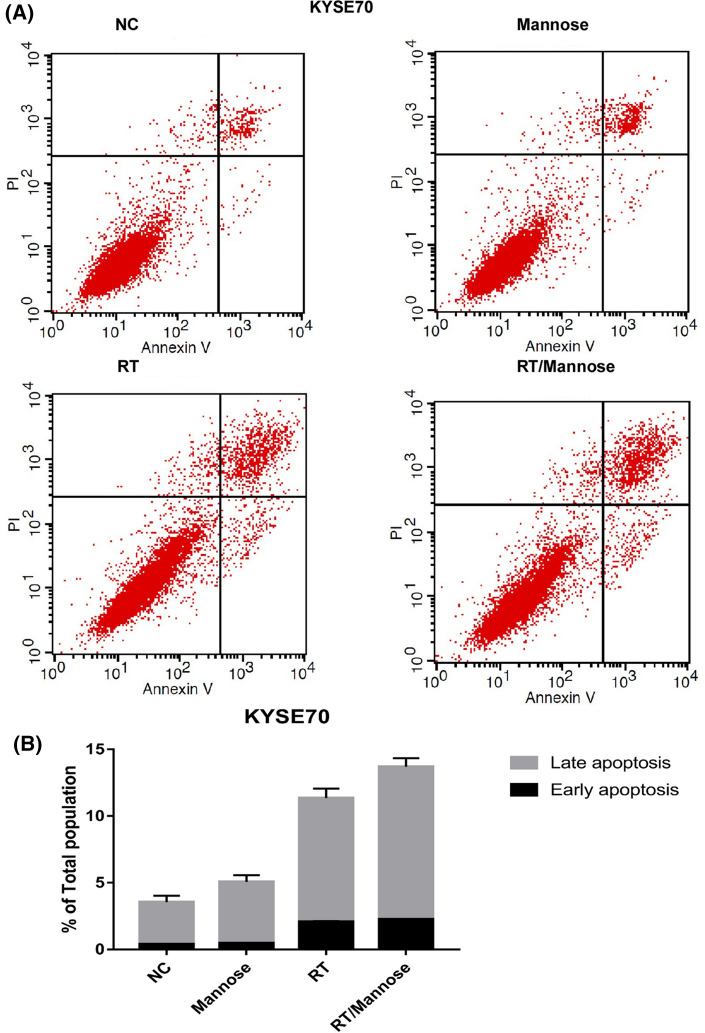
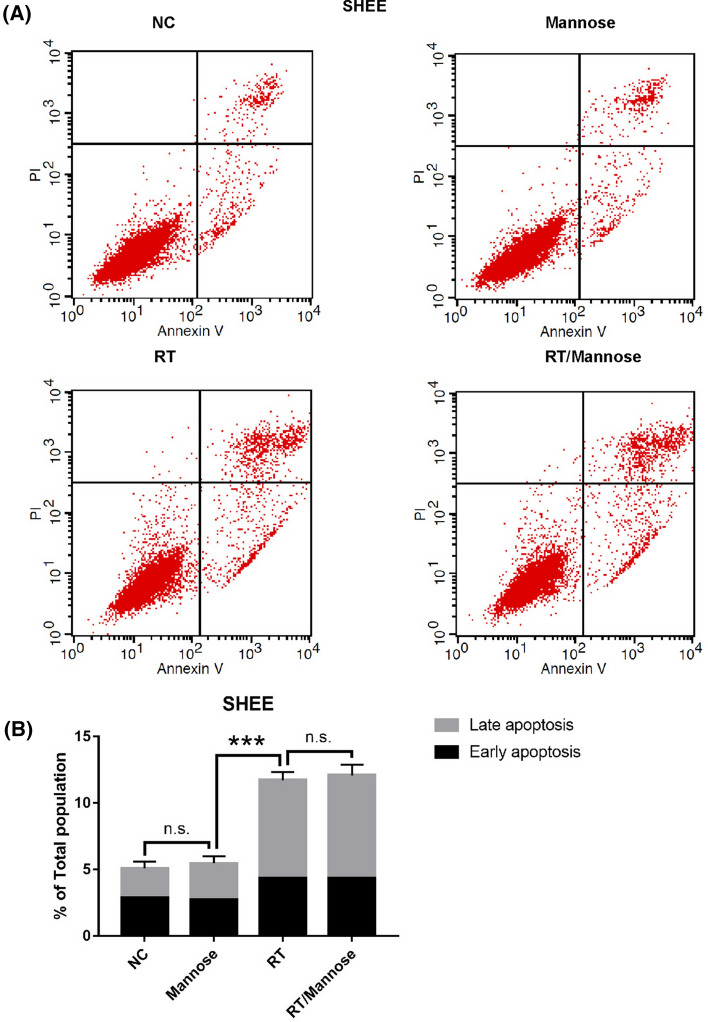
MPI expression was various in human esophageal cancer cells. KYSE70 cells was associated with the highest MPI expression whereas KYSE450 cells had the lowest MPI expression level. When administrated with 11.1 mM/L mannose, the same inhibitory effect was observed in both KYSE70 and KYSE450 cell lines. Moreover, the inhibitory effect was significant on KYSE450 cell lines with an increased mannose concentration. The application of 11.1 mM/L mannose could significantly enhance the radio-sensitivity of KYSE450 cell line; and tumor cell apoptosis rate was also increased. However, there was limited efficacy of mannose on the radio-sensitivity and apoptosis rate of KYSE70 cell line. Additionally, intracellular metabolites analyzation revealed that glycolysis could be disturbed by mannose when combined with radiation therapy in esophageal cancer cells.
In esophageal cancer cell lines with low MPI expression, the administration of mannose was associated with enhanced radio-sensitivity.
探讨甘露糖对人食管鳞状细胞癌(ESCC)细胞系放射敏感性的影响及其可能机制。
采用蛋白质免疫印迹法检测人食管癌细胞系中磷酸甘露糖异构酶(MPI)的表达。采用MTT法观察甘露糖对人食管癌细胞系的抑制作用。进行平板克隆形成试验以研究甘露糖对人食管癌细胞放射敏感性的影响。采用流式细胞术计算经甘露糖和/或放射治疗处理的肿瘤细胞凋亡率。此外,我们使用液相色谱质谱法分析细胞内代谢物,以鉴定选择性糖代谢物。
MPI在人食管癌细胞中的表达各不相同。KYSE70细胞的MPI表达最高,而KYSE450细胞的MPI表达水平最低。当给予11.1 mM/L甘露糖时,KYSE70和KYSE450细胞系均观察到相同的抑制作用。此外,随着甘露糖浓度的增加,对KYSE450细胞系的抑制作用显著。应用11.1 mM/L甘露糖可显著增强KYSE450细胞系的放射敏感性;肿瘤细胞凋亡率也增加。然而,甘露糖对KYSE70细胞系的放射敏感性和凋亡率的影响有限。此外,细胞内代谢物分析显示,在食管癌细胞中,甘露糖与放射治疗联合使用时可干扰糖酵解。
在MPI表达较低的食管癌细胞系中,给予甘露糖可增强放射敏感性。