Department of Cell Biology, Faculty of Sciences, University of Granada, Av. Fuentenueva, 18071 Granada, Spain.
Department of Cell Biology and Immunology, Institute of Parasitology and Biomedicine López-Neyra, IPBLN-CSIC, Av. Conocimiento 17, Parque Tecnológico de la Salud, 18016 Granada, Spain.
Biomolecules. 2022 Jan 27;12(2):219. doi: 10.3390/biom12020219.
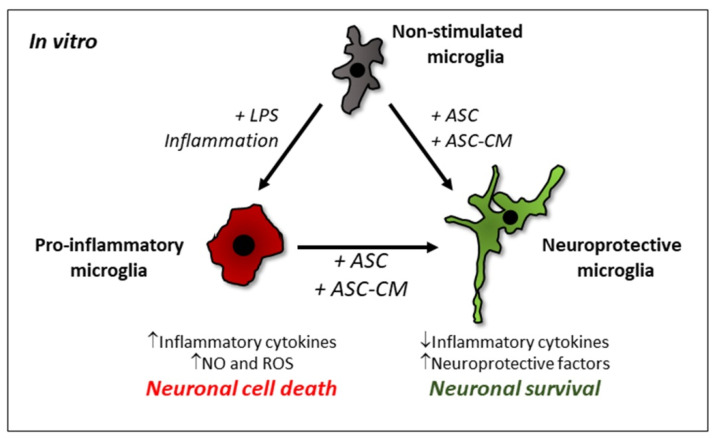
Neurological disorders, including neurodegenerative diseases, are often characterized by neuroinflammation, which is largely driven by microglia, the resident immune cells of the central nervous system (CNS). Under these conditions, microglia are able to secrete neurotoxic substances, provoking neuronal cell death. However, microglia in the healthy brain carry out CNS-supporting functions. This is due to the ability of microglia to acquire different phenotypes that can play a neuroprotective role under physiological conditions or a pro-inflammatory, damaging one during disease. Therefore, therapeutic strategies focus on the downregulation of these neuroinflammatory processes and try to re-activate the neuroprotective features of microglia. Mesenchymal stem cells (MSC) of different origins have been shown to exert such effects, due to their immunomodulatory properties. In recent years, MSC derived from adipose tissue have been made the center of attention because of their easy availability and extraction methods. These cells induce a neuroprotective phenotype in microglia and downregulate neuroinflammation, resulting in an improvement of clinical symptoms in a variety of animal models for neurological pathologies, e.g., Alzheimer's disease, traumatic brain injury and ischemic stroke. In this review, we will discuss the application of adipose tissue-derived MSC and their conditioned medium, including extracellular vesicles, in neurological disorders, their beneficial effect on microglia and the signaling pathways involved.
神经紊乱,包括神经退行性疾病,其特征通常为神经炎症,这在很大程度上是由中枢神经系统(CNS)中的常驻免疫细胞小胶质细胞驱动的。在这些情况下,小胶质细胞能够分泌神经毒性物质,引发神经元细胞死亡。然而,健康大脑中的小胶质细胞具有支持 CNS 的功能。这是因为小胶质细胞能够获得不同的表型,在生理条件下可以发挥神经保护作用,而在疾病期间则发挥促炎、损伤作用。因此,治疗策略侧重于下调这些神经炎症过程,并尝试重新激活小胶质细胞的神经保护特性。不同来源的间充质干细胞(MSC)由于其免疫调节特性,被证明具有这种作用。近年来,由于其易于获得和提取方法,源自脂肪组织的 MSC 成为了关注的焦点。这些细胞诱导小胶质细胞产生神经保护表型,并下调神经炎症,从而改善各种神经病理学动物模型(例如阿尔茨海默病、创伤性脑损伤和缺血性中风)中的临床症状。在这篇综述中,我们将讨论脂肪组织来源的 MSC 及其条件培养基,包括细胞外囊泡,在神经紊乱中的应用,它们对小胶质细胞的有益作用以及涉及的信号通路。