Avots Egils, Jermakovs Klāvs, Bachmann Maie, Päeske Laura, Ozcinar Cagri, Anbarjafari Gholamreza
iCV Lab, Institute of Technology, University of Tartu, 51009 Tartu, Estonia.
Biosignal Processing Laboratory, Tallinn University of Technology, 19086 Tallinn, Estonia.
Entropy (Basel). 2022 Jan 28;24(2):211. doi: 10.3390/e24020211.
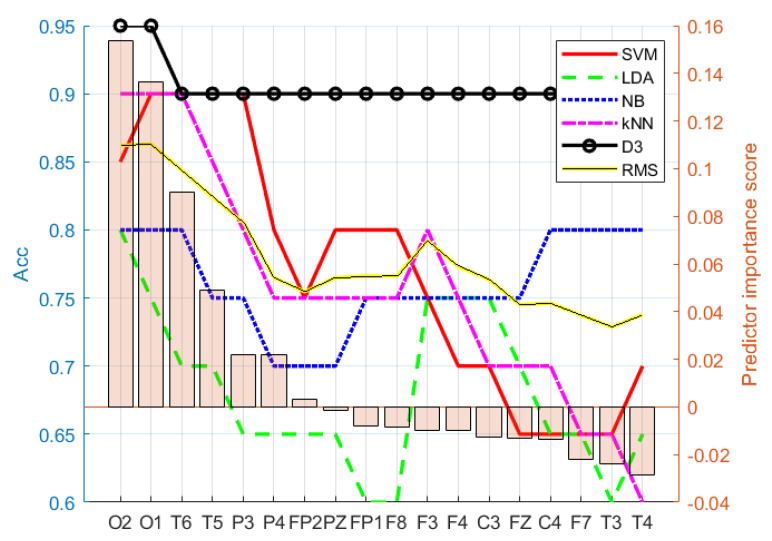
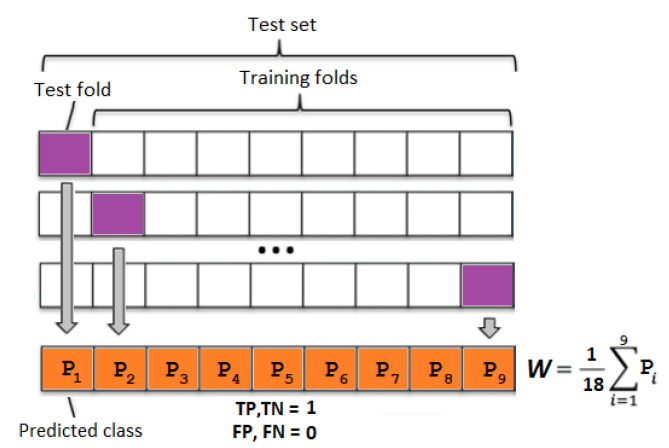
Depression is a public health issue that severely affects one's well being and can cause negative social and economic effects to society. To raise awareness of these problems, this research aims at determining whether the long-lasting effects of depression can be determined from electroencephalographic (EEG) signals. The article contains an accuracy comparison for SVM, LDA, NB, kNN, and D3 binary classifiers, which were trained using linear (relative band power, alpha power variability, spectral asymmetry index) and nonlinear (Higuchi fractal dimension, Lempel-Ziv complexity, detrended fluctuation analysis) EEG features. The age- and gender-matched dataset consisted of 10 healthy subjects and 10 subjects diagnosed with depression at some point in their lifetime. Most of the proposed feature selection and classifier combinations achieved accuracy in the range of 80% to 95%, and all the models were evaluated using a 10-fold cross-validation. The results showed that the motioned EEG features used in classifying ongoing depression also work for classifying the long-lasting effects of depression.
抑郁症是一个严重影响个人幸福并会给社会带来负面社会和经济影响的公共卫生问题。为提高对这些问题的认识,本研究旨在确定是否可以从脑电图(EEG)信号中判断出抑郁症的长期影响。本文对支持向量机(SVM)、线性判别分析(LDA)、朴素贝叶斯(NB)、k近邻(kNN)和D3二元分类器进行了准确率比较,这些分类器使用线性(相对频段功率、阿尔法功率变异性、频谱不对称指数)和非线性( Higuchi分形维数、Lempel-Ziv复杂度、去趋势波动分析)脑电图特征进行训练。年龄和性别匹配的数据集包括10名健康受试者和10名在其一生中曾被诊断为抑郁症的受试者。大多数提出的特征选择和分类器组合的准确率在80%至95%之间,并且所有模型均使用10折交叉验证进行评估。结果表明,用于对当前抑郁症进行分类的上述脑电图特征也适用于对抑郁症的长期影响进行分类。