Fun Weng Hong, Tan Ee Hong, Khalid Ruzelan, Sararaks Sondi, Tang Kar Foong, Ab Rahim Iqbal, Md Sharif Shakirah, Jawahir Suhana, Sibert Raoul Muhammad Yusof, Nawawi Mohd Kamal Mohd
Institute for Health Systems Research, National Institutes of Health, Ministry of Health Malaysia, Shah Alam 40170, Malaysia.
Institute of Strategic Industrial Decision Modelling, School of Quantitative Sciences, Universiti Utara Malaysia, Sintok 06010, Malaysia.
Healthcare (Basel). 2022 Jan 19;10(2):189. doi: 10.3390/healthcare10020189.
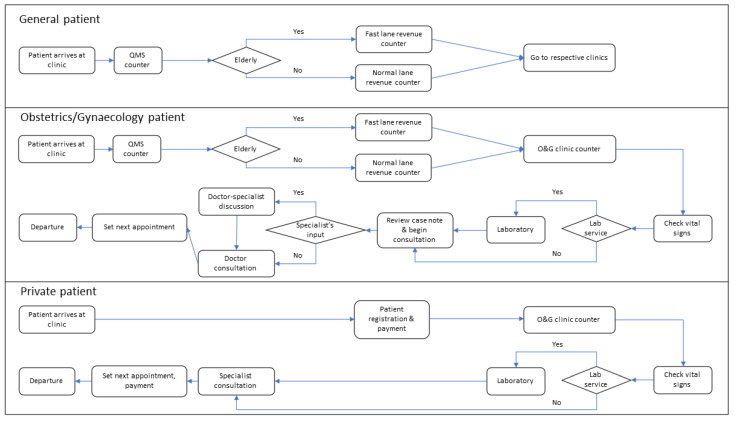
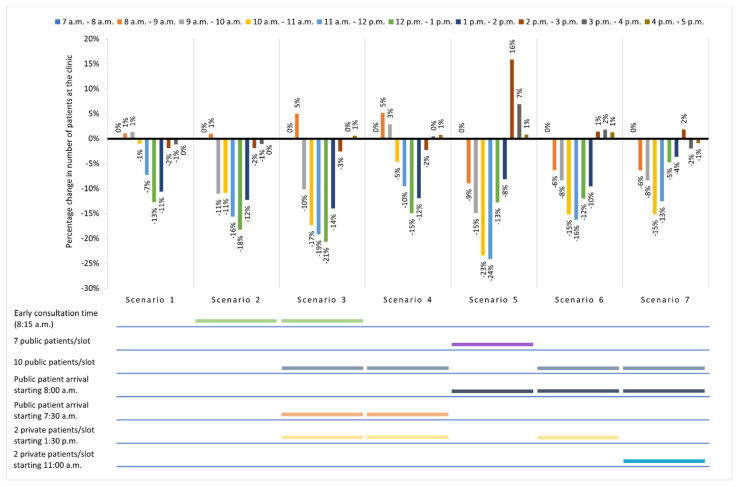
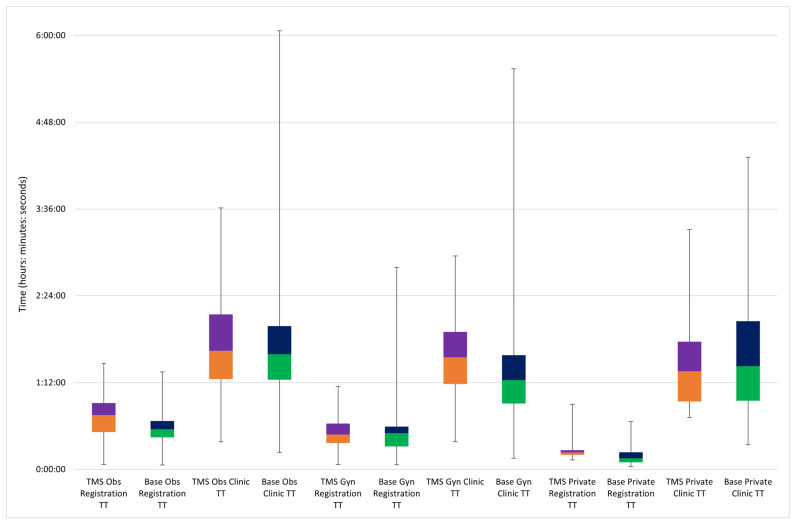
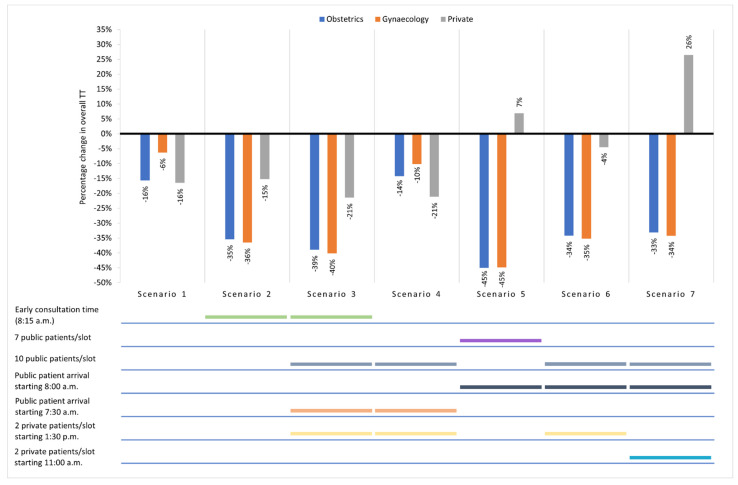
Long wait times and crowding are major issues affecting outpatient service delivery, but it is unclear how these affect patients in dual practice settings. This study aims to evaluate the effects of changing consultation start time and patient arrival on wait times and crowding in an outpatient clinic with a dual practice system. A discrete event simulation (DES) model was developed based on real-world data from an Obstetrics and Gynaecology (O&G) clinic in a public hospital. Data on patient flow, resource availability, and time taken for registration and clinic processes for public and private patients were sourced from stakeholder discussion and time-motion study (TMS), while arrival times were sourced from the hospital's information system database. Probability distributions were used to fit these input data in the model. Scenario analyses involved configurations on consultation start time/staggered patient arrival. The median registration and clinic turnaround times (TT) were significantly different between public and private patients ( < 0.01). Public patients have longer wait times than private patients in this study's dual practice setting. Scenario analyses showed that early consultation start time that matches patient arrival time and staggered arrival could reduce the overall TT for public and private patients by 40% and 21%, respectively. Similarly, the number of patients waiting at the clinic per hour could be reduced by 10-21% during clinic peak hours. Matching consultation start time with staggered patient arrival can potentially reduce wait times and crowding, especially for public patients, without incurring additional resource needs and help narrow the wait time gap between public and private patients. Healthcare managers and policymakers can consider simulation approaches for the monitoring and improvement of healthcare operational efficiency to meet rising healthcare demand and costs.
长时间等待和拥挤是影响门诊服务提供的主要问题,但目前尚不清楚这些因素在双重执业环境中对患者有何影响。本研究旨在评估在具有双重执业系统的门诊诊所中,改变会诊开始时间和患者到达时间对等待时间和拥挤情况的影响。基于一家公立医院妇产科诊所的实际数据开发了一个离散事件模拟(DES)模型。关于患者流量、资源可用性以及公立和私立患者的登记和诊疗流程所需时间的数据,来自利益相关者讨论和时间动作研究(TMS),而到达时间则来自医院的信息系统数据库。使用概率分布将这些输入数据拟合到模型中。情景分析涉及会诊开始时间/错开患者到达时间的配置。公立和私立患者的登记和诊疗周转时间(TT)中位数存在显著差异(<0.01)。在本研究的双重执业环境中,公立患者的等待时间比私立患者更长。情景分析表明,与患者到达时间相匹配的早期会诊开始时间和错开到达时间,可分别将公立和私立患者的总体TT降低40%和21%。同样,在诊疗高峰时段,每小时在诊所等待的患者数量可减少10 - 21%。将会诊开始时间与错开的患者到达时间相匹配,有可能减少等待时间和拥挤情况,尤其是对公立患者而言,且无需增加资源需求,并有助于缩小公立和私立患者之间的等待时间差距。医疗管理者和政策制定者可考虑采用模拟方法来监测和提高医疗运营效率,以满足不断增长的医疗需求和成本。