Cruz-Ramos Nancy Aracely, Alor-Hernández Giner, Colombo-Mendoza Luis Omar, Sánchez-Cervantes José Luis, Rodríguez-Mazahua Lisbeth, Guarneros-Nolasco Luis Rolando
Tecnológico Nacional de México/I. T. Orizaba, Av. Oriente 9, No. 852, Col. Emiliano Zapata, Orizaba, Veracruz C.P. 94320, Mexico.
Tecnológico Nacional de México/Instituto Tecnológico Superior de Teziutlán, Fracción l y ll, Teziutlán, Puebla C.P. 73960, Mexico.
Healthcare (Basel). 2022 Feb 8;10(2):322. doi: 10.3390/healthcare10020322.
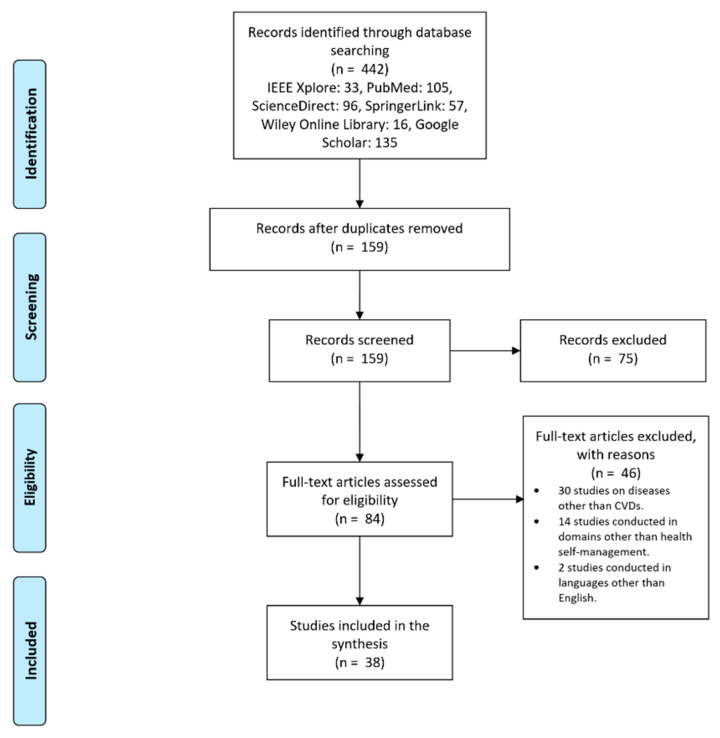
The use of mHealth apps for the self-management of cardiovascular diseases (CVDs) is an increasing trend in patient-centered care. In this research, we conduct a scoping review of mHealth apps for CVD self-management within the period 2014 to 2021. Our review revolves around six main aspects of the current status of mHealth apps for CVD self-management: main CVDs managed, main app functionalities, disease stages managed, common approaches used for data extraction, analysis, management, common wearables used for CVD detection, monitoring and/or identification, and major challenges to overcome and future work remarks. Our review is based on Arksey and O'Malley's methodological framework for conducting studies. Similarly, we adopted the PRISMA model for reporting systematic reviews and meta-analyses. Of the 442 works initially retrieved, the review comprised 38 primary studies. According to our results, the most common CVDs include arrhythmia (34%), heart failure (32%), and coronary heart disease (18%). Additionally, we found that the majority mHealth apps for CVD self-management can provide medical recommendations, medical appointments, reminders, and notifications for CVD monitoring. Main challenges in the use of mHealth apps for CVD self-management include overcoming patient reluctance to use the technology and achieving the interoperability of mHealth applications with other systems.
在以患者为中心的医疗中,使用移动健康(mHealth)应用程序进行心血管疾病(CVD)的自我管理呈上升趋势。在本研究中,我们对2014年至2021年期间用于CVD自我管理的mHealth应用程序进行了范围综述。我们的综述围绕用于CVD自我管理的mHealth应用程序现状的六个主要方面展开:所管理的主要CVD、主要应用程序功能、所管理的疾病阶段、用于数据提取、分析、管理的常用方法、用于CVD检测、监测和/或识别的常用可穿戴设备,以及需要克服的主要挑战和对未来工作的评论。我们的综述基于Arksey和O'Malley进行研究的方法框架。同样,我们采用PRISMA模型报告系统评价和荟萃分析。在最初检索的442项研究中,该综述纳入了38项主要研究。根据我们的结果,最常见的CVD包括心律失常(34%)、心力衰竭(32%)和冠心病(18%)。此外,我们发现大多数用于CVD自我管理的mHealth应用程序可以提供医疗建议、医疗预约、提醒以及CVD监测通知。使用mHealth应用程序进行CVD自我管理的主要挑战包括克服患者对使用该技术的抵触情绪,以及实现mHealth应用程序与其他系统的互操作性。