Matos Rita, Taillieu Emily, De Bruyckere Sofie, De Witte Chloë, Rêma Alexandra, Santos-Sousa Hugo, Nogueiro Jorge, Reis Celso A, Carneiro Fátima, Haesebrouck Freddy, Amorim Irina, Gärtner Fátima
Instituto de Investigação e Inovação em Saúde (i3S), Universidade do Porto, 4200-135 Porto, Portugal.
Institute of Pathology and Molecular Immunology, University of Porto (IPATIMUP), 4200-135 Porto, Portugal.
J Pers Med. 2022 Jan 29;12(2):181. doi: 10.3390/jpm12020181.
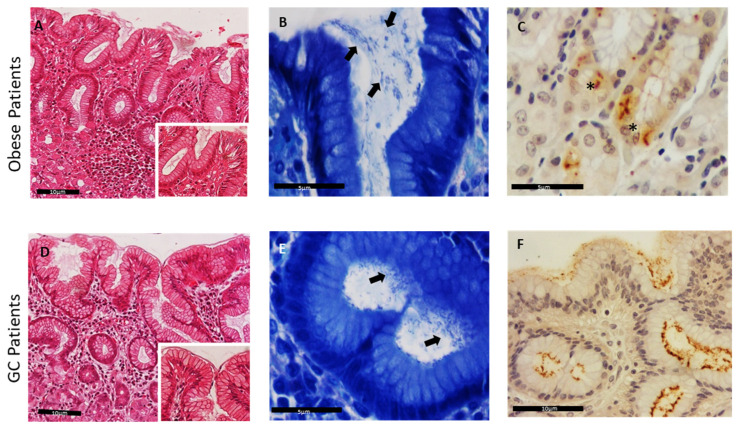
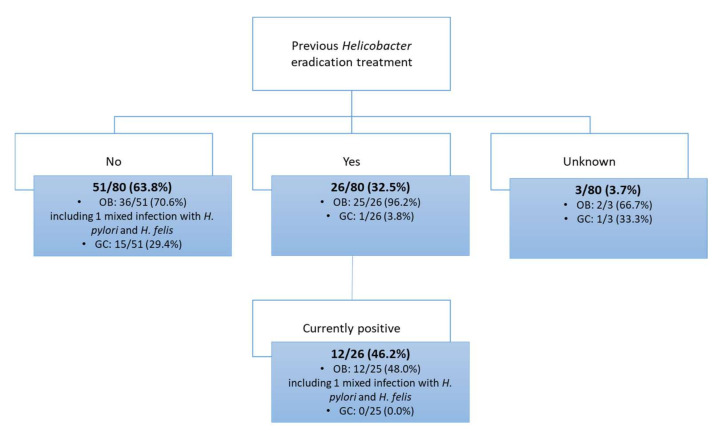
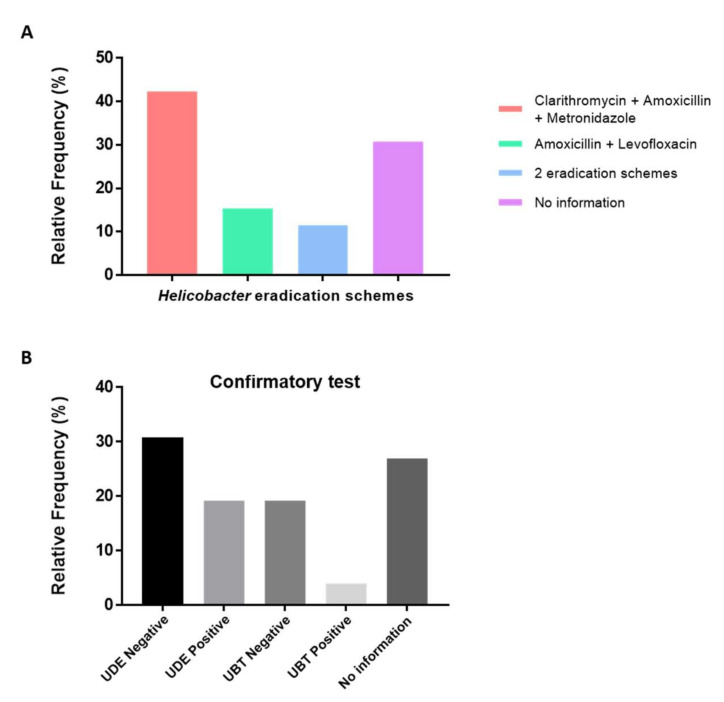
The genus is composed of bacteria that colonize both the human and animal gastrointestinal tract. infects half of the world's population, causing various disorders, such as gastritis, duodenitis and gastric cancer. Additionally, non- species (NHPH) are commonly found in the stomach of pigs, dogs and cats. Most of these species have zoonotic potential and prevalence rates of 0.2-6.0%, and have been described in human patients suffering from gastric disorders undergoing a gastric biopsy. The aim of this study was to determine the occurrence of spp. in the stomach of patients with gastric cancer ( = 17) and obese ( = 63) patients. Furthermore, the outcome of the eradication treatment and the current infection status was evaluated. Overall, based on the genus-specific PCR followed by sequencing, DNA from spp. was detected in 46.3% of the patients, including single infections with in 43.8% of the patients and mixed infections with and canine- or feline-associated in 2.5%. About 32.5% of the patients had been subjected to previous eradication therapy and the triple standard therapy was the most frequent scheme (42.3%). In 48.0% of the patients who received eradication treatment, bacteria were still detected, including one mixed infection. In 23.1% of the patients who reported that a subsequent test had been performed to confirm the elimination of the bacteria, were still detected. In conclusion, although in a smaller percentage, NHPH may also be present in the human stomach. Thus, specific NHPH screening should be included in the diagnostic routine. The continued presence of in the stomach of patients recently subjected to eradication schemes raises questions about the efficacy of the current treatments.
该属由定殖于人类和动物胃肠道的细菌组成。幽门螺杆菌感染了世界上一半的人口,引发各种疾病,如胃炎、十二指肠炎症和胃癌。此外,非幽门螺杆菌(NHPH)常见于猪、狗和猫的胃部。这些物种大多具有人畜共患病潜力,患病率为0.2 - 6.0%,并且在接受胃活检的患有胃部疾病的人类患者中已有描述。本研究的目的是确定胃癌患者(n = 17)和肥胖患者(n = 63)胃中幽门螺杆菌属物种的存在情况。此外,还评估了幽门螺杆菌根除治疗的结果和当前的感染状况。总体而言,基于属特异性聚合酶链反应(PCR)随后进行测序,在46.3%的患者中检测到了幽门螺杆菌属物种的DNA,其中43.8%的患者为幽门螺杆菌单一感染,2.5%的患者为幽门螺杆菌与犬或猫相关的非幽门螺杆菌混合感染。约32.5%的患者曾接受过先前的幽门螺杆菌根除治疗,三联标准疗法是最常用的方案(42.3%)。在接受根除治疗的患者中,48.0%的患者仍检测到细菌,包括一例混合感染。在报告随后进行了检测以确认细菌已被清除的患者中,23.1%的患者仍检测到幽门螺杆菌。总之,尽管比例较小,但非幽门螺杆菌也可能存在于人类胃部。因此,在诊断常规中应包括特定的非幽门螺杆菌筛查。近期接受根除治疗方案的患者胃中持续存在幽门螺杆菌,这引发了对当前幽门螺杆菌治疗效果的质疑。