Amorim Irina, Smet Annemieke, Alves Odete, Teixeira Silvia, Saraiva Ana Laura, Taulescu Marian, Reis Celso, Haesebrouck Freddy, Gärtner Fátima
Instituto de Investigação e Inovação em Saúde, Universidade do Porto, Porto, Portugal ; IPATIMUP - Institute of Molecular Pathology and Immunology of the University of Porto, Rua Dr. Roberto Frias s/n, 4200-465 Porto, Portugal ; Institute of Biomedical Sciences Abel Salazar (ICBAS), University of Porto, Rua Jorge Viterbo Ferreira nr.228, 4050-313 Porto, Portugal.
Faculty of Veterinary Medicine, Ghent University, Salisburylaan 133, Merelbeke, B-9820 Belgium.
Gut Pathog. 2015 Apr 16;7:12. doi: 10.1186/s13099-015-0057-1. eCollection 2015.
Non-Helicobacter pylori Helicobacters (NHPH) are also able to cause disease in humans. Dogs are a natural reservoir for many of these species. Close and intense human contact with animals has been identified as a risk factor and therefore, an important zoonotic significance has been attributed to NHPH.
To determine the prevalence of Helicobacter species and the gastric histopathological changes associated, gastric mucosa samples of 69 dogs were evaluated.
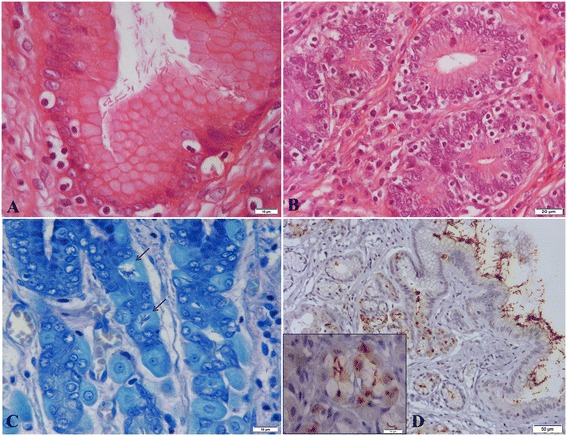
Only one dog presented a normal histopathological mucosa with absence of spiral-shaped organisms. A normal gastric mucosa and the presence of spiral-shaped bacteria was observed in two dogs. All remaining animals presented histopathological changes representative of gastritis. Helicobacter species were detected in 60 dogs (87.0%) by at least one detection method. Histological, histochemical and immunohistochemical evaluations revealed that Helicobacter spp. were present in 45 (65.2%), 52 (75.4%) and 57 (82.6%) dogs, respectively. Spiral-shaped bacteria were detected by qPCR analysis in 33 (47.8%) dogs. H. heilmannii-like organisms were identified in 22 animals (66.7%) and predominantly in the antral gastric region. H. salomonis was the second most prevalent species (51.5%) although it was mainly found in association with other Helicobacter spp. and in the body gastric region. H. bizzozeronii and H. felis were less frequently detected.
It was concluded that, despite the high incidence and worldwide distribution of gastric NHPH in dogs, the presence of specific Helicobacter species may vary between geographic regions. NHPH infections were significantly accompanied by mild to moderate intraepithelial lymphocyte infiltration and mild to moderate gastric epithelial injury, but a clear relationship between gastritis and Helicobacter infection could not be established.
非幽门螺杆菌属螺旋杆菌(NHPH)也能够在人类中引发疾病。狗是其中许多菌种的自然宿主。与动物的密切和频繁接触已被确定为一个风险因素,因此,NHPH具有重要的人畜共患病意义。
为了确定螺旋杆菌属菌种的患病率以及相关的胃组织病理学变化,对69只狗的胃黏膜样本进行了评估。
只有一只狗的组织病理学黏膜正常,未发现螺旋形生物体。两只狗的胃黏膜正常且存在螺旋形细菌。其余所有动物均呈现出代表胃炎的组织病理学变化。通过至少一种检测方法在60只狗(87.0%)中检测到了螺旋杆菌属菌种。组织学、组织化学和免疫组织化学评估显示,螺旋杆菌属分别存在于45只(65.2%)、52只(75.4%)和57只(82.6%)狗中。通过qPCR分析在33只狗(47.8%)中检测到了螺旋形细菌。在22只动物(66.7%)中鉴定出了海尔曼螺旋杆菌样生物体,且主要存在于胃窦区域。萨洛蒙螺旋杆菌是第二常见的菌种(51.5%),不过它主要与其他螺旋杆菌属菌种一起被发现,且存在于胃体区域。比氏螺旋杆菌和猫螺旋杆菌的检测频率较低。
得出的结论是,尽管狗的胃NHPH在全球范围内发病率高且分布广泛,但特定螺旋杆菌属菌种的存在可能因地理区域而异。NHPH感染明显伴有轻度至中度上皮内淋巴细胞浸润和轻度至中度胃上皮损伤,但无法确定胃炎与螺旋杆菌感染之间存在明确关系。