Pozzan Mario Cesare, Grande Francesco, Mochi Zamperoli Edoardo, Tesini Fabio, Carossa Massimo, Catapano Santo
Department of Prosthodontics, University of Ferrara, Via Luigi Borsari 46, 44121 Ferrara, Italy.
Department of Surgical Sciences CIR Dental School, University of Turin, Via Nizza 230, 10126 Turin, Italy.
Materials (Basel). 2022 Feb 20;15(4):1582. doi: 10.3390/ma15041582.
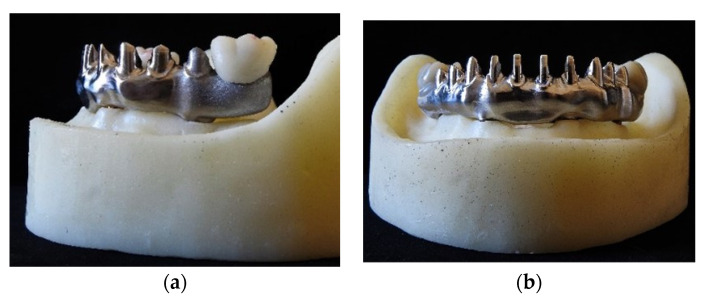
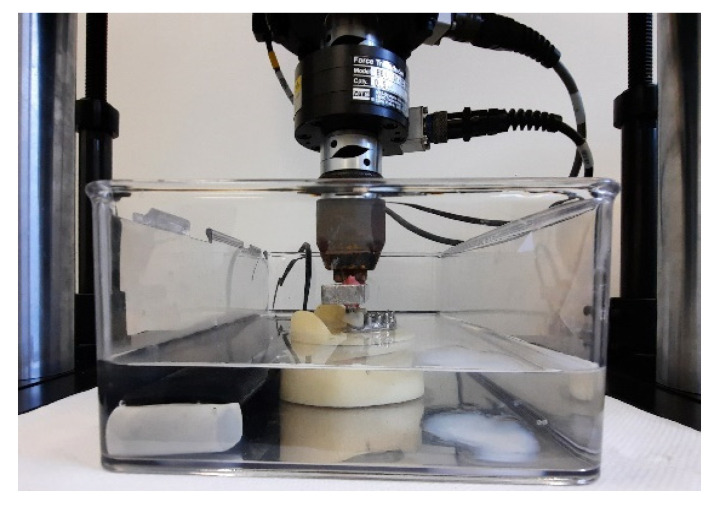
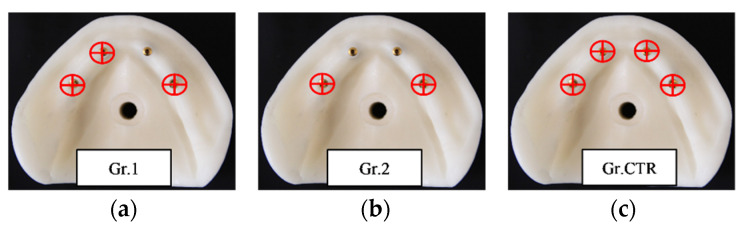
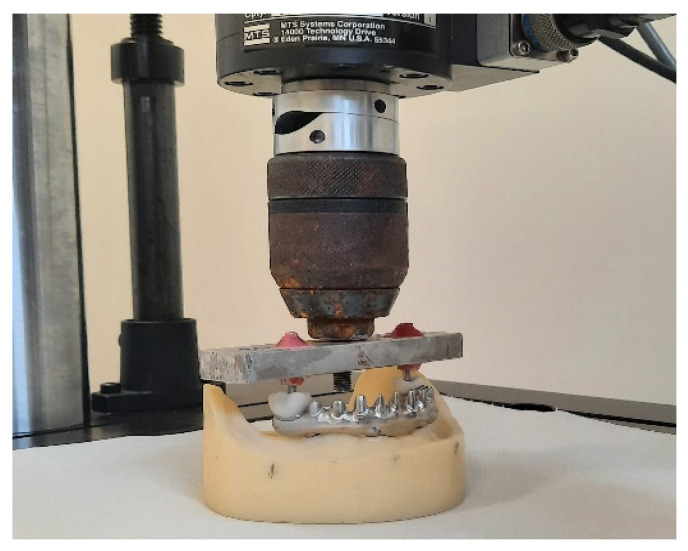
The aim of this study was to evaluate the stability of prosthetic screws after applying cyclic loadings in an "all-on-four" rehabilitation model with the OT Bridge system. The model was tested both with and without anterior screws. Four implant analogues following the "all-on-four" concept were inserted in an edentulous mandibular resin model. An OT Bridge system with a Cr-Co prosthetic framework was fabricated. Depending on the presence or absence of one or two anterior screws on the implant analogues, three groups were created, i.e., Gr.1: three tightening screws, Gr.2: two tightening screws, Control Group: four tightening screws. Each single group underwent subsequent 400,000 cyclic loads, simulating approximately a year of chewing by using a dynamometer machine. This cycle was repeated five times for each group, and preload loss values were evaluated on each prosthetic screw after each cycle. All the data obtained were analyzed by one-way ANOVA and Student's -test. No statistically significant differences after intragroup analysis were found. A statistically significant difference within the Gr.1 between the screws in positions 33 and 36, equal to 15.2% (-value = 0.0176), was found. The OT Bridge seems a useful system to maintain the retention of a prosthesis during mechanical stress conditions even in the absence of one screw in an "all-on-four" rehabilitation. This could represent a good solution to solve the esthetic problem of the screw buccal access hole for fixed solutions.
本研究的目的是在采用OT Bridge系统的“全口四颗种植体”修复模型中,评估施加循环载荷后修复螺丝的稳定性。该模型在有或无前部螺丝的情况下均进行了测试。按照“全口四颗种植体”理念,将四颗种植体代型植入无牙下颌树脂模型中。制作了一个带有钴铬修复框架的OT Bridge系统。根据种植体代型上是否存在一颗或两颗前部螺丝,创建了三组,即:第1组:三颗紧固螺丝;第2组:两颗紧固螺丝;对照组:四颗紧固螺丝。每组均随后承受400,000次循环载荷,使用测力计模拟大约一年的咀嚼过程。每组重复此循环五次,并在每个循环后评估每个修复螺丝的预紧力损失值。对所有获得的数据进行单因素方差分析和学生t检验。组内分析未发现统计学上的显著差异。在第1组中,位置33和36的螺丝之间发现了统计学上的显著差异,等于15.2%(p值 = 0.0176)。OT Bridge似乎是一种有用的系统,即使在“全口四颗种植体”修复中缺少一颗螺丝的情况下,也能在机械应力条件下保持修复体的固位。这可能是解决固定修复中螺丝颊侧接入孔美学问题的一个好方案。