Dumas Thibaut, Courant Frédérique, Fenet Hélène, Gomez Elena
HydroSciences Montpellier, IRD, CNRS, University of Montpellier, Montpellier, France.
Metabolites. 2022 Feb 17;12(2):186. doi: 10.3390/metabo12020186.
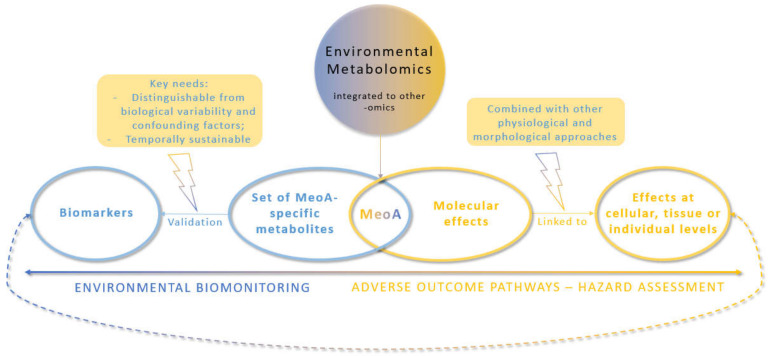
Scientists often set ambitious targets using environmental metabolomics to address challenging ecotoxicological issues. This promising approach has a high potential to elucidate the mechanisms of action (MeOAs) of contaminants (in hazard assessments) and to develop biomarkers (in environmental biomonitoring). However, metabolomics fingerprints often involve a complex mixture of molecular effects that are hard to link to a specific MeOA (if detected in the analytical conditions used). Given these promises and limitations, here we propose an updated review on the achievements of this approach. Metabolomics-based studies conducted on the effects of pharmaceutical active compounds in aquatic organisms provide a relevant means to review the achievements of this approach, as prior knowledge about the MeOA of these molecules could help overcome some shortcomings. This review highlighted that current metabolomics advances have enabled more accurate MeOA assessment, especially when combined with other omics approaches. The combination of metabolomics with other measured biological endpoints has also turned out to be an efficient way to link molecular effects to (sub)-individual adverse outcomes, thereby paving the way to the construction of adverse outcome pathways (AOPs). Here, we also discuss the importance of determining MeOA as a key strategy in the identification of MeOA-specific biomarkers for biomonitoring. We have put forward some recommendations to take full advantage of environmental metabolomics and thus help fulfil these promises.
科学家们常常利用环境代谢组学设定雄心勃勃的目标,以解决具有挑战性的生态毒理学问题。这种前景广阔的方法在阐明污染物的作用机制(用于危害评估)以及开发生物标志物(用于环境生物监测)方面具有很大潜力。然而,代谢组学指纹图谱往往涉及复杂的分子效应混合物,在所用分析条件下(如果检测到)很难将其与特定的作用机制联系起来。鉴于这些前景和局限性,在此我们对该方法的成果进行一次更新综述。对水生生物中药物活性化合物的影响开展的基于代谢组学的研究,为审视该方法的成果提供了一种相关手段,因为关于这些分子作用机制的先验知识有助于克服一些不足。本综述强调,当前代谢组学的进展已使作用机制评估更加准确,尤其是与其他组学方法相结合时。代谢组学与其他测量的生物终点相结合,也已证明是将分子效应与(亚)个体不良后果联系起来的有效方法,从而为构建不良后果途径(AOP)铺平了道路。在此,我们还讨论了确定作用机制作为识别用于生物监测的作用机制特异性生物标志物的关键策略的重要性。我们提出了一些建议,以充分利用环境代谢组学,从而帮助实现这些前景。