Phadungsombat Juthamas, Imad Hisham A, Nakayama Emi E, Leaungwutiwong Pornsawan, Ramasoota Pongrama, Nguitragool Wang, Matsee Wasin, Piyaphanee Watcharapong, Shioda Tatsuo
Mahidol-Osaka Center for Infectious Diseases (MOCID), Faculty of Tropical Medicine, Mahidol University, Bangkok 10400, Thailand.
Center for Infectious Disease Education and Research, Department of Viral Infections, Research Institute for Microbial Diseases (RIMD), Osaka University, Osaka 565-0871, Japan.
Microorganisms. 2022 Feb 3;10(2):354. doi: 10.3390/microorganisms10020354.
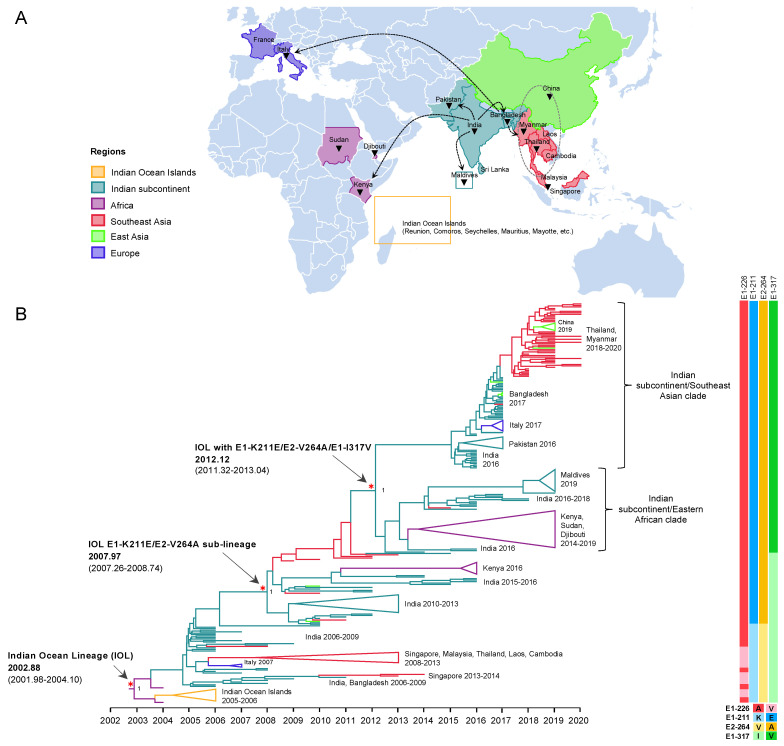
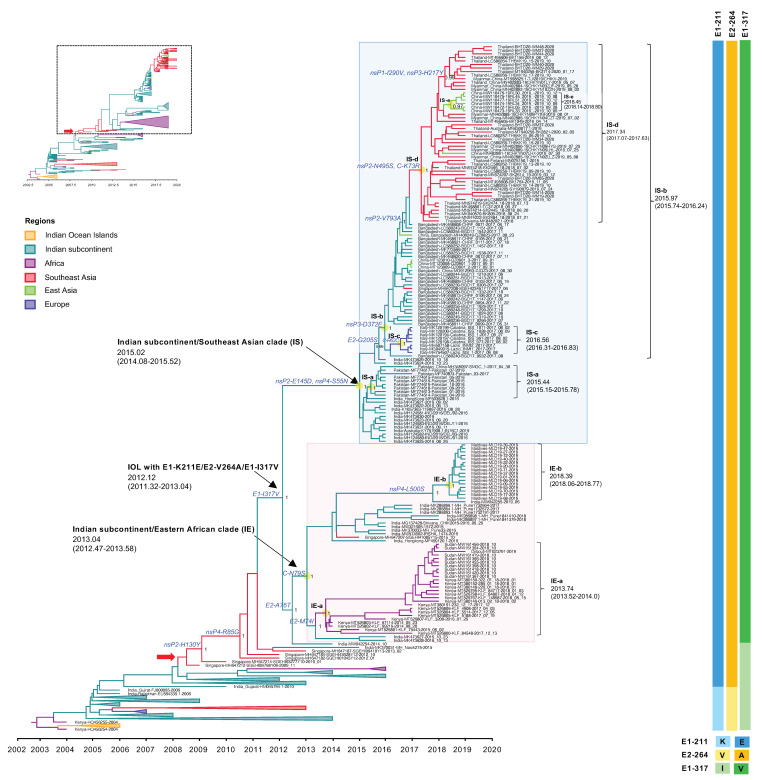
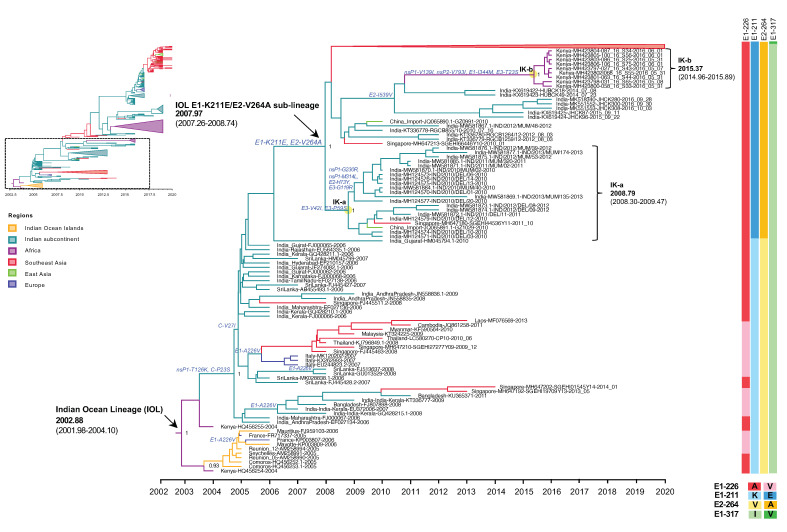
The Indian Ocean Lineage (IOL) of the chikungunya virus (CHIKV) East/Central/South African (ECSA) genotype, which originated in Kenya, spread to the Indian ocean and the Indian subcontinent, and then expanded through Southeast Asia in the previous decade. It carried an adaptive mutation E1-A226V, which enhances CHIKV replication in . However, the IOL CHIKV of the most recent outbreaks during 2016-2020 in India, Pakistan, Bangladesh, the Maldives, Myanmar, Thailand, and Kenya lacked E1-A226V but carried E1-K211E and E2-V264A. Recent CHIKV genome sequences of the Maldives and Thailand were determined, and their phylogenetic relationships were further investigated together with IOL sequences reported in 2004-2020 in the database. The results showed that the ancestral IOLs diverged to a sub-lineage E1-K211E/E2-V264A, probably in India around 2008, and caused sporadic outbreaks in India during 2010-2015 and in Kenya in 2016. The massive expansion of this new sub-lineage occurred after the acquisition of E1-I317V in other neighboring and remote regions in 2014-2020. Additionally, the phylogenetic tree indicated that independent clades formed according to the geographical regions and introduction timing. The present results using all available partial or full sequences of the recent CHIKVs emphasized the dynamics of the IOL sub-lineages in the Indian subcontinent, Southeast Asia, and Eastern Africa.
基孔肯雅病毒(CHIKV)东非/中非/南非(ECSA)基因型的印度洋谱系(IOL)起源于肯尼亚,在过去十年中传播到印度洋和印度次大陆,然后通过东南亚扩散。它携带适应性突变E1-A226V,可增强CHIKV在……中的复制。然而,2016 - 2020年期间在印度、巴基斯坦、孟加拉国、马尔代夫、缅甸、泰国和肯尼亚最近疫情中出现的IOL CHIKV缺乏E1-A226V,但携带E1-K211E和E2-V264A。测定了马尔代夫和泰国最近的CHIKV基因组序列,并将其与数据库中2004 - 2020年报告的IOL序列一起进一步研究其系统发育关系。结果表明,IOL的祖先谱系可能在2008年左右在印度分化为一个E1-K211E/E2-V264A亚谱系,并在2010 - 2015年期间在印度以及2016年在肯尼亚引起零星疫情。这个新亚谱系在2014 - 2020年在其他邻近和偏远地区获得E1-I317V后出现大规模扩张。此外,系统发育树表明根据地理区域和引入时间形成了独立的分支。使用最近CHIKV的所有可用部分或完整序列的当前结果强调了IOL亚谱系在印度次大陆、东南亚和东非的动态变化。