Institute for Asthma and Allergy Prevention (IAP), Helmholtz Zentrum Munich, German Research Center for Environmental Health (GmbH), Munich, Germany.
Dr von Hauner Children's Hospital, Ludwig Maximilians University, Munich, Germany.
Eur Respir J. 2022 Sep 29;60(3). doi: 10.1183/13993003.02288-2021. Print 2022 Sep.
In adults, personalised asthma treatment targets patients with type 2 (T2)-high and eosinophilic asthma phenotypes. It is unclear whether such classification is achievable in children.
To define T2-high asthma with easily accessible biomarkers and compare resulting phenotypes across all ages.
In the multicentre clinical All Age Asthma Cohort (ALLIANCE), 1125 participants (n=776 asthmatics, n=349 controls) were recruited and followed for 2 years (1 year in adults). Extensive clinical characterisation (questionnaires, blood differential count, allergy testing, lung function and sputum induction (in adults)) was performed at baseline and follow-ups. Interleukin (IL)-4, IL-5 and IL-13 were measured after stimulation of whole blood with lipopolysaccharide (LPS) or anti-CD3/CD28.
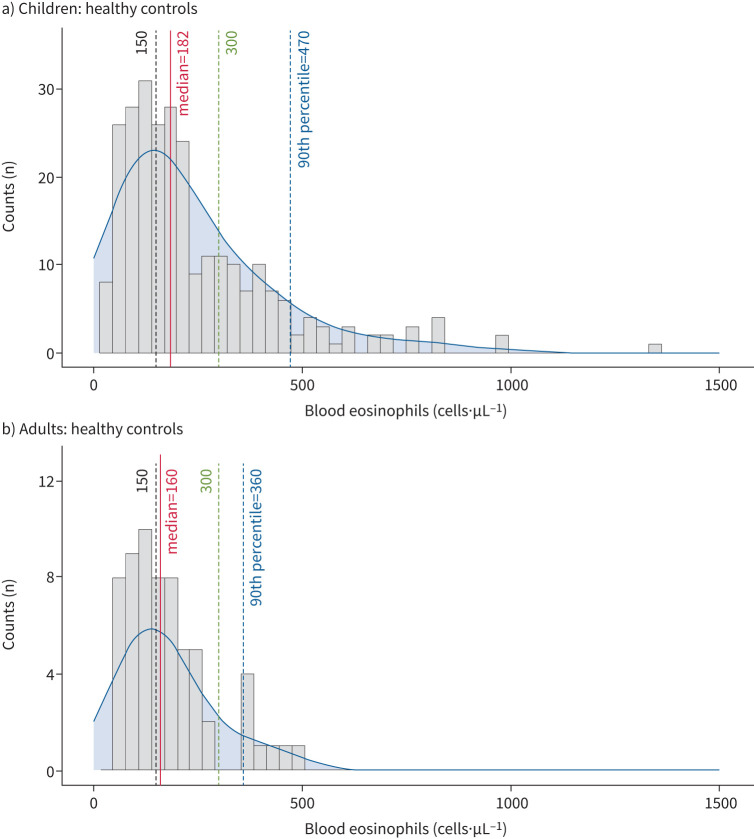
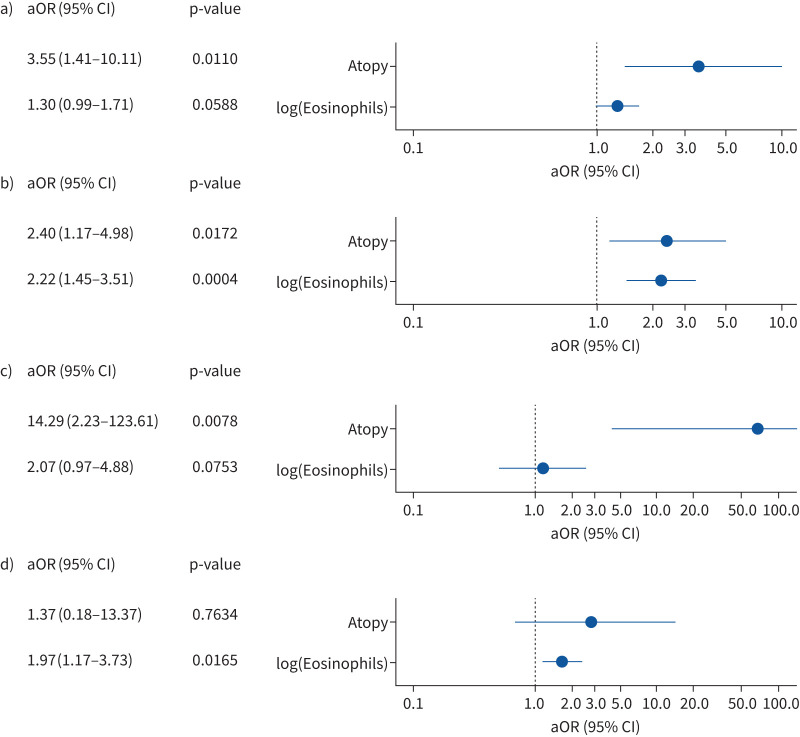
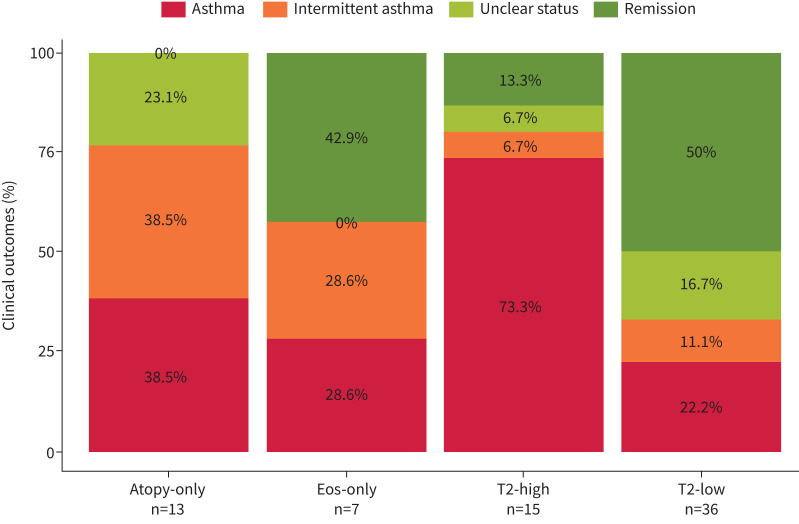
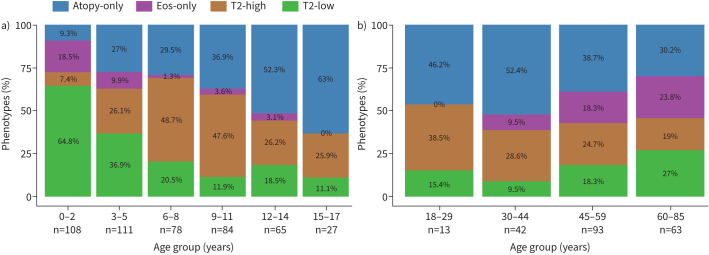
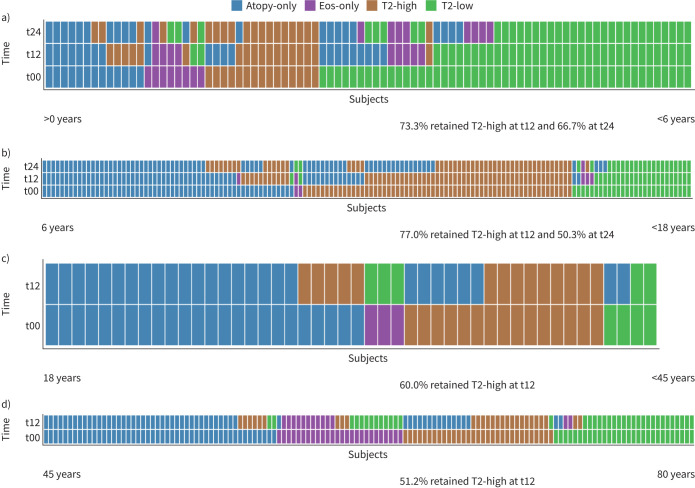
Based on blood eosinophil counts and allergen-specific serum IgE antibodies, patients were categorised into four mutually exclusive phenotypes: "atopy-only", "eosinophils-only", "T2-high" (eosinophilia + atopy) and "T2-low" (neither eosinophilia nor atopy). The T2-high phenotype was found across all ages, even in very young children in whom it persisted to a large degree even after 2 years of follow-up. T2-high asthma in adults was associated with childhood onset, suggesting early origins of this asthma phenotype. In both children and adults, the T2-high phenotype was characterised by excessive production of specific IgE to allergens (p<0.0001) and, from school age onwards, by increased production of IL-5 after anti-CD3/CD28 stimulation of whole blood.
Using easily accessible biomarkers, patients with T2-high asthma can be identified across all ages delineating a distinct phenotype. These patients may benefit from therapy with biologicals even at a younger age.
在成年人中,个性化哮喘治疗针对的是 2 型(T2)高和嗜酸性粒细胞性哮喘表型的患者。目前尚不清楚在儿童中是否可以实现这种分类。
使用易于获取的生物标志物定义 T2 高哮喘,并比较所有年龄段的表型。
在多中心临床全年龄段哮喘队列研究(ALLIANCE)中,招募了 1125 名参与者(n=776 名哮喘患者,n=349 名对照者),并随访 2 年(成人随访 1 年)。在基线和随访时进行了广泛的临床特征评估(问卷调查、血液分类计数、过敏测试、肺功能和诱导痰液(仅在成人中进行))。用脂多糖(LPS)或抗 CD3/CD28 刺激全血后,测量白细胞介素(IL)-4、IL-5 和 IL-13。
根据血液嗜酸性粒细胞计数和过敏原特异性血清 IgE 抗体,将患者分为四个互斥的表型:“仅过敏”、“仅嗜酸性粒细胞”、“T2 高”(嗜酸性粒细胞增多+过敏)和“T2 低”(既无嗜酸性粒细胞增多也无过敏)。T2 高表型存在于所有年龄段,甚至在非常年幼的儿童中,即使在随访 2 年后,它仍在很大程度上持续存在。成人中的 T2 高哮喘与儿童时期发病有关,表明这种哮喘表型具有早期起源。在儿童和成人中,T2 高表型的特征是对过敏原的特异性 IgE 过度产生(p<0.0001),并且从学龄期开始,用抗 CD3/CD28 刺激全血后,IL-5 的产生增加。
使用易于获取的生物标志物,可以在所有年龄段识别出 T2 高哮喘患者,并划定一个独特的表型。这些患者即使在年幼时也可能受益于生物制剂治疗。