Han Lu, Shu Xu, Wang Jian
Department of Gastroenterology, The First Affiliated Hospital of Nanchang University, Nanchang, China.
Jiangxi Clinical Research Center for Gastroenterology, The First Affiliated Hospital of Nanchang University, Nanchang, China.
Front Microbiol. 2022 Feb 8;13:811258. doi: 10.3389/fmicb.2022.811258. eCollection 2022.
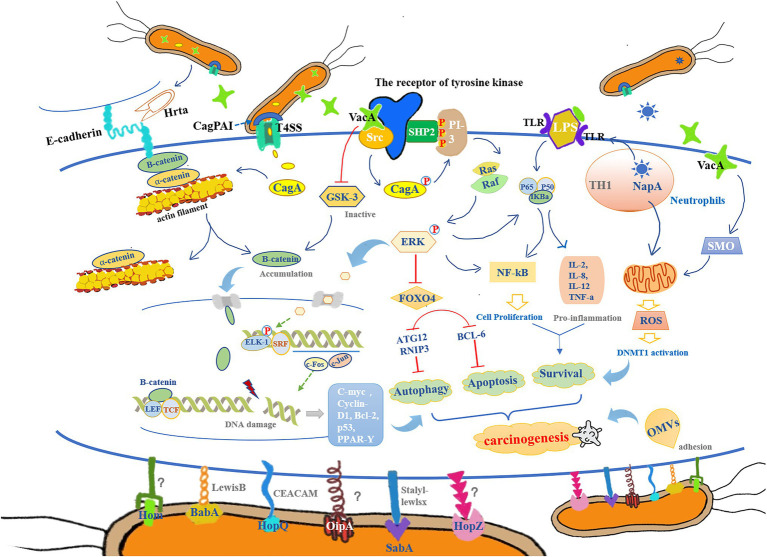
Gastric cancer is considered to be a type of gastrointestinal tumor and is mostly accompanied by (HP) infection at the early stage. Hence, the long-term colonization of the gastric mucosa by HP as a causative factor for gastrointestinal diseases cannot be ignored. The virulence factors secreted by the bacterium activate the signaling pathway of oxidative stress and mediate chronic inflammatory response in the host cells. The virulence factors also thwart the antibacterial effect of neutrophils. Subsequently, DNA methylation is induced, which causes continuous cell proliferation and evolution toward low-grade-differentiated gastric cells. This process provides the pathological basis for the occurrence of progressive gastric cancer. Therefore, this review aims to summarize the oxidative stress response triggered by HP in the gastric mucosa and the subsequent signaling pathways. The findings are expected to help in the formulation of new targeted drugs for preventing the occurrence of early gastric cancer and its progression to middle and advanced cancer.
胃癌被认为是一种胃肠道肿瘤,早期大多伴有幽门螺杆菌(HP)感染。因此,HP作为胃肠道疾病的致病因素在胃黏膜中的长期定植不容忽视。该细菌分泌的毒力因子激活氧化应激信号通路并介导宿主细胞中的慢性炎症反应。这些毒力因子还会阻碍中性粒细胞的抗菌作用。随后,诱导DNA甲基化,导致细胞持续增殖并向低分化胃细胞演变。这一过程为进展期胃癌的发生提供了病理基础。因此,本综述旨在总结HP在胃黏膜中引发的氧化应激反应及随后的信号通路。这些研究结果有望有助于制定新的靶向药物,以预防早期胃癌的发生及其向中晚期癌症的进展。