Tiezzi Margherita, Morra Sofia, Seminerio Jimmy, Van Muylem Alain, Godefroid Audrey, Law-Weng-Sam Noémie, Van Praet Anne, Corbière Véronique, Orte Cano Carmen, Karimi Sina, Del Marmol Véronique, Bondue Benjamin, Benjelloun Mariam, Lavis Philomène, Mascart Françoise, van de Borne Philippe, Cardozo Alessandra K
Department of Cardiology, Erasme University Hospital, Université Libre de Bruxelles, Brussels, Belgium.
Inflammation and Cell Death Signalling Group, Experimental Gastroenterology Laboratory and Endotools-Medical Faculty, ULB, Brussels, Belgium.
Front Med (Lausanne). 2022 Feb 8;8:761299. doi: 10.3389/fmed.2021.761299. eCollection 2021.
Surfactant protein D (SP-D) and pulmonary club cell protein 16 (CC-16) are called "pneumoproteins" and are involved in host defense against oxidative stress, inflammation, and viral outbreak. This study aimed to determine the predictive value of these pneumoproteins on the incidence of acute respiratory distress syndrome (ARDS) or death in patients with coronavirus disease-2019 (COVID-19).
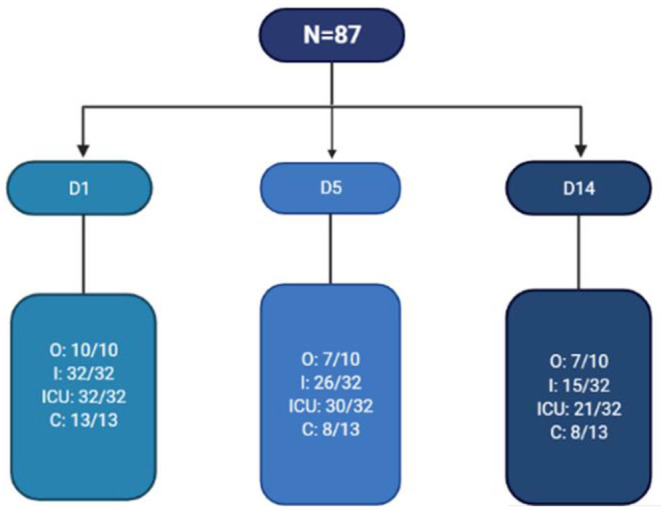
This retrospective study included 87 patients admitted to an emergency department. Blood samples were collected on three time points (days 1, 5, and 14 from hospital admission). SP-D and CC-16 serum levels were determined, and univariate and multivariate analyses considering confounding variables (age, body mass index, tobacco use, dyspnea, hypertension, diabetes mellitus, neutrophil-to-lymphocyte ratio) were performed.
Based on the multivariate analysis, SP-D level on D1 was positively and slightly correlated with subsequent development of ARDS, independent of body mass index, dyspnea, and diabetes mellitus. CC-16 level on D1 was modestly and positively correlated with fatal outcome. A rise in SP-D between D1 and D5 and D1 and D14 had a strong negative association with incidence of ARDS. These associations were independent of tobacco use and neutrophil-to-lymphocyte ratio.
Overall, our data reveal that increase in SP-D levels is a good prognostic factor for patients with COVID-19, and that initial CC-16 levels correlated with slightly higher risk of death. SP-D and CC-16 may prove useful to predict outcomes in patients with COVID-19.
表面活性蛋白D(SP-D)和肺俱乐部细胞蛋白16(CC-16)被称为“肺蛋白”,参与宿主对抗氧化应激、炎症和病毒爆发的防御。本研究旨在确定这些肺蛋白对2019冠状病毒病(COVID-19)患者急性呼吸窘迫综合征(ARDS)发病率或死亡的预测价值。
这项回顾性研究纳入了87名入住急诊科的患者。在三个时间点(入院第1天、第5天和第14天)采集血样。测定SP-D和CC-16血清水平,并进行单因素和多因素分析,同时考虑混杂变量(年龄、体重指数、吸烟、呼吸困难、高血压、糖尿病、中性粒细胞与淋巴细胞比值)。
基于多因素分析,第1天的SP-D水平与ARDS的后续发展呈正相关且相关性较弱,独立于体重指数、呼吸困难和糖尿病。第1天的CC-16水平与致命结局呈中度正相关。第1天至第5天以及第1天至第14天SP-D的升高与ARDS的发病率呈强烈负相关。这些关联独立于吸烟和中性粒细胞与淋巴细胞比值。
总体而言,我们的数据表明,SP-D水平升高是COVID-19患者的良好预后因素,而初始CC-16水平与略高的死亡风险相关。SP-D和CC-16可能有助于预测COVID-19患者的预后。