Departments of Pediatrics, Pathology, and Genetics, Yale University School of Medicine, New Haven, CT.
Blood. 2022 Aug 11;140(6):571-593. doi: 10.1182/blood.2020006479.
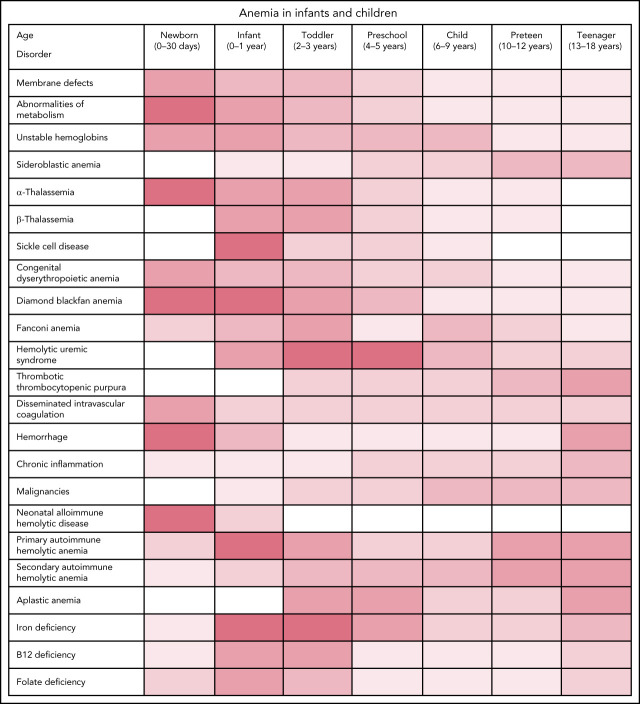
The World Health Organization estimates that approximately a quarter of the world's population suffers from anemia, including almost half of preschool-age children. Globally, iron deficiency anemia is the most common cause of anemia. Other important causes of anemia in children are hemoglobinopathies, infection, and other chronic diseases. Anemia is associated with increased morbidity, including neurologic complications, increased risk of low birth weight, infection, and heart failure, as well as increased mortality. When approaching a child with anemia, detailed historical information, particularly diet, environmental exposures, and family history, often yield important clues to the diagnosis. Dysmorphic features on physical examination may indicate syndromic causes of anemia. Diagnostic testing involves a stepwise approach utilizing various laboratory techniques. The increasing availability of genetic testing is providing new mechanistic insights into inherited anemias and allowing diagnosis in many previously undiagnosed cases. Population-based approaches are being taken to address nutritional anemias. Novel pharmacologic agents and advances in gene therapy-based therapeutics have the potential to ameliorate anemia-associated disease and provide treatment strategies even in the most difficult and complex cases.
世界卫生组织估计,全世界约有四分之一的人口患有贫血症,其中近一半是学龄前儿童。在全球范围内,缺铁性贫血是最常见的贫血症病因。儿童贫血症的其他重要病因包括血红蛋白病、感染和其他慢性疾病。贫血症与发病率增加有关,包括神经系统并发症、低出生体重风险增加、感染和心力衰竭,以及死亡率增加。在治疗贫血儿童时,详细的病史信息,特别是饮食、环境暴露和家族史,通常可以为诊断提供重要线索。体格检查中的畸形特征可能表明贫血症的综合征病因。诊断性检测涉及利用各种实验室技术逐步进行的方法。基因检测的日益普及为遗传性贫血症提供了新的机制见解,并使许多以前无法诊断的病例得以确诊。正在采取基于人群的方法来解决营养性贫血症问题。新型药物和基于基因治疗的治疗方法有潜力改善与贫血症相关的疾病,并为即使是最困难和复杂的病例提供治疗策略。