Phytochemical and Functional Food Research Unit for Clinical Nutrition, Department of Nutrition and Dietetics, Faculty of Allied Health Science, Chulalongkorn University, Bangkok 10330, Thailand.
Nutrients. 2022 Feb 20;14(4):890. doi: 10.3390/nu14040890.
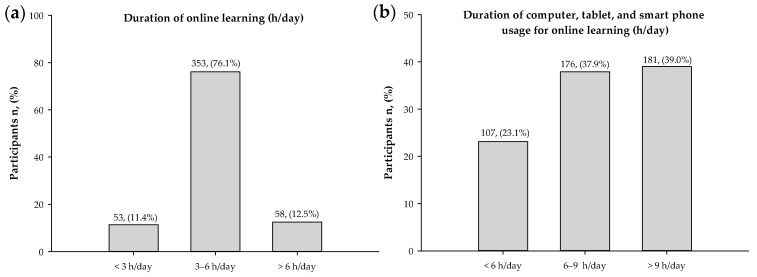
The COVID-19 pandemic caused the abrupt replacement of traditional face-to-face classes into online classes. Several studies showed that online teaching and learning produced adverse mental health for students. However, no research has been conducted so far analyzing the association between the duration of online and food consumption and lifestyle behaviors and quality of life in terms of mental health of undergraduate students. This study aimed to determine the association between the duration of online learning and food consumption behaviors, lifestyles, and quality of life in terms of mental health among Thai undergraduate students during COVID-19 restrictions. A cross-sectional online survey of 464 undergraduate students was conducted at Chulalongkorn University, Bangkok, Thailand, between March and May 2021. The majority of undergraduate students stated that they spent 3-6 h per day on online learning (76.1%) and used their digital devices such as computers, tablets, or smartphones more than 6 h per day (76.9%). In addition, they had 75.4% of skipping breakfast (≥3 times/week) and 63.8% of sleep duration (6-8 h/day). A higher proportion of students who drank tea or coffee with milk and sugar while online learning was observed. The results found that the increased duration of online learning was significantly associated with skipping breakfast and the frequency of sugary beverage consumption. On the other hand, the increased computer, tablet, and smartphone usage for online learning was correlated with lower sleep duration and a poor quality of life in terms of mental health. The findings from this study contribute to a report of the association between online learning and food consumption and lifestyle behaviors and quality of life of undergraduate students, emphasizing the necessity for intervention strategies to promote healthy behaviors.
新冠疫情大流行导致传统的面对面课程突然被网课取代。有几项研究表明,线上教学和学习对学生的心理健康产生了不良影响。然而,目前尚无研究分析在新冠疫情限制期间,大学生在线学习时间与食物消费行为、生活方式以及心理健康方面的生活质量之间的关系。本研究旨在确定在新冠疫情限制期间,泰国大学生的在线学习时间与食物消费行为、生活方式以及心理健康方面的生活质量之间的关系。2021 年 3 月至 5 月,在泰国曼谷的朱拉隆功大学,对 464 名大学生进行了横断面在线调查。大多数大学生表示,他们每天花 3-6 小时进行在线学习(76.1%),每天使用电脑、平板电脑或智能手机等数字设备超过 6 小时(76.9%)。此外,他们有 75.4%的人(每周≥3 次)不吃早餐,63.8%的人(每天 6-8 小时)睡眠不足。观察到更多在上网学习时喝加奶加糖茶或咖啡的学生。研究结果发现,在线学习时间的增加与不吃早餐和含糖饮料消费频率显著相关。另一方面,用于在线学习的电脑、平板电脑和智能手机使用时间增加与睡眠时间减少和心理健康方面的生活质量较差有关。本研究的结果有助于报告大学生在线学习与食物消费行为、生活方式以及心理健康方面的生活质量之间的关系,强调有必要采取干预策略来促进健康行为。