Department of Healthcare Professional, Faculty of Health and Life Sciences, Management and Science University, University Drive, Off Persiaran Olahraga, Seksyen 13, Shah Alam 40100, Malaysia.
Department of Allied Health Sciences, Faculty of Science, Universiti Tunku Abdul Rahman, Jalan Universiti, Bandar Barat, Kampar 31900, Malaysia.
Nutrients. 2021 Oct 23;13(11):3752. doi: 10.3390/nu13113752.
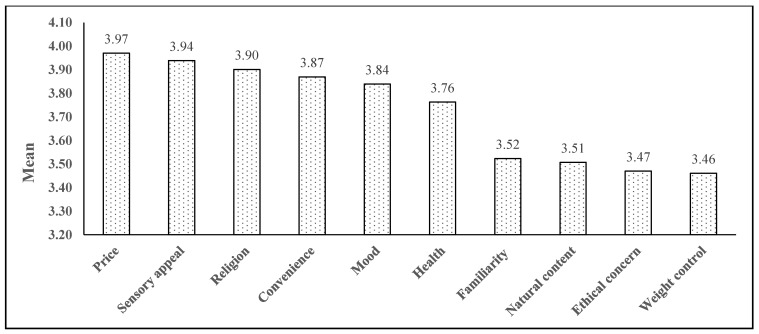
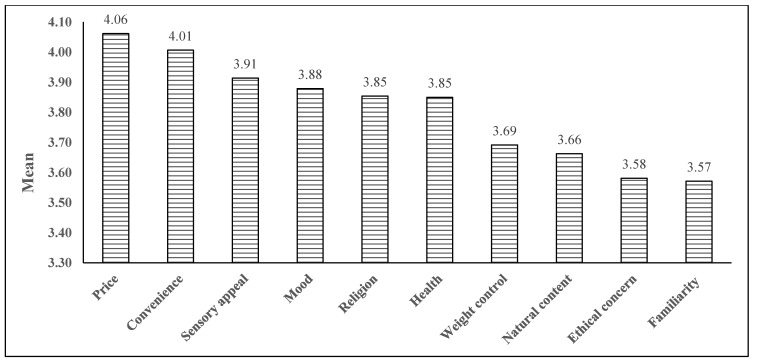
Stay-at-home orders have abruptly altered food purchasing behaviour, dietary habits, and food choice motives. Therefore, this study aims to investigate the trajectory of food choice motives and their associations with the weight status of Malaysian youths in the time of COVID-19. Socio-demographic information and anthropometric measurements were self-reported by the respondents, while the food choice motives were assessed using a validated 38-item food choice questionnaire (FCQ). Of the 1013 Malaysian youths, 48.6% gained weight due to the confinement, with an average weight gain of 3.90 ± 2.92 kg. On the other hand, 47.0% to 73.0% of the youths changed their food choice motives in the time of COVID-19. Of the 10 motives, convenience (48.5%) had the largest percentage increase, followed by weight control (47.0%) and health (45.3%). Moreover, the mean scores of health ( = -3.324, = 0.001), convenience ( = -5.869, < 0.001), weight control ( = -7.532, < 0.001), natural content ( = -5.957, < 0.001), ethical concern ( = -4.419, < 0.001) and price ( = -3.737, < 0.001) were significantly higher during the pandemic compared to pre-pandemic. Findings from the multinomial regression model revealed that youths highly concerned for weight control were more likely to be in the weight loss category (Adjusted odds ratio (AOR) = 1.633, Confidence Interval (CI) = 1.230-2.168, = 0.001). Conversely, those who gained weight due to the pandemic confinement highly valued natural content in foods (AOR = 0.653, CI = 0.481-0.886, = 0.006) when making their food choices in this unprecedented pandemic. In conclusion, Malaysian youths made healthier food choices to mitigate the risk of COVID-19 infection.
居家令突然改变了食物购买行为、饮食习惯和食物选择动机。因此,本研究旨在调查 COVID-19 期间马来西亚青少年食物选择动机的变化轨迹及其与体重状况的关系。受访者自行报告社会人口统计学信息和人体测量数据,而食物选择动机则使用经过验证的 38 项食物选择问卷 (FCQ) 进行评估。在 1013 名马来西亚青少年中,48.6%的人因隔离而体重增加,平均体重增加 3.90 ± 2.92 公斤。另一方面,47.0% 至 73.0%的青少年在 COVID-19 期间改变了他们的食物选择动机。在 10 个动机中,便利性(48.5%)的百分比增幅最大,其次是体重控制(47.0%)和健康(45.3%)。此外,健康( = -3.324, = 0.001)、便利( = -5.869, < 0.001)、体重控制( = -7.532, < 0.001)、天然成分( = -5.957, < 0.001)、道德关注( = -4.419, < 0.001)和价格( = -3.737, < 0.001)的平均得分在大流行期间明显高于大流行前。多项回归模型的结果表明,高度关注体重控制的青少年更有可能处于减肥类别(调整后的优势比(AOR)= 1.633,置信区间(CI)= 1.230-2.168, = 0.001)。相反,那些因疫情隔离而体重增加的人在做出食物选择时更看重食物的天然成分(AOR = 0.653,CI = 0.481-0.886, = 0.006)。总之,马来西亚青少年做出了更健康的食物选择,以降低 COVID-19 感染的风险。