Kim Jihoon, Koo Bon-Kyoung, Clevers Hans
Department of Medical and Biological Sciences, The Catholic University of Korea, Bucheon, Korea.
Institute of Molecular Biotechnology of the Austrian Academy of Sciences (IMBA), Vienna Biocenter (VBC), Vienna, Austria.
Int J Stem Cells. 2022 Feb 28;15(1):3-13. doi: 10.15283/ijsc21251.
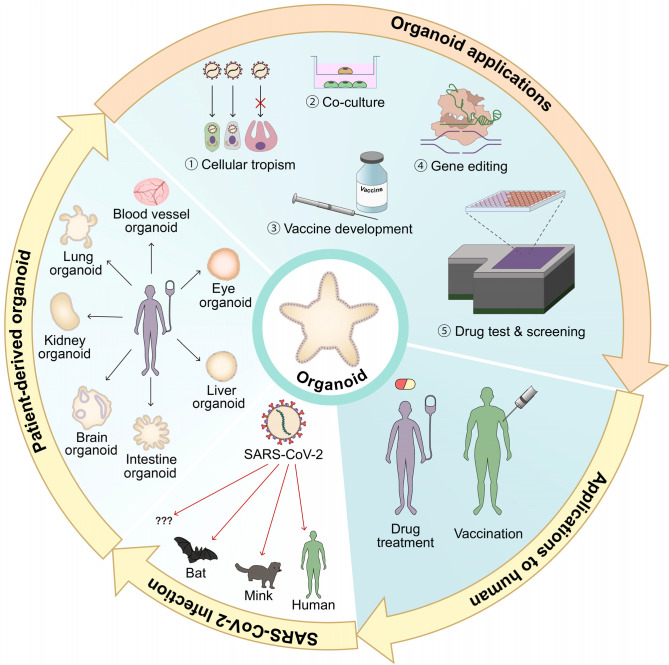
The current COVID-19 pandemic caused by severe acute respiratory syndrome coronavirus 2 (SARS-CoV-2) has completely changed human life for more than two years. Upon the emergence of this new lethal virus, multiple approaches were utilized to gain basic knowledge about its biology. Moreover, modern technologies, such as the organoid model system and next-generation sequencing, enabled us to rapidly establish strategies to tackle the disease, including vaccines and therapeutics. The recently developed organoid technology reflects human physiology more closely than other model systems. Coupled with its rapidness, high efficiency, and outstanding reliability, it has provided an opportunity to develop new drugs and understand the impact of the viral pathogen on the host. Recent findings using organoids have successfully revealed the cellular tropism of the virus in different organs and identified potential drug candidates that impact the disease. This review will summarize current achievements made with organoids in the fight against COVID-19.
由严重急性呼吸综合征冠状病毒2(SARS-CoV-2)引起的当前新冠疫情已经彻底改变人类生活长达两年多。这种新型致命病毒出现后,人们采用了多种方法来获取有关其生物学的基础知识。此外,诸如类器官模型系统和下一代测序等现代技术,使我们能够迅速制定应对该疾病的策略,包括疫苗和治疗方法。最近开发的类器官技术比其他模型系统更能紧密反映人类生理学。再加上其快速性、高效性和出色的可靠性,它为开发新药和了解病毒病原体对宿主的影响提供了契机。最近使用类器官的研究结果成功揭示了病毒在不同器官中的细胞嗜性,并确定了对该疾病有影响的潜在候选药物。本综述将总结类器官在抗击新冠疫情方面取得的当前成果。