Del Lo Gaye, Basséne Théophile, Séne Babacar
Faculty of Economics and Management, CEPN, UMR-CNRS 7234, University Sorbonne Paris Nord, Villetaneuse 93430, France.
UMR SMART Agrocampus Ouest Rennes, France.
Financ Res Lett. 2022 Mar;45:102148. doi: 10.1016/j.frl.2021.102148. Epub 2021 May 18.
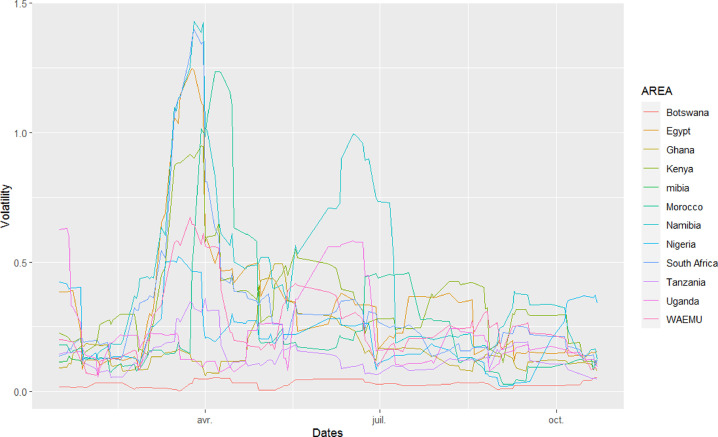
Has the relatively low number of COVID-19 cases and deaths saved Africa from the disease's economic and financial consequences ? This article assesses the impact of the pandemic on the volatility of major African stock markets using a panel data model. Like other financial markets worldwide, Africa's have been characterised by increased volatility during the pandemic. The markets appear to respond to the external shocks caused by the health crisis, and Google search volume activity related to the COVID-19 virus, which is treated here as a proxy for panic and fear, is associated with an increase in market volatility of around 7%. For health data, only increases in confirmed cases appear to impact the stability of African markets, and the relatively low fatality rate has had no influence on market dynamics. However, Political responses are associated with a drop in volatility, while the fear of global financial markets exacerbates it. These results have several implications in terms of risk management.
新冠肺炎病例和死亡人数相对较少,使非洲免受了该疾病带来的经济和金融后果吗?本文使用面板数据模型评估了疫情对非洲主要股票市场波动性的影响。与全球其他金融市场一样,非洲的金融市场在疫情期间也呈现出波动性加剧的特点。这些市场似乎对健康危机引发的外部冲击做出了反应,与新冠病毒相关的谷歌搜索量活动(在此被视为恐慌和恐惧的代理指标)与市场波动性增加约7%有关。就健康数据而言,似乎只有确诊病例的增加会影响非洲市场的稳定性,而相对较低的死亡率对市场动态没有影响。然而,政治反应与波动性下降有关,而对全球金融市场的担忧则加剧了波动性。这些结果在风险管理方面有若干启示。