Abdel-Latif Khaled H A, Meister Hartmut
Jean-Uhrmacher-Institute for Clinical ENT-Research, University of Cologne, Cologne, Germany.
Front Neurosci. 2022 Feb 10;15:725412. doi: 10.3389/fnins.2021.725412. eCollection 2021.
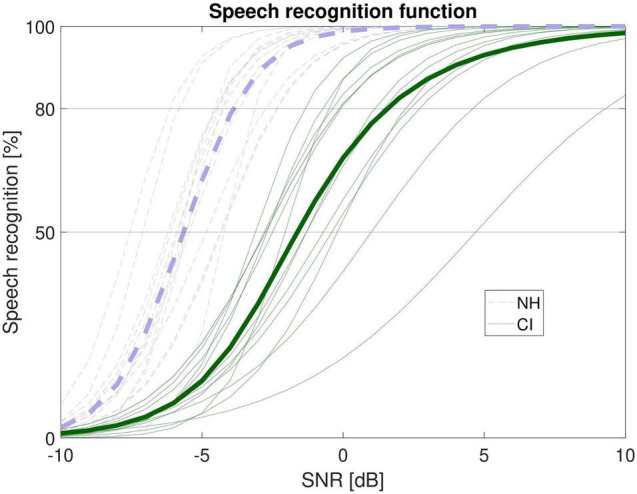
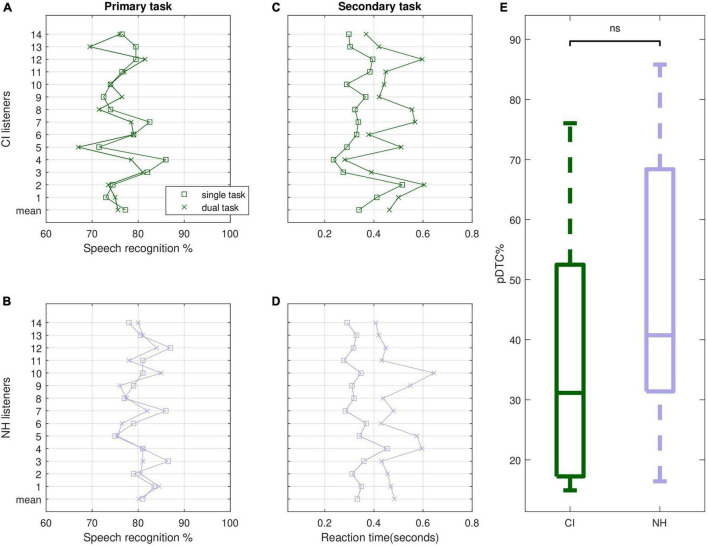
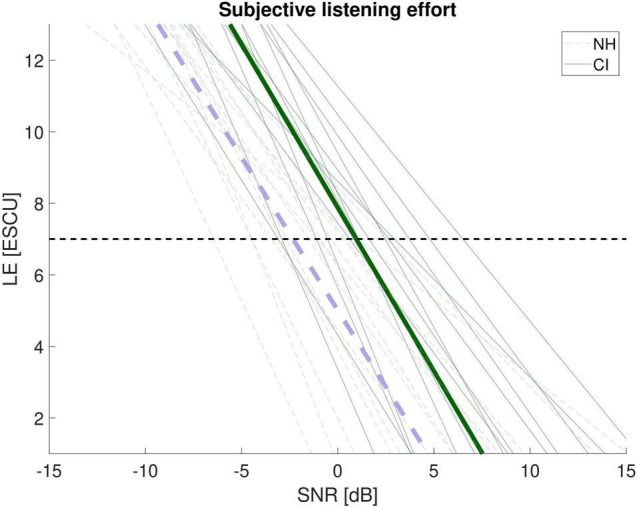
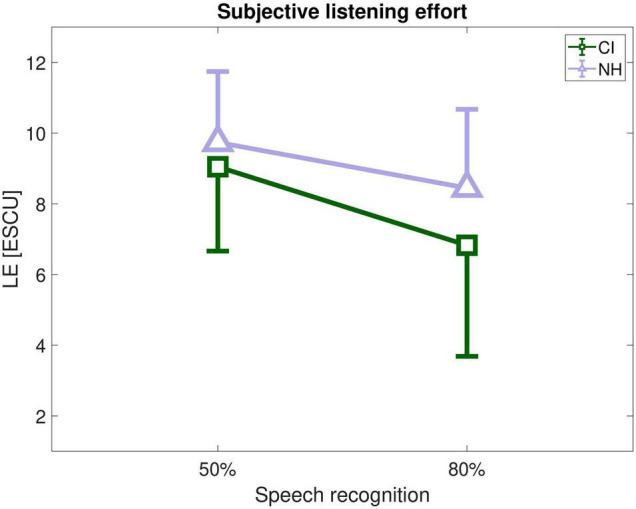
The outcome of cochlear implantation is typically assessed by speech recognition tests in quiet and in noise. Many cochlear implant recipients reveal satisfactory speech recognition especially in quiet situations. However, since cochlear implants provide only limited spectro-temporal cues the effort associated with understanding speech might be increased. In this respect, measures of listening effort could give important extra information regarding the outcome of cochlear implantation. In order to shed light on this topic and to gain knowledge for clinical applications we compared speech recognition and listening effort in cochlear implants (CI) recipients and age-matched normal-hearing listeners while considering potential influential factors, such as cognitive abilities. Importantly, we estimated speech recognition functions for both listener groups and compared listening effort at similar performance level. Therefore, a subjective listening effort test (adaptive scaling, "ACALES") as well as an objective test (dual-task paradigm) were applied and compared. Regarding speech recognition CI users needed about 4 dB better signal-to-noise ratio to reach the same performance level of 50% as NH listeners and even 5 dB better SNR to reach 80% speech recognition revealing shallower psychometric functions in the CI listeners. However, when targeting a fixed speech intelligibility of 50 and 80%, respectively, CI users and normal hearing listeners did not differ significantly in terms of listening effort. This applied for both the subjective and the objective estimation. Outcome for subjective and objective listening effort was not correlated with each other nor with age or cognitive abilities of the listeners. This study did not give evidence that CI users and NH listeners differ in terms of listening effort - at least when the same performance level is considered. In contrast, both listener groups showed large inter-individual differences in effort determined with the subjective scaling and the objective dual-task. Potential clinical implications of how to assess listening effort as an outcome measure for hearing rehabilitation are discussed.
人工耳蜗植入的效果通常通过安静环境和噪声环境下的言语识别测试来评估。许多人工耳蜗植入者的言语识别表现令人满意,尤其是在安静环境中。然而,由于人工耳蜗仅提供有限的频谱-时间线索,理解言语所需的努力可能会增加。在这方面,聆听努力的测量可以提供有关人工耳蜗植入效果的重要额外信息。为了阐明这一主题并获取临床应用知识,我们比较了人工耳蜗(CI)植入者和年龄匹配的正常听力听众的言语识别和聆听努力,同时考虑了潜在的影响因素,如认知能力。重要的是,我们估计了两组听众的言语识别功能,并比较了相似表现水平下的聆听努力。因此,应用并比较了主观聆听努力测试(自适应标度,“ACALES”)和客观测试(双任务范式)。关于言语识别,CI使用者需要比正常听力听众大约高4 dB的信噪比才能达到相同的50%表现水平,甚至需要高5 dB的信噪比才能达到80%的言语识别率,这表明CI听众的心理测量函数更浅。然而,当分别以50%和80%的固定言语可懂度为目标时,CI使用者和正常听力听众在聆听努力方面没有显著差异。这在主观和客观估计中均适用。主观和客观聆听努力的结果彼此之间以及与听众的年龄或认知能力均无相关性。这项研究没有证据表明CI使用者和正常听力听众在聆听努力方面存在差异——至少在考虑相同表现水平时如此。相比之下,两组听众在主观标度和客观双任务确定的努力方面都表现出较大的个体差异。文中讨论了如何将聆听努力评估作为听力康复的一项结果指标的潜在临床意义。