Pattnaik Dipti, Poddar Nirmala, Pathi Basanti K, Panigrahi Kumudini, Sabat Smaranita, Roy Ankita, Patro A Raj K, Mohapatra Amrut, Patro Shubhransu, Praharaj Ashok K
Microbiology, Kalinga Institute of Medical Sciences, Bhubaneswar, IND.
Community Medicine, Institute of Medical Sciences and SUM Hospital (IMS and SUM Hospital), Bhubaneswar, IND.
Cureus. 2022 Feb 21;14(2):e22470. doi: 10.7759/cureus.22470. eCollection 2022 Feb.
The gold standard test for detection of severe acute respiratory syndrome coronavirus 2 (SARS-CoV-2) recommended by WHO is real-time reverse transcription polymerase chain reaction (RT-PCR), which has a turnaround time of five to six hours. Abbott ID NOW (Abbott Diagnostics Scarborough, Inc., Scarborough, ME, USA), the cartridge-based loop-mediated isothermal amplification (LAMP) assay, was approved by FDA for Emergency Use Authorization as rapid point of care testing. The present study was planned to evaluate the performance of the cartridge-based Abbott ID NOW test by comparing it to the currently used standard probe-based real-time RT-PCR method for detection of SARS-CoV-2.
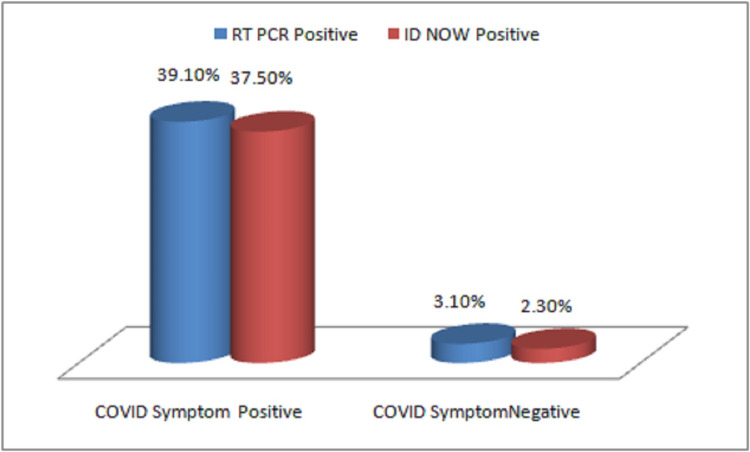
A cross-sectional study was conducted in a tertiary care hospital in the eastern part of India after getting institutional ethics committee (IEC) approval. Two hundred fifty-nine cases of various age groups of both sexes who were advised for testing for SARS-CoV-2 were included in the study. Nasopharyngeal swabs were collected according to protocol advisory by the Indian Council of Medical Research (ICMR), India. Dry swabs were sent for Abbott ID NOW testing and swabs in viral transport medium were sent for probe-based RT-PCR assay using the CoviPath kit (Thermo Fisher Scientific, Bangalore, India). The data were collected and statistical analysis was performed using Statistical Package for Social Sciences (SPSS) (IBM Corp., Armonk, NY, USA). Sensitivity, specificity, positive and negative predictive values for ID NOW were calculated taking RT-PCR as the gold standard. Results: Out of 259 patients enrolled in the study, 49% were symptomatic for coronavirus disease 2019 (COVID-19). The prevalence rate of SARS-CoV-2 was 20.84% among the study population. Sensitivity and specificity, positive and negative predictive values of ID NOW test in comparison to RT-PCR assay was found to be 87%, 98%, 92.1% and 96.8% respectively. ID NOW detected seven out of 54 (12.9%) cases as false negative who were found to be positive with RT-PCR, with mean Ct value of the target genes >34.
In this study the overall sensitivity for ID NOW assay was found to be lower, but specificity, positive and negative predictive values were found to be higher. It had the highest correlation to RT-PCR among symptomatic patients and at higher viral loads. Due to the ease of use and shortest result time for detecting COVID-19, ID NOW test could be used as a point-of-care test. But for all tests, the results should be interpreted according to the clinical and epidemiological context.
世界卫生组织推荐的用于检测严重急性呼吸综合征冠状病毒2(SARS-CoV-2)的金标准检测方法是实时逆转录聚合酶链反应(RT-PCR),其周转时间为五到六个小时。雅培ID NOW(美国缅因州斯卡伯勒市雅培诊断公司),即基于试剂盒的环介导等温扩增(LAMP)检测法,已获得美国食品药品监督管理局批准用于紧急使用授权,作为即时护理快速检测方法。本研究旨在通过将基于试剂盒的雅培ID NOW检测与目前使用的基于标准探针的实时RT-PCR方法进行比较,来评估其检测SARS-CoV-2的性能。
在获得机构伦理委员会(IEC)批准后,于印度东部的一家三级护理医院进行了一项横断面研究。本研究纳入了259例不同年龄组的男女患者,这些患者均被建议进行SARS-CoV-2检测。根据印度医学研究理事会(ICMR)的方案建议采集鼻咽拭子。干燥拭子送去进行雅培ID NOW检测,而置于病毒运输培养基中的拭子则送去使用CoviPath试剂盒(印度班加罗尔赛默飞世尔科技公司)进行基于探针的RT-PCR检测。收集数据并使用社会科学统计软件包(SPSS)(美国纽约州阿蒙克市IBM公司)进行统计分析。以RT-PCR作为金标准,计算ID NOW的敏感性、特异性、阳性和阴性预测值。
在本研究纳入的259例患者中,49%有2019冠状病毒病(COVID-19)症状。研究人群中SARS-CoV-2的患病率为20.84%。与RT-PCR检测相比,ID NOW检测的敏感性和特异性、阳性和阴性预测值分别为87%、98%、92.1%和96.8%。ID NOW将54例(12.9%)经RT-PCR检测为阳性的病例中的7例检测为假阴性,这些病例目标基因的平均Ct值>34。
在本研究中,发现ID NOW检测的总体敏感性较低,但特异性、阳性和阴性预测值较高。在有症状的患者和病毒载量较高时,它与RT-PCR的相关性最高。由于其使用方便且检测COVID-19的结果时间最短,ID NOW检测可作为即时护理检测方法。但对于所有检测,结果应根据临床和流行病学背景进行解读。